
Baudhayana
Baudhayana, the traditional author of the Sutra, originally belonged to the Kanva school of the White Yajurveda.
Baudhāyana Sulbasūtra 
Pythagorean theorem
It is also referred to as Baudhayana theorem. The most notable of the rules (the Sulbasūtra-s do not contain any proofs for the rules which they describe, since they are sūtra-s, formulae, concise) in the Baudhāyana Sulba Sūtra says:
दीर्घचतुरश्रस्याक्ष्णया रज्जु: पार्श्र्वमानी तिर्यग् मानी च यत् पृथग् भूते कुरूतस्तदुभयं करोति ॥
A rope stretched along the length of the diagonal produces an area which the vertical and horizontal sides make together.
dīrghachatursrasyākṣaṇayā rajjuḥ pārśvamānī, tiryagmānī,
cha yatpṛthagbhūte kurutastadubhayāṅ karoti.
The lines are to be referring to a rectangle, although some interpretations consider this to refer to a square. In either case, it states that the square of the hypotenuse equals the sum of the squares of the sides. If restricted to right-angled isosceles triangles, however, it would constitute a less general claim, but the text seems to be quite open to unequal sides.
If this refers to a rectangle, it is the earliest recorded statement of the Pythagorean theorem.
Baudhāyana also provides a non-axiomatic demonstration using a rope measure of the reduced form of the Pythagorean theorem for an isosceles right triangle:
Sequences of Pythagorean triples used in cryptography as random sequences and for the generation of keys have been dubbed "Baudhayana sequences" in a 2014 paper.
Circling the square
Another problem tackled by Baudhāyana is that of finding a circle whose area is the same as that of a square (the reverse of squaring the circle). His sūtra i.58 gives this construction:
Explanation:
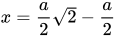
- Draw the half-diagonal of the square, which is larger than the half-side by {\displaystyle x={a \over 2}{\sqrt {2}}-{a \over 2}}.
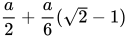
- Then draw a circle with radius {\displaystyle {a \over 2}+{x \over 3}}, or {\displaystyle {a \over 2}+{a \over 6}({\sqrt {2}}-1)}, which equals {\displaystyle {a \over 6}(2+{\sqrt {2}})}.
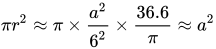
- Now {\displaystyle (2+{\sqrt {2}})^{2}\approx 11.66\approx {36.6 \over \pi }}, so the area {\displaystyle {\pi }r^{2}\approx \pi \times {a^{2} \over 6^{2}}\times {36.6 \over \pi }\approx a^{2}}.



Square root of 2
Baudhāyana i.61-2 (elaborated in Āpastamba Sulbasūtra i.6) gives the length of the diagonal of a square in terms of its sides, which is equivalent to a formula for the square root of 2:
That is,

which is correct to five decimals.[8]
Other theorems include: diagonals of rectangle bisect each other, diagonals of rhombus bisect at right angles, area of a square formed by joining the middle points of a square is half of original, the midpoints of a rectangle joined forms a rhombus whose area is half the rectangle, etc.
Note the emphasis on rectangles and squares; this arises from the need to specify yajña bhūmikās—i.e. the altar on which a rituals were conducted, including fire offerings (yajña). This is an aspect of Vaastu Shastras and Shilpa Shastras. These theroms are derived from those texts.

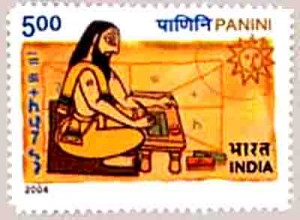
Panini:
Father of linguistics.
The history of linguistics begins not with Plato or Aristotle, but with the Indian grammarian Panini.
— Rens Bod, University of Amsterdam
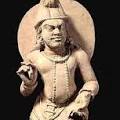
Panini was an ancient Sanskrit scholar from Indian subcontinent.
Panini (IAST Pāṇini, fl. 4th century BCE is an ancient Sanskrit philologist, grammarian, and a revered scholar in Hinduism.Considered the father of Indian linguistics,Pāṇini likely lived in the northwest Indian subcontinent during the Mahajanapada era.
Pāṇini is known for his text Ashtadhyayi, a sutra-style treatise on Sanskrit grammar, 3,959 "verses" or rules on linguistics, syntaxand semantics in "eight chapters" which is the foundational text of the Vyākaraṇa branch of the Vedanga, the auxiliary scholarly disciplines of the Vedic period.His aphoristic text attracted numerous bhashya (commentaries), of which Patanjali's Mahābhāṣyais the most famous in Hindu traditions.His ideas influenced and attracted commentaries from scholars of other Indian religions such as Buddhism.
Pāṇini's analysis of noun compounds still forms the basis of modern linguistic theories of compounding in Indian languages. Pāṇini's comprehensive and scientific theory of grammar is conventionally taken to mark the start of Classical Sanskrit. His systematic treatise inspired and made Sanskrit the preeminent Indian language of learning and literature for two millennia.
Pāṇini's theory of morphological analysis was more advanced than any equivalent Western theory before the 20th century. His treatise is generative and descriptive, and has been compared to the Turing machine wherein the logical structure of any computing device has been reduced to its essentials using an idealized mathematical model.
The name Pāṇini is a patronymic meaning descendant of Paṇina.[16] His full name was "Dakṣiputra Pāṇini" according to verses 1.75.13 and 3.251.12 of Patanjali's Mahābhāṣya, with the first part suggesting his mother's name was Dakṣi.
Date and context
Father of linguistics
The history of linguistics begins not with Plato or Aristotle, but with the Indian grammarian Panini.
— Rens Bod, University of Amsterdam[18]
Nothing definite is known about when Pāṇini lived, not even in which century he lived. Most scholarship suggests he lived in or before mid-fourth century BCE (floruit),[2][3] possibly in the sixth or fifth century BCE.[1][17] Pāṇini's grammar defines Classical Sanskrit, so Pāṇini is chronologically placed in the later part of the Vedic period. According to Rens Bod, a professor of Humanities specializing in comparative history, Pāṇini must have lived sometime between seventh and fifth centuries BCE.[18]
Some proposals have attempted to date Pāṇini from references within the text. The first proposal is based on sutra 2.1.70 of Pāṇini, which mentions kumāraśramaṇa, with the word śramaṇa interpreted to imply that he may have had "Buddhist nuns" in mind, and therefore he should be placed after Gautama Buddha. Other scholars question this theory because nuns in the Indian traditions existed outside of and before Buddhism, such as in Jainism.[19] The second proposal is based on the occurrence of the word yavanānī (in 4.1.49, either "Greek woman", or "Greek alphabet").[19] This occurrence of yavanānī, some suggest a terminus post quem as 519 BCE, i.e. the time of Darius I's Behistun Inscription that included the province of Gandhara (IAST: Gandhāra). However, in 1862 Max Müller objected to this interpretation with the statement that there is no reason to assume that yavana meant "Greek" before and in the century Pāṇini lived, and it could as well might have been a reference in a Semitic or a South Indian context.[20] More recently, Patrick Olivelle – a professor of Sanskrit and Indian religions, concurs and states that the term yona or yavana in Pāṇini is "merely linguistic and does not necessarily indicate that he knew or was in contact with Greek settlers", adding that while Pāṇini is generally estimated around the 5th century BCE, placing Pāṇini in a century "is an educated guess".[21]
It is not certain whether Pāṇini used writing for the composition of his work, though it is generally agreed that he knew of a form of writing, based on references to words such as lipi("script") and lipikara ("scribe") in section 3.2 of the Aṣṭādhyāyī.[22][23][24][note 2] Pāṇini cites ten grammarians and linguists before him, none of whom can be chronologically placed with any certainty. The ten Vedic scholar names he quotes are of Apisali, Kashyapa, Gargya, Galava, Cakravarmana, Bharadvaja, Sakatayana, Sakalya, Senaka and Sphotayana.[31]
Both Brihatkatha and Mañjuśrī-mūla-kalpa mention Paninit to have been a contemporary with the Nanda king.[32]
While Pāṇini is considered a Hindu scholar of grammar and linguistics,[4][33][12] his text is also an important historical source of cultural and geographical information. His work is significant such as in including the word Vasudeva (4.3.98), which scholars disagree whether it refers to a deity or a person.[34] The concept of dharma is attested in his sutra 4.4.41 as, dharmam carati or "he observes dharma (duty, righteousness)" (cf. Taittiriya Upanishad 1.11).[35][36]
Biography and location
Also spelled without diacritics as Panini in scholarly literature,[1][11] nothing certain is known about Pāṇini's personal life. According to the Mahābhāṣya of Patanjali, his mother's name was Dākṣī.[37] Patañjali calls Pāṇini Dākṣīputra (meaning son of Dākṣī) at several places in the Mahābhāṣya.[37] Rambhadracharya gives the name of his father as Paṇina, from which the name Pāṇini derives.[37]
In an inscription of Siladitya VII of Valabhi, he is called Śalāturiya, which means "man from Salatura". This means Panini lived in Salatura of ancient Gandhara, which likely was near Lahur, a town at the junction of Indus and Kabul rivers.[38] According to the memoirs of 7th-century Chinese scholar Xuanzang, there was a town called Suoluoduluo on the Indus where Pāṇini was born, and he composed the Qingming-lun (Sanskrit: Vyākaraṇa).[38][39][37]
According to Hartmut Scharfe, Pāṇini lived in Gandhara close to the borders of the Achaemenid Empire, and Gandhara was then an Achaemenian satrap. He must therefore have been technically a Persian subject, but states Scharfe, his work shows no trace of Persian.[17] Inferences, however, vary between scholars. According to Patrick Olivelle, Pāṇini's text and references to him elsewhere suggest that "he was clearly a northerner, probably from the northwestern region".[40]
Legends and later reception
Panini is mentioned in Indian fables and ancient texts. The Panchatantra, for example, mentions that Pāṇini was killed by a lion.[41][42][43]
Pāṇini was depicted on a five-rupee Indian postage stamp in 2004.[44]
Aṣṭādhyāyī
The Aṣṭādhyāyī is the central part of Pāṇini's grammar, and by far the most complex. The Ashtadhyayi is the oldest surviving complete linguistic and grammar text of Sanskrit, and Pāṇini refers to previous texts and authors such as the Unadisutra, Dhatupatha, and Ganapatha some of which have not survived. It complements the Vedic ancillary sciences such as the Niruktas, Nighantus, and Shiksha.[45] Regarded as extremely compact without sacrificing completeness, it would become the model for later specialist technical texts or sutras.[46][47]
The text takes material from lexical lists (Dhatupatha, Ganapatha) as input and describes algorithms to be applied to them for the generation of well-formed words. It is highly systematised and technical. Inherent in its approach are the concepts of the phoneme, the morpheme and the root. His rules have a reputation for perfection[48] – that is, they tersely describe Sanskrit morphology unambiguously and completely. A consequence of his grammar's focus on brevity is its highly unintuitive structure, reminiscent of modern notations such as the "Backus–Naur form". His sophisticated logical rules and technique have been widely influential in ancient and modern linguistics.
The Aṣṭādhyāyī was not the first description of Sanskrit grammar, but it is the earliest that has survived in full. The Aṣṭādhyāyī became the foundation of Vyākaraṇa, a Vedanga.[49]
In the Aṣṭādhyāyī, language is observed in a manner that has no parallel among Greek or Latin grammarians. Pāṇini's grammar, according to Renou and Filliozat, defines the linguistic expression and a classic that set the standard for Sanskrit language.[50] Pāṇini made use of a technical metalanguage consisting of a syntax, morphology and lexicon. This metalanguage is organised according to a series of meta-rules, some of which are explicitly stated while others can be deduced.[51]
The Aṣṭādhyāyī consists of 3,959 sutras or "aphoristic threads" in eight chapters, which are each subdivided into four sections or padas (pādāḥ). This text attracted a famous and one of the most ancient Bhasya (commentary) called the Mahabhasya.[52] The author of Mahabhasya is named Patanjali, who may or may not be the same person as the one who authored Yogasutras.[53] The Mahabhasya, literally "great commentary", is more than a commentary on Ashtadhyayi. It is the earliest known philosophical text of the Hindu Grammarians.[53][note 3] Non-Hindu texts and traditions on grammar emerged after Patanjali, some of which include the Sanskrit grammar text of Jainendra of Jainism and the Chandra school of Buddhism.[55]
Rules
The first two sutras are as follows:
1.1.1 vṛddhir ādaiC (वृद्धिरादैच् । १।१।१)1.1.2 adeṄ guṇaḥ (अदेङ्गुणः । १।१।२)
In these sutras, the capital letters are special meta-linguistic symbols; they are called IT (इत्) markers or, in later writers such as Katyayana and Patanjali, anubandhas (see below). The C and Ṅ refer to Shiva Sutras 4 ("ai, au, C") and 3 ("e, o, Ṅ"), respectively, forming what are known as the pratyāhāras "comprehensive designations" aiC, eṄ. They denote the list of phonemes {ai, au} and {e, o} respectively. The त् (T) appearing (in its variant form /d/) in both sutras is also an IT marker: Sutra 1.1.70 defines it as indicating that the preceding phoneme does not represent a list, but a single phoneme, encompassing all supra-segmental features such as accent and nasality. For further example, आत् (āT) and अत् (aT) represent आ {ā} and अ {a} respectively.
When a sutra defines a technical term, the term defined comes at the end, so the first sutra should have properly been ādaiJ vṛddhir instead of vṛddhir ādaiC. However the order is reversed to have a good-luck word at the very beginning of the work; vṛddhir happens to mean 'prosperity' in its non-technical use.
Thus the two sūtras consist of a list of phonemes, followed by a technical term; the final interpretation of the two sūtras above is thus:
1.1.1: {ā, ai, au} are called vṛ́ddhi.1.1.2: {a, e, o} are called guṇa.
At this point, one can see they are definitions of terminology: guṇa and vṛ́ddhi are the terms for the full and the lengthened Indo-European ablaut grades, respectively.
List of IT markers
its or anubandhas are defined in P. 1.3.2 through P. 1.3.8. These definitions refer only to items taught in the grammar or its ancillary texts such at the dhātupāţha; this fact is made clear in P. 1.3.2 by the word upadeśe, which is then continued in the following six rules by anuvṛtti, Ellipsis. As these anubandhas are metalinguistic markers and not pronounced in the final derived form, pada (word), they are elided by P. 1.3.9 tasya lopaḥ – 'There is elision of that (i.e. any of the preceding items which have been defined as an it).' Accordingly, Pāṇini defines the anubandhas as follows:
- Nasalized vowels, e.g. bhañjO. Cf. P. 1.3.2.
- A final consonant (haL). Cf. P. 1.3.3.
2. (a) except a dental, m and s in verbal or nominal endings. Cf. P. 1.3.4. - Initial ñi ṭu ḍu. Cf. P 1.3.5
- Initial ṣ of a suffix (pratyaya). Cf. P. 1.3.6.
- Initial palatals and cerebrals of a suffix. Cf. P. 1.3.7
- Initial l, ś, and k but not in a taddhita 'secondary' suffix. Cf. P. 1.3.8.
A few examples of elements that contain its are as follows:
- suP nominal suffix
- Ś-IT
- Śi strong case endings
- Ślu elision
- ŚaP active marker
- P-IT
- luP elision
- āP ā-stems
- CāP
- ṬāP
- ḌāP
- LyaP (7.1.37)
- L-IT
- K-IT
- Ktvā
- luK elision
- saN Desiderative
- C-IT
- M-IT
- Ṅ-IT
- Ṅí Causative
- Ṅii ī-stems
- ṄīP
- ṄīN
- Ṅī'Ṣ
- tiṄ verbal suffix
- lUṄ Aorist
- lIṄ Precative
- S-IT
- GHU class of verbal stems (1.1.20)
- GHI (1.4.7)
Auxiliary texts
Pāṇini's Ashtadhyayi has three associated texts.
- The Shiva Sutras are a brief but highly organised list of phonemes.
- The Dhatupatha is a lexical list of verbal roots sorted by present class.
- The Ganapatha is a lexical list of nominal stems grouped by common properties.
Shiva Sutras
The Shiva Sutras describe a phonemic notational system in the fourteen initial lines preceding the Ashtadhyayi. The notational system introduces different clusters of phonemes that serve special roles in the morphology of Sanskrit, and are referred to throughout the text. Each cluster, called a pratyāhara ends with a dummy sound called an anubandha (the so-called IT index), which acts as a symbolic referent for the list. Within the main text, these clusters, referred through the anubandhas, are related to various grammatical functions.
Dhatupatha
The Dhatupatha is a lexicon of Sanskrit verbal roots subservient to the Ashtadhyayi. It is organised by the ten present classes of Sanskrit, i.e. the roots are grouped by the form of their stem in the present tense.
The ten present classes of Sanskrit are:
- bhū-ādayaḥ (root-full grade thematic presents)
- ad-ādayaḥ (root presents)
- juhoti-ādayaḥ (reduplicated presents)
- div-ādayaḥ (ya thematic presents)
- su-ādayaḥ (nu presents)
- tud-ādayaḥ (root-zero grade thematic presents)
- rudh-ādayaḥ (n-infix presents)
- tan-ādayaḥ (no presents)
- krī-ādayaḥ (ni presents)
- cur-ādayaḥ (aya presents, causatives)
The small number of class 8 verbs are a secondary group derived from class 5 roots, and class 10 is a special case, in that any verb can form class 10 presents, then assuming causative meaning. The roots specifically listed as belonging to class 10 are those for which any other form has fallen out of use (causative deponents, so to speak).
Ganapatha
The Ganapatha (gaṇapāṭha) is a list of groups of primitive nominal stems used by the Ashtadhyayi.
Commentary
After Pāṇini, the Mahābhāṣya ("great commentary") of Patañjali on the Ashtadhyayi is one of the three most famous works in Sanskrit grammar. It was with Patañjali that Indian linguistic science reached its definite form. The system thus established is extremely detailed as to shiksha (phonology, including accent) and vyakarana (morphology). Syntax is scarcely touched, but nirukta (etymology) is discussed, and these etymologies naturally lead to semantic explanations. People interpret his work to be a defence of Pāṇini, whose Sūtras are elaborated meaningfully. He also attacks Katyayana rather severely. But the main contributions of Patañjali lies in the treatment of the principles of grammar enunciated by him.
Editions
- Rama Nath Sharma, The Aṣṭādhyāyī of Pāṇini (6 Vols.), 2001, ISBN 8121500516[56]
- Otto Böhtlingk, Panini's Grammatik 1887, reprint 1998 ISBN 3-87548-198-4
- Katre, Sumitra M., Astadhyayi of Panini, Austin: University of Texas Press, 1987. Reprint Delhi: Motilal Banarsidass, 1989. ISBN 0-292-70394-5
- Misra, Vidya Niwas, The Descriptive Technique of Panini, Mouton and Co., 1966.
- The Ashtadhyayi.(of Pāṇini) Translated into English by Srisa Chandra Vasu (1897), from this archive.
Bhaṭṭikāvya
The learning of Indian curriculum in late classical times had at its heart a system of grammatical study and linguistic analysis.[57] The core text for this study was the Aṣṭādhyāyī of Pāṇini, the sine qua non of learning.[58] This grammar of Pāṇini had been the object of intense study for the ten centuries prior to the composition of the Bhaṭṭikāvya. It was plainly Bhaṭṭi's purpose to provide a study aid to Pāṇini's text by using the examples already provided in the existing grammatical commentaries in the context of the gripping and morally improving story of the Rāmāyaṇa. To the dry bones of this grammar Bhaṭṭi has given juicy flesh in his poem. The intention of the author was to teach this advanced science through a relatively easy and pleasant medium. In his own words:
This composition is like a lamp to those who perceive the meaning of words and like a hand mirror for a blind man to those without grammar. This poem, which is to be understood by means of a commentary, is a joy to those sufficiently learned: through my fondness for the scholar I have here slighted the dullard.
Bhaṭṭikāvya 22.33–34.
Modern linguistics
Pāṇini's work became known in 19th-century Europe, where it influenced modern linguistics initially through Franz Bopp, who mainly looked at Pāṇini. Subsequently, a wider body of work influenced Sanskrit scholars such as Ferdinand de Saussure, Leonard Bloomfield, and Roman Jakobson. Frits Staal (1930–2012) discussed the impact of Indian ideas on language in Europe. After outlining the various aspects of the contact, Staal notes that the idea of formal rules in language – proposed by Ferdinand de Saussure in 1894 and developed by Noam Chomsky in 1957 – has origins in the European exposure to the formal rules of Pāṇinian grammar.[citation needed] In particular, de Saussure, who lectured on Sanskrit for three decades, may have been influenced by Pāṇini and Bhartrihari; his idea of the unity of signifier-signified in the sign somewhat resembles the notion of Sphoṭa. More importantly, the very idea that formal rules can be applied to areas outside of logic or mathematics may itself have been catalysed by Europe's contact with the work of Sanskrit grammarians.[59]
De Saussure
Pāṇini, and the later Indian linguist Bhartrihari, had a significant influence on many of the foundational ideas proposed by Ferdinand de Saussure, professor of Sanskrit, who is widely considered the father of modern structural linguistics and with Charles S. Peirce on the other side, to semiotics, although the concept Saussure used was semiology. Saussure himself cited Indian grammar as an influence on some of his ideas. In his Mémoire sur le système primitif des voyelles dans les langues indo-européennes (Memoir on the Original System of Vowels in the Indo-European Languages) published in 1879, he mentions Indian grammar as an influence on his idea that "reduplicated aorists represent imperfects of a verbal class." In his De l'emploi du génitif absolu en sanscrit (On the Use of the Genitive Absolute in Sanskrit) published in 1881, he specifically mentions Pāṇini as an influence on the work.[60]
Prem Singh, in his foreword to the reprint edition of the German translation of Pāṇini's Grammar in 1998, concluded that the "effect Panini's work had on Indo-European linguistics shows itself in various studies" and that a "number of seminal works come to mind," including Saussure's works and the analysis that "gave rise to the laryngeal theory," further stating: "This type of structural analysis suggests influence from Panini's analytical teaching." George Cardona, however, warns against overestimating the influence of Pāṇini on modern linguistics: "Although Saussure also refers to predecessors who had taken this Paninian rule into account, it is reasonable to conclude that he had a direct acquaintance with Panini's work. As far as I am able to discern upon rereading Saussure's Mémoire, however, it shows no direct influence of Paninian grammar. Indeed, on occasion, Saussure follows a path that is contrary to Paninian procedure."[60][61]
Leonard Bloomfield
The founding father of American structuralism, Leonard Bloomfield, wrote a 1927 paper titled "On some rules of Pāṇini".[62]
Comparison with modern formal systems
Pāṇini's grammar is the world's first formal system, developed well before the 19th century innovations of Gottlob Frege and the subsequent development of mathematical logic. In designing his grammar, Pāṇini used the method of "auxiliary symbols", in which new affixes are designated to mark syntactic categories and the control of grammatical derivations. This technique, rediscovered by the logician Emil Post, became a standard method in the design of computer programming languages.[63] Sanskritists now accept that Pāṇini's linguistic apparatus is well-described as an "applied" Post system. Considerable evidence shows ancient mastery of context-sensitive grammars, and a general ability to solve many complex problems. Frits Staal has written that "Panini is the Indian Euclid."
Other works
Two literary works are attributed to Pāṇini, though they are now lost.
- Jāmbavati Vijaya is a lost work cited by one Rajashekhar in Jahlana's Sukti Muktāvalī. A fragment is to be found in Ramayukta's commentary on Namalinganushasana. From the title it may be inferred that the work dealt with Krishna's winning of Jambavati in the underworld as his bride. Rajashekhara in Jahlana's Sukti Muktāvalī:
नमः पाणिनये तस्मै यस्मादाविर भूदिह।आदौ व्याकरणं काव्यमनु जाम्बवतीजयम्॥namaḥ pāṇinaye tasmai yasmādāvirabhūdiha।ādau vyākaraṇaṃ kāvyamanu jāmbavatījayam॥
- Ascribed to Pāṇini, Pātāla Vijaya is a lost work cited by Namisadhu in his commentary on Kavyalankara of Rudrata.
Āryabhatta
Born: 476 CE
Kusumapura (Pataliputra) (present day Patna)[1]
Died: 550 CE
Residence: India
Academic background
Influences : Surya Siddhanta
Academic work
Era: Gupta era
Main interests: Mathematics, astronomy
Notable works: Āryabhaṭīya, Arya-siddhanta
Notable ideas: Explanation of lunar eclipse and solar eclipse, rotation of Earth on its axis, reflection of light by moon, sinusoidal functions, solution of single variable quadratic equation, value of π correct to 4 decimal places, circumference of Earth to 99.8% accuracy, calculation of the length of sidereal year
Influenced: Lalla, Bhaskara I, Brahmagupta, Varahamihira.
Biography
Name
While there is a tendency to misspell his name as "Aryabhatta" by analogy with other names having the "bhatta" suffix, his name is properly spelled Aryabhata: every astronomical text spells his name thus,[7] including Brahmagupta's references to him "in more than a hundred places by name".[1] Furthermore, in most instances "Aryabhatta" would not fit the metre either.[7]
Time and place of birth
Aryabhata mentions in the Aryabhatiya that it was composed 3,600 years into the Kali Yuga, when he was 23 years old. This corresponds to 499 CE, and implies that he was born in 476.[5] Aryabhata called himself a native of Kusumapura or Pataliputra (present day Patna, Bihar).[1]
Other hypothesis
Bhāskara I describes Aryabhata as āśmakīya, "one belonging to the Aśmaka country." During the Buddha's time, a branch of the Aśmaka people settled in the region between the Narmada and Godavari rivers in central India.[7][8]
It has been claimed that the aśmaka (Sanskrit for "stone") where Aryabhata originated may be the present day Kodungallur which was the historical capital city of Thiruvanchikkulamof ancient Kerala.[9] This is based on the belief that Koṭuṅṅallūr was earlier known as Koṭum-Kal-l-ūr ("city of hard stones"); however, old records show that the city was actually Koṭum-kol-ūr ("city of strict governance"). Similarly, the fact that several commentaries on the Aryabhatiya have come from Kerala has been used to suggest that it was Aryabhata's main place of life and activity; however, many commentaries have come from outside Kerala, and the Aryasiddhanta was completely unknown in Kerala.[7] K. Chandra Hari has argued for the Kerala hypothesis on the basis of astronomical evidence.[10]
Aryabhata mentions "Lanka" on several occasions in the Aryabhatiya, but his "Lanka" is an abstraction, standing for a point on the equator at the same longitude as his Ujjayini.[11]
Education
It is fairly certain that, at some point, he went to Kusumapura for advanced studies and lived there for some time.[12] Both Hindu and Buddhist tradition, as well as Bhāskara I (CE 629), identify Kusumapura as Pāṭaliputra, modern Patna.[7] A verse mentions that Aryabhata was the head of an institution (kulapa) at Kusumapura, and, because the university of Nalanda was in Pataliputra at the time and had an astronomical observatory, it is speculated that Aryabhata might have been the head of the Nalanda university as well.[7] Aryabhata is also reputed to have set up an observatory at the Sun temple in Taregana, Bihar.[13]
Works
Aryabhata is the author of several treatises on mathematics and astronomy, some of which are lost.
His major work, Aryabhatiya, a compendium of mathematics and astronomy, was extensively referred to in the Indian mathematical literature and has survived to modern times. The mathematical part of the Aryabhatiya covers arithmetic, algebra, plane trigonometry, and spherical trigonometry. It also contains continued fractions, quadratic equations, sums-of-power series, and a table of sines.
The Arya-siddhanta, a lost work on astronomical computations, is known through the writings of Aryabhata's contemporary, Varahamihira, and later mathematicians and commentators, including Brahmagupta and Bhaskara I. This work appears to be based on the older Surya Siddhanta and uses the midnight-day reckoning, as opposed to sunrise in Aryabhatiya. It also contained a description of several astronomical instruments: the gnomon (shanku-yantra), a shadow instrument (chhAyA-yantra), possibly angle-measuring devices, semicircular and circular (dhanur-yantra / chakra-yantra), a cylindrical stick yasti-yantra, an umbrella-shaped device called the chhatra-yantra, and water clocks of at least two types, bow-shaped and cylindrical.[8]
A third text, which may have survived in the Arabic translation, is Al ntf or Al-nanf. It claims that it is a translation by Aryabhata, but the Sanskrit name of this work is not known.
Probably dating from the 9th century, it is mentioned by the Persian scholar and chronicler of India, Abū Rayhān al-Bīrūnī.[8]
Aryabhatiya
Direct details of Aryabhata's work are known only from the Aryabhatiya. The name "Aryabhatiya" is due to later commentators. Aryabhata himself may not have given it a name. His disciple Bhaskara I calls it Ashmakatantra (or the treatise from the Ashmaka). It is also occasionally referred to as Arya-shatas-aShTa (literally, Aryabhata's 108), because there are 108 verses in the text. It is written in the very terse style typical of sutra literature, in which each line is an aid to memory for a complex system. Thus, the explication of meaning is due to commentators. The text consists of the 108 verses and 13 introductory verses, and is divided into four pādas or chapters:
- Gitikapada: (13 verses): large units of time—kalpa, manvantra, and yuga—which present a cosmology different from earlier texts such as Lagadha's Vedanga Jyotisha (c. 1st century BCE). There is also a table of sines (jya), given in a single verse. The duration of the planetary revolutions during a mahayuga is given as 4.32 million years.
- Ganitapada (33 verses): covering mensuration (kṣetra vyāvahāra), arithmetic and geometric progressions, gnomon / shadows (shanku-chhAyA), simple, quadratic, simultaneous, and indeterminate equations (kuṭṭaka).
- Kalakriyapada (25 verses): different units of time and a method for determining the positions of planets for a given day, calculations concerning the intercalary month (adhikamAsa), kShaya-tithis, and a seven-day week with names for the days of week.
- Golapada (50 verses): Geometric/trigonometric aspects of the celestial sphere, features of the ecliptic, celestial equator, node, shape of the earth, cause of day and night, rising of zodiacal signs on horizon, etc. In addition, some versions cite a few colophons added at the end, extolling the virtues of the work, etc.
The Aryabhatiya presented a number of innovations in mathematics and astronomy in verse form, which were influential for many centuries. The extreme brevity of the text was elaborated in commentaries by his disciple Bhaskara I (Bhashya, c. 600 CE) and by Nilakantha Somayaji in his Aryabhatiya Bhasya, (1465 CE).
Mathematics
Place value system and zero
The place-value system, first seen in the 3rd-century Bakhshali Manuscript, was clearly in place in his work. While he did not use a symbol for zero, the French mathematician Georges Ifrah argues that knowledge of zero was implicit in Aryabhata's place-value system as a place holder for the powers of ten with null coefficients.[14]
However, Aryabhata did not use the Brahmi numerals. Continuing the Sanskritic tradition from Vedic times, he used letters of the alphabet to denote numbers, expressing quantities, such as the table of sines in a mnemonic form.[15]
Approximation of π
Aryabhata worked on the approximation for pi (π), and may have come to the conclusion that π is irrational. In the second part of the Aryabhatiyam (gaṇitapāda 10), he writes:
caturadhikaṃ śatamaṣṭaguṇaṃ dvāṣaṣṭistathā sahasrāṇām
[16]
ayutadvayaviṣkambhasyāsanno vṛttapariṇāhaḥ.
"Add four to 100, multiply by eight, and then add 62,000. By this rule the circumference of a circle with a diameter of 20,000 can be approached."
This implies that the ratio of the circumference to the diameter is ((4 + 100) × 8 + 62000)/20000 = 62832/20000 = 3.1416, which is accurate to five significant figures.
It is speculated that Aryabhata used the word āsanna (approaching), to mean that not only is this an approximation but that the value is incommensurable (or irrational). If this is correct, it is quite a sophisticated insight, because the irrationality of pi (π) was proved in Europe only in 1761 by Lambert.[17]
After Aryabhatiya was translated into Arabic (c. 820 CE) this approximation was mentioned in Al-Khwarizmi's book on algebra.[8]
Trigonometry
In Ganitapada 6, Aryabhata gives the area of a triangle as
tribhujasya phalaśarīraṃ samadalakoṭī bhujārdhasaṃvargaḥ
that translates to: "for a triangle, the result of a perpendicular with the half-side is the area."[18]
Aryabhata discussed the concept of sine in his work by the name of ardha-jya, which literally means "half-chord". For simplicity, people started calling it jya. When Arabic writers translated his works from Sanskrit into Arabic, they referred it as jiba. However, in Arabic writings, vowels are omitted, and it was abbreviated as jb. Later writers substituted it with jaib, meaning "pocket" or "fold (in a garment)". (In Arabic, jiba is a meaningless word.) Later in the 12th century, when Gherardo of Cremona translated these writings from Arabic into Latin, he replaced the Arabic jaib with its Latin counterpart, sinus, which means "cove" or "bay"; thence comes the English word sine.[19]
Indeterminate equations
A problem of great interest to Indian mathematicians since ancient times has been to find integer solutions to Diophantine equations that have the form ax + by = c. (This problem was also studied in ancient Chinese mathematics, and its solution is usually referred to as the Chinese remainder theorem.) This is an example from Bhāskara's commentary on Aryabhatiya:
Find the number which gives 5 as the remainder when divided by 8, 4 as the remainder when divided by 9, and 1 as the remainder when divided by 7
That is, find N = 8x+5 = 9y+4 = 7z+1. It turns out that the smallest value for N is 85. In general, diophantine equations, such as this, can be notoriously difficult. They were discussed extensively in ancient Vedic text Sulba Sutras, whose more ancient parts might date to 800 BCE. Aryabhata's method of solving such problems, elaborated by Bhaskara in 621 CE, is called the kuṭṭaka (कुट्टक) method. Kuṭṭaka means "pulverizing" or "breaking into small pieces", and the method involves a recursive algorithm for writing the original factors in smaller numbers. This algorithm became the standard method for solving first-order diophantine equations in Indian mathematics, and initially the whole subject of algebra was called kuṭṭaka-gaṇita or simply kuṭṭaka.[20]
Algebra
In Aryabhatiya, Aryabhata provided elegant results for the summation of series of squares and cubes:[21]
{\displaystyle 1^{2}+2^{2}+\cdots +n^{2}={n(n+1)(2n+1) \over 6}}

and
{\displaystyle 1^{3}+2^{3}+\cdots +n^{3}=(1+2+\cdots +n)^{2}} (see squared triangular number)

Astronomy
Aryabhata's system of astronomy was called the audAyaka system, in which days are reckoned from uday, dawn at lanka or "equator". Some of his later writings on astronomy, which apparently proposed a second model (or ardha-rAtrikA, midnight) are lost but can be partly reconstructed from the discussion in Brahmagupta's Khandakhadyaka. In some texts, he seems to ascribe the apparent motions of the heavens to the Earth's rotation. He may have believed that the planet's orbits as elliptical rather than circular.[22][23]
Motions of the solar system
Aryabhata correctly insisted that the earth rotates about its axis daily, and that the apparent movement of the stars is a relative motion caused by the rotation of the earth, contrary to the then-prevailing view, that the sky rotated.[24] This is indicated in the first chapter of the Aryabhatiya, where he gives the number of rotations of the earth in a yuga,[25] and made more explicit in his gola chapter:[26]
In the same way that someone in a boat going forward sees an unmoving [object] going backward, so [someone] on the equator sees the unmoving stars going uniformly westward. The cause of rising and setting [is that] the sphere of the stars together with the planets [apparently?] turns due west at the equator, constantly pushed by the cosmic wind.
Aryabhata described a geocentric model of the solar system, in which the Sun and Moon are each carried by epicycles. They in turn revolve around the Earth. In this model, which is also found in the Paitāmahasiddhānta (c. CE 425), the motions of the planets are each governed by two epicycles, a smaller manda (slow) and a larger śīghra (fast). [27] The order of the planets in terms of distance from earth is taken as: the Moon, Mercury, Venus, the Sun, Mars, Jupiter, Saturn, and the asterisms."[8]
The positions and periods of the planets was calculated relative to uniformly moving points. In the case of Mercury and Venus, they move around the Earth at the same mean speed as the Sun. In the case of Mars, Jupiter, and Saturn, they move around the Earth at specific speeds, representing each planet's motion through the zodiac. Most historians of astronomy consider that this two-epicycle model reflects elements of pre-Ptolemaic Greek astronomy.[28] Another element in Aryabhata's model, the śīghrocca, the basic planetary period in relation to the Sun, is seen by some historians as a sign of an underlying heliocentric model.[29]
Eclipses
Solar and lunar eclipses were scientifically explained by Aryabhata. He states that the Moon and planets shine by reflected sunlight. Instead of the prevailing cosmogony in which eclipses were caused by Rahu and Ketu (identified as the pseudo-planetary lunar nodes), he explains eclipses in terms of shadows cast by and falling on Earth. Thus, the lunar eclipse occurs when the moon enters into the Earth's shadow (verse gola.37). He discusses at length the size and extent of the Earth's shadow (verses gola.38–48) and then provides the computation and the size of the eclipsed part during an eclipse. Later Indian astronomers improved on the calculations, but Aryabhata's methods provided the core. His computational paradigm was so accurate that 18th-century scientist Guillaume Le Gentil, during a visit to Pondicherry, India, found the Indian computations of the duration of the lunar eclipse of 30 August 1765 to be short by 41 seconds, whereas his charts (by Tobias Mayer, 1752) were long by 68 seconds.[8]
Sidereal periods
Considered in modern English units of time, Aryabhata calculated the sidereal rotation (the rotation of the earth referencing the fixed stars) as 23 hours, 56 minutes, and 4.1 seconds;[30] the modern value is 23:56:4.091. Similarly, his value for the length of the sidereal year at 365 days, 6 hours, 12 minutes, and 30 seconds (365.25858 days)[31] is an error of 3 minutes and 20 seconds over the length of a year (365.25636 days).[32]
Heliocentrism
As mentioned, Aryabhata advocated an astronomical model in which the Earth turns on its own axis. His model also gave corrections (the śīgra anomaly) for the speeds of the planets in the sky in terms of the mean speed of the sun. Thus, it has been suggested that Aryabhata's calculations were based on an underlying heliocentric model, in which the planets orbit the Sun,[33][34][35] though this has been rebutted.[36] It has also been suggested that aspects of Aryabhata's system may have been derived from an earlier, likely pre-Ptolemaic Greek, heliocentric model of which Indian astronomers were unaware,[37] though the evidence is scant.[38] The general consensus is that a synodic anomaly (depending on the position of the sun) does not imply a physically heliocentric orbit (such corrections being also present in late Babylonian astronomical texts), and that Aryabhata's system was not explicitly heliocentric.[39]
Legacy

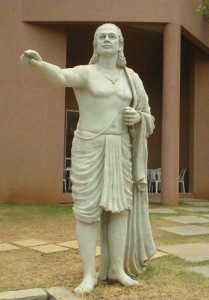
Statue of Aryabhata on the grounds of IUCAA, Pune.[a]

India's first satellite named after Aryabhata

This section needs additional citations for verification. (March 2017) (Learn how and when to remove this template message)
Aryabhata's work was of great influence in the Indian astronomical tradition and influenced several neighbouring cultures through translations. The Arabic translation during the Islamic Golden Age (c. 820 CE), was particularly influential. Some of his results are cited by Al-Khwarizmi and in the 10th century Al-Biruni stated that Aryabhata's followers believed that the Earth rotated on its axis.
His definitions of sine (jya), cosine (kojya), versine (utkrama-jya), and inverse sine (otkram jya) influenced the birth of trigonometry. He was also the first to specify sine and versine (1 − cos x) tables, in 3.75° intervals from 0° to 90°, to an accuracy of 4 decimal places.
In fact, modern names "sine" and "cosine" are mistranscriptions of the words jya and kojya as introduced by Aryabhata. As mentioned, they were translated as jiba and kojiba in Arabic and then misunderstood by Gerard of Cremona while translating an Arabic geometry text to Latin. He assumed that jiba was the Arabic word jaib, which means "fold in a garment", L. sinus (c. 1150).[40]
Aryabhata's astronomical calculation methods were also very influential. Along with the trigonometric tables, they came to be widely used in the Islamic world and used to compute many Arabic astronomical tables (zijes). In particular, the astronomical tables in the work of the Arabic Spain scientist Al-Zarqali (11th century) were translated into Latin as the Tables of Toledo (12th century) and remained the most accurate ephemeris used in Europe for centuries.
Calendric calculations devised by Aryabhata and his followers have been in continuous use in India for the practical purposes of fixing the Panchangam (the Hindu calendar). In the Islamic world, they formed the basis of the Jalali calendar introduced in 1073 CE by a group of astronomers including Omar Khayyam,[41] versions of which (modified in 1925) are the national calendars in use in Iran and Afghanistan today. The dates of the Jalali calendar are based on actual solar transit, as in Aryabhata and earlier Siddhanta calendars. This type of calendar requires an ephemeris for calculating dates. Although dates were difficult to compute, seasonal errors were less in the Jalali calendar than in the Gregorian calendar.
Aryabhatta Knowledge University (AKU), Patna has been established by Government of Bihar for the development and management of educational infrastructure related to technical, medical, management and allied professional education in his honour. The university is governed by Bihar State University Act 2008.
India's first satellite Aryabhata and the lunar crater Aryabhata are named in his honour. An Institute for conducting research in astronomy, astrophysics and atmospheric sciences is the Aryabhatta Research Institute of Observational Sciences (ARIES) near Nainital, India. The inter-school Aryabhata Maths Competition is also named after him,[42] as is Bacillus aryabhata, a species of bacteria discovered in the stratosphere by ISRO scientists in 2009.

Varāhamihira
VārāhaMihira
Born: 505 CE
Died: 587 CE
Occupation: astronomer, mathematician, and astrologer.
Period: Gupta era
Subject: Astronomy, Astrology, Mathematics
Notable works: Pancha-Siddhāntikā, Brihat-Samhita, Brihat Jataka
Vārāhamihira  pronunciation (help·info) (505–587 CE), also called Vārāha or Mihira, was an Indian astronomer, mathematician, and astrologer who lived in Ujjain. He was born in the Avanti region, roughly corresponding to modern-day Malwa, to Adityadasa, who was himself an astronomer. According to one of his own works, he was educated at Kapitthaka.[1] He is considered to be one of the "Nine Jewels" (Navaratnas) of the court of legendary ruler Yashodharman Vikramaditya of Malwa
Works:
Pancha-Siddhantika
Varahamihira's main work is the book Pañcasiddhāntikā (or Pancha-Siddhantika, "[Treatise] on the Five [Astronomical] Canons) dated ca. 575 CE gives us information about older Indian texts which are now lost. The work is a treatise on mathematical astronomy and it summarises five earlier astronomical treatises, namely the Surya Siddhanta, Romaka Siddhanta, Paulisa Siddhanta, Vasishtha Siddhanta and Paitamaha Siddhanta. It is a compendium of Vedanga Jyotisha as well as Hellenistic astronomy (including Greek, Egyptian and Roman elements).[4] Varahamihira was the first one to mention that the ayanamsa, or the shifting of the equinox is 50.32 seconds.[clarification needed]
"They [the Indians] have 5 Siddhāntas:
- Sūrya-Siddhānta, ie. the Siddhānta of the Sun, thought to be composed by Lāṭadeva, but actually composed by Mayasura also known as Mamuni Mayan as stated in the text itself.
- Vasishtha-siddhānta, so called from one of the stars of the Great Bear, composed by Vishnucandra,
- Paulisa-siddhānta, so called from Pulisa, the Greek, from the city of Saintra, which is supposed to be Alexandria, composed by Pulisa.
- Romaka-siddhānta, so called from the Rūm, ie. the subjects of the Roman Empire, composed by Śrīsheṇa.
- Paitahama-siddhānta.
Brihat-Samhita
Another important contribution of Varahamihira is the encyclopedic Brihat-Samhita. It covers wide ranging subjects of human interest, including astrology, planetary movements, eclipses, rainfall, clouds, architecture, growth of crops, manufacture of perfume, matrimony, domestic relations, gems, pearls, and rituals. The volume expounds on gemstone evaluation criterion found in the Garuda Purana, and elaborates on the sacred Nine Pearls from the same text. It contains 106 chapters and is known as the "great compilation".
On Astrology
He was also an astrologer. He wrote on all the three main branches of Jyotisha astrology:
- Brihat Jataka - is considered as one of the five main treatises on Hindu astrology on horoscopy.
- Laghu Jataka - also known as 'Swalpa Jataka'
- Samasa Samhita - also known as 'Lagu Samhita' or 'Swalpa Samhita'
- Brihat Yogayatra - also known as 'Mahayatra' or 'Yakshaswamedhiya yatra'
- Yoga Yatra - also known as 'Swalpa yatra'
- Tikkani Yatra
- Brihat Vivaha Patal
- Lagu Vivaha Patal - also known as 'Swalpa Vivaha Patal'
- Lagna Varahi
- Kutuhala Manjari
- Daivajna Vallabha (apocryphal)
His son Prithuyasas also contributed to Hindu astrology; his book Hora Sara is a famous book on horoscopy. Khana (also named Lilavati elsewhere), the medieval Bengali poet astrologer, is believed to be the daughter-in-law of Varahamihira.
Influences
The Romaka Siddhanta ("Doctrine of the Romans") and the Paulisa Siddhanta were two works of Western origin which influenced Varahamihira's thought, though this view is controversial as there is much evidence to suggest that it was actually Vedic thought indigenous to India which first influenced Western astrologers and subsequently came back to India reformulated.[5] Paulisa Siddhanta is often mistakenly thought to be a single work and attributed to Paul of Alexandria (c. 378 CE).[6] However, this notion has been rejected by other scholars in the field, notably by David Pingree who stated that "...the identification of Paulus Alexandrinus with the author of the Pauliśa Siddhānta is totally false".[7] Number of his writings share similarities with the earlier texts like Vedanga Jyotisha.[8]
A comment in the Brihat-Samhita by Varahamihira says: "The Greeks, though impure.,[9] must be honored since they have shown tremendous interest in our science....." ("mleccha hi yavanah tesu samyak shastram kdamsthitam/ rsivat te 'p i pujyante kim punar daivavid dvijah" (Brihat-Samhita 2.15)).[citation needed]
Contributions
Trigonometry
Varahamihira improved the accuracy of the sine tables of Aryabhata .
Combinatorics
He was among the first mathematicians to discover a version of what is now known as the Pascal's triangle. He used it to calculate the binomial coefficients.
Optics
Among Varahamihira's contribution to physics is his statement that reflection is caused by the back-scattering of particles and refraction (the change of direction of a light ray as it moves from one medium into another) by the ability of the particles to penetrate inner spaces of the material, much like fluids that move through porous objects.
1. ^ "the Pañca-siddhāntikā ("Five Treatises"), a compendium of Greek, Egyptian, Roman and Indian astronomy. Varāhamihira's knowledge of Western astronomy was thorough. In 5 sections, his monumental work progresses through native Indian astronomy and culminates in 2 treatises on Western astronomy, showing calculations based on Greek and Alexandrian reckoning and even giving complete Ptolemaic mathematical charts and tables. Encyclopædia Britannica (2007) s.v.Varahamihira ^
2. E. C. Sachau, Alberuni's India (1910), vol. I, p. 153.

Brahmagupta
Born: c. 598 CE
Died: c. 668 CE
Residence
Known for
- Zero
- Modern number system
- Brahmagupta's theorem
- Brahmagupta's identity
- Brahmagupta's problem
- Brahmagupta-Fibonacci identity
- Brahmagupta's interpolation formula
- Brahmagupta's formula
Scientific career
Fields: Mathematics, astronomy
Brahmagupta ( listen (help·info)) (born c. 598 CE, died c. 668 CE) was an Indian mathematician and astronomer. He is the author of two early works on mathematics and astronomy: the Brāhmasphuṭasiddhānta (BSS, "correctly established doctrine of Brahma", dated 628), a theoretical treatise, and the Khaṇḍakhādyaka ("edible bite", dated 665), a more practical text.
Brahmagupta was the first to give rules to compute with zero. The texts composed by Brahmagupta were composed in elliptical verse in Sanskrit, as was common practice in Indian mathematics. As no proofs are given, it is not known how Brahmagupta's results were derived.
Life and career
Brahmagupta was born in 598 CE according to his own statement. He lived in Bhillamala (modern Bhinmal) during the reign of the Chapa dynasty ruler, Vyagrahamukha. He was the son of Jishnugupta and was a Shaivite by religion.[3] Even though most scholars assume that Brahmagupta was born in Bhillamala, there is no conclusive evidence for it. However, he lived and worked there for a good part of his life. Prithudaka Svamin, a later commentator, called him Bhillamalacharya, the teacher from Bhillamala.[4] Sociologist G. S. Ghuryebelieved that he might have been from the Multan or Abu region.[5]
Bhillamala, called pi-lo-mo-lo by Xuanzang, was the apparent capital of the Gurjaradesa, the second largest kingdom of Western India, comprising southern Rajasthan and northern Gujarat in modern-day India. It was also a centre of learning for mathematics and astronomy. Brahmagupta became an astronomer of the Brahmapaksha school, one of the four major schools of Indian astronomy during this period. He studied the five traditional siddhanthas on Indian astronomy as well as the work of other astronomers including Aryabhata I, Latadeva, Pradyumna, Varahamihira, Simha, Srisena, Vijayanandin and Vishnuchandra.[4]
In the year 628, at an age of 30, he composed the Brāhmasphuṭasiddhānta (the improved treatise of Brahma) which is believed to be a revised version of the received siddhanta of the Brahmapaksha school. Scholars state that he incorporated a great deal of originality to his revision, adding a considerable amount of new material. The book consists of 24 chapters with 1008 verses in the ārya metre. A good deal of it is astronomy, but it also contains key chapters on mathematics, including algebra, geometry, trigonometry and algorithmics, which are believed to contain new insights due to Brahmagupta himself.[4][6][7]
Later, Brahmagupta moved to Ujjain, which was also a major centre for astronomy. At the age of 67, he composed his next well known work Khanda-khādyaka, a practical manual of Indian astronomy in the karana category meant to be used by students.[8]
Brahmagupta lived beyond 665 CE. He is believed to have died in Ujjain.[citation needed]
Controversy
Brahmagupta directed a great deal of criticism towards the work of rival astronomers, and his Brahmasphutasiddhanta displays one of the earliest schisms among Indian mathematicians. The division was primarily about the application of mathematics to the physical world, rather than about the mathematics itself. In Brahmagupta's case, the disagreements stemmed largely from the choice of astronomical parameters and theories.[9] Critiques of rival theories appear throughout the first ten astronomical chapters and the eleventh chapter is entirely devoted to criticism of these theories, although no criticisms appear in the twelfth and eighteenth chapters.[9]
Reception
The historian of science George Sarton called him "one of the greatest scientists of his race and the greatest of his time."[8] Brahmagupta's mathematical advances were carried on further by Bhāskara II, a lineal descendant in Ujjain, who described Brahmagupta as the ganaka-chakra-chudamani (the gem of the circle of mathematicians). Prithudaka Svaminwrote commentaries on both of his works, rendering difficult verses into simpler language and adding illustrations. Lalla and Bhattotpala in the 8th and 9th centuries wrote commentaries on the Khanda-khadyaka.[10] Further commentaries continued to be written into the 12th century.[8]
A few decades after the death of Brahmagupta, Sindh came under the Arab Caliphate in 712 CE. Expeditions were sent into Gurjaradesa. The kingdom of Bhillamala seems to have been annihilated but Ujjain repulsed the attacks. The court of Caliph Al-Mansur (754–775) received an embassy from Sindh, including an astrologer called Kanaka, who brought (possibly memorised) astronomical texts, including those of Brahmagupta. Brahmagupta's texts were translated into Arabic by Muhammad al-Fazari, an astronomer in Al-Mansur's court under the names Sindhind and Arakhand. An immediate outcome was the spread of the decimal number system used in the texts. The mathematician Al-Khwarizmi (800–850 CE) wrote a text called al-Jam wal-tafriq bi hisal-al-Hind (Addition and Subtraction in Indian Arithmetic), which was translated into Latin in the 13th century as Algorithmi de numero indorum. Through these texts, the decimal number system and Brahmagupta's algorithms for arithmetic have spread throughout the world. Al-Khwarizmi also wrote his own version of Sindhind, drawing on Al-Fazari's version and incorporating Ptolemaic elements. Indian astronomic material circulated widely for centuries, even passing into medieval Latin texts.[11][12][13]
Mathematics
Algebra
Brahmagupta gave the solution of the general linear equation in chapter eighteen of Brahmasphutasiddhanta,
The difference between rupas, when inverted and divided by the difference of the unknowns, is the unknown in the equation. The rupas are [subtracted on the side] below that from which the square and the unknown are to be subtracted.[14]
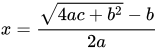
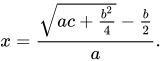
which is a solution for the equation bx + c = dx + e equivalent to x = e − c/b − d, where rupas refers to the constants c and e. He further gave two equivalent solutions to the general quadratic equation
18.44. Diminish by the middle [number] the square-root of the rupas multiplied by four times the square and increased by the square of the middle [number]; divide the remainder by twice the square. [The result is] the middle [number].
18.45. Whatever is the square-root of the rupas multiplied by the square [and] increased by the square of half the unknown, diminish that by half the unknown [and] divide [the remainder] by its square. [The result is] the unknown.[14]
which are, respectively, solutions for the equation ax2 + bx = c equivalent to,
{\displaystyle x={\frac {{\sqrt {4ac+b^{2}}}-b}{2a}}}
and
{\displaystyle x={\frac {{\sqrt {ac+{\tfrac {b^{2}}{4}}}}-{\tfrac {b}{2}}}{a}}.}
He went on to solve systems of simultaneous indeterminate equations stating that the desired variable must first be isolated, and then the equation must be divided by the desired variable's coefficient. In particular, he recommended using "the pulverizer" to solve equations with multiple unknowns.
18.51. Subtract the colors different from the first color. [The remainder] divided by the first [color's coefficient] is the measure of the first. [Terms] two by two [are] considered [when reduced to] similar divisors, [and so on] repeatedly. If there are many [colors], the pulverizer [is to be used].[14]
Like the algebra of Diophantus, the algebra of Brahmagupta was syncopated. Addition was indicated by placing the numbers side by side, subtraction by placing a dot over the subtrahend, and division by placing the divisor below the dividend, similar to our notation but without the bar. Multiplication, evolution, and unknown quantities were represented by abbreviations of appropriate terms.[15] The extent of Greek influence on this syncopation, if any, is not known and it is possible that both Greek and Indian syncopation may be derived from a common Babylonian source.[15]
Arithmetic
The four fundamental operations (addition, subtraction, multiplication, and division) were known to many cultures before Brahmagupta. This current system is based on the Hindu Arabic number system and first appeared in Brahmasphutasiddhanta. Brahmagupta describes the multiplication as thus “The multiplicand is repeated like a string for cattle, as often as there are integrant portions in the multiplier and is repeatedly multiplied by them and the products are added together. It is multiplication. Or the multiplicand is repeated as many times as there are component parts in the multiplier”. [16][page needed] Indian arithmetic was known in Medieval Europe as "Modus Indoram" meaning method of the Indians. In Brahmasphutasiddhanta, multiplication was named Gomutrika. In the beginning of chapter twelve of his Brahmasphutasiddhanta, entitled Calculation, Brahmagupta details operations on fractions. The reader is expected to know the basic arithmetic operations as far as taking the square root, although he explains how to find the cube and cube-root of an integer and later gives rules facilitating the computation of squares and square roots. He then gives rules for dealing with five types of combinations of fractions: a/c + b/c; a/c × b/d; a/1 + b/d; a/c + b/d × a/c = a(d + b)/cd; and a/c − b/d × a/c = a(d − b)/cd.[17]
Series
Brahmagupta then goes on to give the sum of the squares and cubes of the first n integers.
12.20. The sum of the squares is that [sum] multiplied by twice the [number of] step[s] increased by one [and] divided by three. The sum of the cubes is the square of that [sum] Piles of these with identical balls [can also be computed].[18]
Here Brahmagupta found the result in terms of the sum of the first n integers, rather than in terms of n as is the modern practice.[19]
He gives the sum of the squares of the first n natural numbers as n(n + 1)(2n + 1)/6 and the sum of the cubes of the first n natural numbers as (n(n + 1)/2)2
.
Zero
Brahmagupta's Brahmasphuṭasiddhanta is the first book that provides rules for arithmetic manipulations that apply to zero and to negative numbers.[20] The Brahmasphutasiddhantais the earliest known text to treat zero as a number in its own right, rather than as simply a placeholder digit in representing another number as was done by the Babylonians or as a symbol for a lack of quantity as was done by Ptolemy and the Romans. In chapter eighteen of his Brahmasphutasiddhanta, Brahmagupta describes operations on negative numbers. He first describes addition and subtraction,
18.30. [The sum] of two positives is positives, of two negatives negative; of a positive and a negative [the sum] is their difference; if they are equal it is zero. The sum of a negative and zero is negative, [that] of a positive and zero positive, [and that] of two zeros zero.
[...]
18.32. A negative minus zero is negative, a positive [minus zero] positive; zero [minus zero] is zero. When a positive is to be subtracted from a negative or a negative from a positive, then it is to be added.[14]
He goes on to describe multiplication,
18.33. The product of a negative and a positive is negative, of two negatives positive, and of positives positive; the product of zero and a negative, of zero and a positive, or of two zeros is zero.[14]
But his description of division by zero differs from our modern understanding:
18.34. A positive divided by a positive or a negative divided by a negative is positive; a zero divided by a zero is zero; a positive divided by a negative is negative; a negative divided by a positive is [also] negative.
18.35. A negative or a positive divided by zero has that [zero] as its divisor, or zero divided by a negative or a positive [has that negative or positive as its divisor]. The square of a negative or of a positive is positive; [the square] of zero is zero. That of which [the square] is the square is [its] square-root.[14]
Here Brahmagupta states that 0/0 = 0 and as for the question of a/0 where a ≠ 0 he did not commit himself.[21] His rules for arithmetic on negative numbers and zero are quite close to the modern understanding, except that in modern mathematics division by zero is left undefined.
Diophantine analysis
Pythagorean triples
In chapter twelve of his Brahmasphutasiddhanta, Brahmagupta provides a formula useful for generating Pythagorean triples:
12.39. The height of a mountain multiplied by a given multiplier is the distance to a city; it is not erased. When it is divided by the multiplier increased by two it is the leap of one of the two who make the same journey.[22]
Or, in other words, if d = mx/x + 2, then a traveller who "leaps" vertically upwards a distance d from the top of a mountain of height m, and then travels in a straight line to a city at a horizontal distance mx from the base of the mountain, travels the same distance as one who descends vertically down the mountain and then travels along the horizontal to the city.[22] Stated geometrically, this says that if a right-angled triangle has a base of length a = mx and altitude of length b = m + d, then the length, c, of its hypotenuse is given by c = m(1 + x) − d. And, indeed, elementary algebraic manipulation shows that a2 + b2 = c2 whenever d has the value stated. Also, if m and x are rational, so are d, a, b and c. A Pythagorean triple can therefore be obtained from a, b and c by multiplying each of them by the least common multiple of their denominators.
Pell's equation
Brahmagupta went on to give a recurrence relation for generating solutions to certain instances of Diophantine equations of the second degree such as Nx2 + 1 = y2 (called Pell's equation) by using the Euclidean algorithm. The Euclidean algorithm was known to him as the "pulverizer" since it breaks numbers down into ever smaller pieces.[23]
The nature of squares:
18.64. [Put down] twice the square-root of a given square by a multiplier and increased or diminished by an arbitrary [number]. The product of the first [pair], multiplied by the multiplier, with the product of the last [pair], is the last computed.
18.65. The sum of the thunderbolt products is the first. The additive is equal to the product of the additives. The two square-roots, divided by the additive or the subtractive, are the additive rupas.[14]
The key to his solution was the identity,
{\displaystyle (x_{1}^{2}-Ny_{1}^{2})(x_{2}^{2}-Ny_{2}^{2})=(x_{1}x_{2}+Ny_{1}y_{2})^{2}-N(x_{1}y_{2}+x_{2}y_{1})^{2}}

which is a generalisation of an identity that was discovered by Diophantus,
{\displaystyle (x_{1}^{2}-y_{1}^{2})(x_{2}^{2}-y_{2}^{2})=(x_{1}x_{2}+y_{1}y_{2})^{2}-(x_{1}y_{2}+x_{2}y_{1})^{2}.}

Using his identity and the fact that if (x1, y1) and (x2, y2) are solutions to the equations x2 − Ny2 = k1 and x2 − Ny2 = k2, respectively, then (x1x2 + Ny1y2, x1y2 + x2y1) is a solution to x2 − Ny2 = k1k2, he was able to find integral solutions to Pell's equation through a series of equations of the form x2 − Ny2 = ki. Brahmagupta was not able to apply his solution uniformly for all possible values of N, rather he was only able to show that if x2 − Ny2 = k has an integer solution for k = ±1, ±2, or ±4, then x2 − Ny2 = 1 has a solution. The solution of the general Pell's equation would have to wait for Bhaskara II in c. 1150 CE.[24]
Geometry
Brahmagupta's formula

Diagram for reference
Brahmagupta's most famous result in geometry is his formula for cyclic quadrilaterals. Given the lengths of the sides of any cyclic quadrilateral, Brahmagupta gave an approximate and an exact formula for the figure's area,
12.21. The approximate area is the product of the halves of the sums of the sides and opposite sides of a triangle and a quadrilateral. The accurate [area] is the square root from the product of the halves of the sums of the sides diminished by [each] side of the quadrilateral.[18]
So given the lengths p, q, r and s of a cyclic quadrilateral, the approximate area is p + r/2 · q + s/2 while, letting t = p + q + r + s/2, the exact area is
√(t − p)(t − q)(t − r)(t − s).
Although Brahmagupta does not explicitly state that these quadrilaterals are cyclic, it is apparent from his rules that this is the case.[25] Heron's formula is a special case of this formula and it can be derived by setting one of the sides equal to zero.
Triangles
Brahmagupta dedicated a substantial portion of his work to geometry. One theorem gives the lengths of the two segments a triangle's base is divided into by its altitude:
12.22. The base decreased and increased by the difference between the squares of the sides divided by the base; when divided by two they are the true segments. The perpendicular [altitude] is the square-root from the square of a side diminished by the square of its segment.[18]
Thus the lengths of the two segments are 1/2(b ± c2 − a2/b).
He further gives a theorem on rational triangles. A triangle with rational sides a, b, c and rational area is of the form:
{\displaystyle a={\frac {1}{2}}\left({\frac {u^{2}}{v}}+v\right),\ \ b={\frac {1}{2}}\left({\frac {u^{2}}{w}}+w\right),\ \ c={\frac {1}{2}}\left({\frac {u^{2}}{v}}-v+{\frac {u^{2}}{w}}-w\right)}

for some rational numbers u, v, and w.[26]
Brahmagupta's theorem

Brahmagupta's theorem states that AF = FD.
Brahmagupta continues,
12.23. The square-root of the sum of the two products of the sides and opposite sides of a non-unequal quadrilateral is the diagonal. The square of the diagonal is diminished by the square of half the sum of the base and the top; the square-root is the perpendicular [altitudes].[18]
So, in a "non-unequal" cyclic quadrilateral (that is, an isosceles trapezoid), the length of each diagonal is √pr + qs.
He continues to give formulas for the lengths and areas of geometric figures, such as the circumradius of an isosceles trapezoid and a scalene quadrilateral, and the lengths of diagonals in a scalene cyclic quadrilateral. This leads up to Brahmagupta's famous theorem,
12.30-31. Imaging two triangles within [a cyclic quadrilateral] with unequal sides, the two diagonals are the two bases. Their two segments are separately the upper and lower segments [formed] at the intersection of the diagonals. The two [lower segments] of the two diagonals are two sides in a triangle; the base [of the quadrilateral is the base of the triangle]. Its perpendicular is the lower portion of the [central] perpendicular; the upper portion of the [central] perpendicular is half of the sum of the [sides] perpendiculars diminished by the lower [portion of the central perpendicular].[18]
Pi
In verse 40, he gives values of π,
12.40. The diameter and the square of the radius [each] multiplied by 3 are [respectively] the practical circumference and the area [of a circle]. The accurate [values] are the square-roots from the squares of those two multiplied by ten.[18]
So Brahmagupta uses 3 as a "practical" value of π, and {\displaystyle {\sqrt {10}}\approx 3.1622\ldots } as an "accurate" value of π. The error in this "accurate" value is less than 1%.

Measurements and constructions
In some of the verses before verse 40, Brahmagupta gives constructions of various figures with arbitrary sides. He essentially manipulated right triangles to produce isosceles triangles, scalene triangles, rectangles, isosceles trapezoids, isosceles trapezoids with three equal sides, and a scalene cyclic quadrilateral.
After giving the value of pi, he deals with the geometry of plane figures and solids, such as finding volumes and surface areas (or empty spaces dug out of solids). He finds the volume of rectangular prisms, pyramids, and the frustum of a square pyramid. He further finds the average depth of a series of pits. For the volume of a frustum of a pyramid, he gives the "pragmatic" value as the depth times the square of the mean of the edges of the top and bottom faces, and he gives the "superficial" volume as the depth times their mean area.[27]
Trigonometry
Sine table
In Chapter 2 of his Brahmasphutasiddhanta, entitled Planetary True Longitudes, Brahmagupta presents a sine table:
2.2-5. The sines: The Progenitors, twins; Ursa Major, twins, the Vedas; the gods, fires, six; flavors, dice, the gods; the moon, five, the sky, the moon; the moon, arrows, suns [...][28]
Here Brahmagupta uses names of objects to represent the digits of place-value numerals, as was common with numerical data in Sanskrit treatises. Progenitors represents the 14 Progenitors ("Manu") in Indian cosmology or 14, "twins" means 2, "Ursa Major" represents the seven stars of Ursa Major or 7, "Vedas" refers to the 4 Vedas or 4, dice represents the number of sides of the tradition die or 6, and so on. This information can be translated into the list of sines, 214, 427, 638, 846, 1051, 1251, 1446, 1635, 1817, 1991, 2156, 2312, 1459, 2594, 2719, 2832, 2933, 3021, 3096, 3159, 3207, 3242, 3263, and 3270, with the radius being 3270.[29]
Interpolation formula
In 665 Brahmagupta devised and used a special case of the Newton–Stirling interpolation formula of the second-order to interpolate new values of the sine function from other values already tabulated.[30] The formula gives an estimate for the value of a function f at a value a + xh of its argument (with h > 0 and −1 ≤ x ≤ 1) when its value is already known at a − h, a and a + h.
The formula for the estimate is:
{\displaystyle f(a+xh)\approx f(a)+x\left({\frac {\Delta f(a)+\Delta f(a-h)}{2}}\right)+{\frac {x^{2}\Delta ^{2}f(a-h)}{2!}}.}

where Δ is the first-order forward-difference operator, i.e.
{\displaystyle \Delta f(a)\ {\stackrel {\mathrm {def} }{=}}\ f(a+h)-f(a).}

Astronomy
![[icon]](https://en.wikipedia.org/wiki/File:Wiki_letter_w_cropped.svg)
This section needs expansionwith: Astronomical details reflecting his substantial astronomical work. You can help byadding to it. (July 2016)
Some of the important contributions made by Brahmagupta in astronomy are his methods for calculating the position of heavenly bodies over time (ephemerides), their rising and setting, conjunctions, and the calculation of solar and lunar eclipses.[31]
In chapter seven of his Brahmasphutasiddhanta, entitled Lunar Crescent, Brahmagupta rebuts the idea that the Moon is farther from the Earth than the Sun, an idea which had been suggested by Vedic scripture.[clarification needed] He does this by explaining the illumination of the Moon by the Sun.[32]
7.1. If the moon were above the sun, how would the power of waxing and waning, etc., be produced from calculation of the [longitude of the] moon? the near half [would be] always bright.
7.2. In the same way that the half seen by the sun of a pot standing in sunlight is bright, and the unseen half dark, so is [the illumination] of the moon [if it is] beneath the sun.
7.3. The brightness is increased in the direction of the sun. At the end of a bright [i.e. waxing] half-month, the near half is bright and the far half dark. Hence, the elevation of the horns [of the crescent can be derived] from calculation. [...][33]
He explains that since the Moon is closer to the Earth than the Sun, the degree of the illuminated part of the Moon depends on the relative positions of the Sun and the Moon, and this can be computed from the size of the angle between the two bodies.[32]
Further work exploring the longitudes of the planets, diurnal rotation, lunar and solar eclipses, risings and settings, the moon's crescent and conjunctions of the planets, are discussed in his treatise Khandakhadyaka.
Bhaskar-1
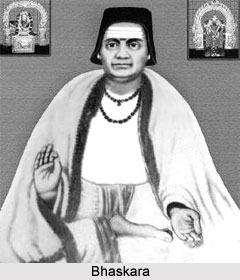
Bhāskara (c. 600 – c. 680) (commonly called Bhaskara I to avoid confusion with the 12th century mathematician Bhāskara II) was a 7th-century mathematician, who was the first to write numbers in the Hindu decimal system with a circle for the zero, and who gave a unique and remarkable rational approximation of the sine function in his commentary on Aryabhatta's work.[1] This commentary, Āryabhaṭīyabhāṣya, written in 629 CE, is among the oldest known prose works in Sanskrit on mathematics and astronomy. He also wrote two astronomical works in the line of Aryabhata's school, the Mahābhāskarīya and the Laghubhāskarīya.[2]
On 7 June 1979 the Indian Space Research Organisation launched Bhaskara I honouring the mathematician.
Biography
Little is known about Bhāskara's life. He was probably a Marathi astronomer.[4] He was born at Bori, in Parbhani district of Maharashtra state in India in 7th century.[citation needed]
His astronomical education was given by his father. Bhaskara is considered the most important scholar of Aryabhata's astronomical school. He and Brahmagupta are two of the most renowned Indian mathematicians who made considerable contributions to the study of fractions.
Representation of numbers
Bhaskara's probably most important mathematical contribution concerns the representation of numbers in a positional system. The first positional representations were known to Indian astronomers about 500 years ago. However, the numbers were not written in figures, but in words or allegories, and were organized in verses. For instance, the number 1 was given as moon, since it exists only once; the number 2 was represented by wings, twins, or eyes, since they always occur in pairs; the number 5 was given by the (5) senses. Similar to our current decimal system, these words were aligned such that each number assigns the factor of the power of ten corresponding to its position, only in reverse order: the higher powers were right from the lower ones.
His system is truly positional, since the same words representing, can also be used to represent the values 40 or 400.[5] Quite remarkably, he often explains a number given in this system, using the formula ankair api ("in figures this reads"), by repeating it written with the first nine Brahmi numerals, using a small circle for the zero . Contrary to his word number system, however, the figures are written in descending valuedness from left to right, exactly as we do it today. Therefore, at least since 629 the decimal system is definitely known to the Indian scientists. Presumably, Bhaskara did not invent it, but he was the first having no compunctions to use the Brahmi numerals in a scientific contribution in Sanskrit.
Further contributions
Bhaskara wrote three astronomical contributions. In 629 he annotated the Aryabhatiya, written in verses, about mathematical astronomy. The comments referred exactly to the 33 verses dealing with mathematics. There he considered variable equations and trigonometric formulae.
His work Mahabhaskariya divides into eight chapters about mathematical astronomy. In chapter 7, he gives a remarkable approximation formula for sin x, that is
{\displaystyle \sin x\approx {\frac {16x(\pi -x)}{5\pi ^{2}-4x(\pi -x)}},\qquad (0\leq x\leq {\frac {\pi }{2}})}

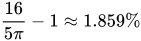
which he assigns to Aryabhata. It reveals a relative error of less than 1.9% (the greatest deviation {\displaystyle {\frac {16}{5\pi }}-1\approx 1.859\%} at {\displaystyle x=0}). Moreover, relations between sine and cosine, as well as between the sine of an angle >90° >180° or >270° to the sine of an angle <90° are given. Parts of Mahabhaskariya were later translated into Arabic.

Bhaskara already dealt with the assertion that if p is a prime number, then 1 + (p–1)! is divisible by p.[dubious ][citation needed] It was proved later by Al-Haitham, also mentioned by Fibonacci, and is now known as Wilson's theorem.
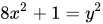
Moreover, Bhaskara stated theorems about the solutions of today so called Pell equations. For instance, he posed the problem: "Tell me, O mathematician, what is that square which multiplied by 8 becomes - together with unity - a square?" In modern notation, he asked for the solutions of the Pell equation {\displaystyle 8x^{2}+1=y^{2}}. It has the simple solution x = 1, y = 3, or shortly (x,y) = (1,3), from which further solutions can be constructed, e.g., (x,y) = (6,17).

Sridhar acharya
(Bengali: শ্রীধর আচার্য; c. 750 CE – c. 930 CE) was an Indian mathematician, Sanskrit pandit and philosopher. He was born in Bhurishresti (Bhurisristi or Bhurshut) village in South Radha (at present day Hughli) in the 8th Century AD. His father's name was Baladev Acharya and his mother's name was Acchoka bai. His father was a Sanskrit pandit.
Works
He was known for 2 treatises: Trisatika (nit sometimes called the Patiganitasara) and the Patiganita. His major work Patiganitasara was named Trisatika because it was written in three hundred slokas. The book discusses counting of numbers, measures, natural number, multiplication, division, zero, squares, cubes, fraction, rule of three, interest- calculation, joint business or partnership and mensurations.
- He gave an exposition on the zero. He wrote, "If zero is added to any number, the sum is the same number; if zero is subtracted from any number, the number remains unchanged; if zero is multiplied by any number, the product is zero".
- In the case of dividing a fraction he has found out the method of multiplying the fraction by the reciprocal of the divisor.
- He wrote on the practical applications of algebra
- He separated algebra from arithmetic
- He was one of the first to give a formula for solving quadratic equations.
Derivation:
Multiply both sides by 4a,{\displaystyle 4a^{2}x^{2}+4abx+4ac=0}Subtract 4ac from both sides,{\displaystyle 4a^{2}x^{2}+4abx=-4ac}Add {\displaystyle b^{2}} to both sides,{\displaystyle 4a^{2}x^{2}+4abx+b^{2}=-4ac+b^{2}}Since{\displaystyle (m+n)^{2}=m^{2}+2mn+n^{2}}Complete the square on the left side,{\displaystyle (2ax+b)^{2}=b^{2}-4ac={D}}Take square roots,{\displaystyle 2ax+b=\pm {\sqrt {D}}}{\displaystyle 2ax=-b\pm {\sqrt {D}}}and, divide by 2a,{\displaystyle x={\frac {-b\pm {\sqrt {b^{2}-4ac\ }}}{2a}}.}









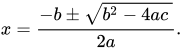

Mahāvīra
(or Mahaviracharya, "Mahavira the Teacher") was a 9th-century Jain mathematician from Karnataka, India.[1][2][3] He was the author of Gaṇitasārasan̄graha (or Ganita Sara Samgraha, c. 850), which revised the Brāhmasphuṭasiddhānta.[1] He was patronised by the Rashtrakuta king Amoghavarsha.[4] He separated astrology from mathematics. It is the earliest Indian text entirely devoted to mathematics.[5] He expounded on the same subjects on which Aryabhata and Brahmagupta contended, but he expressed them more clearly. His work is a highly syncopated approach to algebra and the emphasis in much of his text is on developing the techniques necessary to solve algebraic problems.[6] He is highly respected among Indian mathematicians, because of his establishment of terminology for concepts such as equilateral, and isosceles triangle; rhombus; circle and semicircle.[7] Mahāvīra's eminence spread in all South India and his books proved inspirational to other mathematicians in Southern India.[8] It was translated into Telugu language by Pavuluri Mallana as Saar Sangraha Ganitam.[9]
He discovered algebraic identities like a3 = a (a + b) (a − b) + b2 (a − b) + b3.[3] He also found out the formula for nCr as
[n (n − 1) (n − 2) ... (n − r + 1)] / [r (r − 1) (r − 2) ... 2 * 1].[10] He devised a formula which approximated the area and perimeters of ellipses and found methods to calculate the square of a number and cube roots of a number.[11] He asserted that the square root of a negative number did not exist.
Rules for decomposing fractions
Mahāvīra's Gaṇita-sāra-saṅgraha gave systematic rules for expressing a fraction as the sum of unit fractions.[13] This follows the use of unit fractions in Indian mathematics in the Vedic period, and the Śulba Sūtras' giving an approximation of √2 equivalent to {\displaystyle 1+{\tfrac {1}{3}}+{\tfrac {1}{3\cdot 4}}-{\tfrac {1}{3\cdot 4\cdot 34}}}.[13]

In the Gaṇita-sāra-saṅgraha (GSS), the second section of the chapter on arithmetic is named kalā-savarṇa-vyavahāra (lit. "the operation of the reduction of fractions"). In this, the bhāgajāti section (verses 55–98) gives rules for the following:[13]
- To express 1 as the sum of n unit fractions (GSS kalāsavarṇa 75, examples in 76):[13]
rūpāṃśakarāśīnāṃ rūpādyās triguṇitā harāḥ kramaśaḥ /
dvidvitryaṃśābhyastāv ādimacaramau phale rūpe //
When the result is one, the denominators of the quantities having one as numerators are [the numbers] beginning with one and multiplied by three, in order. The first and the last are multiplied by two and two-thirds [respectively].
{\displaystyle 1={\frac {1}{1\cdot 2}}+{\frac {1}{3}}+{\frac {1}{3^{2}}}+\dots +{\frac {1}{3^{n-2}}}+{\frac {1}{{\frac {2}{3}}\cdot 3^{n-1}}}}

- To express 1 as the sum of an odd number of unit fractions (GSS kalāsavarṇa 77):[13]
{\displaystyle 1={\frac {1}{2\cdot 3\cdot 1/2}}+{\frac {1}{3\cdot 4\cdot 1/2}}+\dots +{\frac {1}{(2n-1)\cdot 2n\cdot 1/2}}+{\frac {1}{2n\cdot 1/2}}}

- To express a unit fraction {\displaystyle 1/q} as the sum of n other fractions with given numerators {\displaystyle a_{1},a_{2},\dots ,a_{n}} (GSS kalāsavarṇa 78, examples in 79):


{\displaystyle {\frac {1}{q}}={\frac {a_{1}}{q(q+a_{1})}}+{\frac {a_{2}}{(q+a_{1})(q+a_{1}+a_{2})}}+\dots +{\frac {a_{n-1}}{(q+a_{1}+\dots +a_{n-2})(q+a_{1}+\dots +a_{n-1})}}+{\frac {a_{n}}{a_{n}(q+a_{1}+\dots +a_{n-1})}}}

- To express any fraction {\displaystyle p/q} as a sum of unit fractions (GSS kalāsavarṇa 80, examples in 81):[13]

Choose an integer i such that {\displaystyle {\tfrac {q+i}{p}}} is an integer r, then write{\displaystyle {\frac {p}{q}}={\frac {1}{r}}+{\frac {i}{r\cdot q}}}and repeat the process for the second term, recursively. (Note that if i is always chosen to be the smallest such integer, this is identical to the greedy algorithm for Egyptian fractions.)

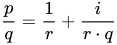
- To express a unit fraction as the sum of two other unit fractions (GSS kalāsavarṇa 85, example in 86):[13]
{\displaystyle {\frac {1}{n}}={\frac {1}{p\cdot n}}+{\frac {1}{\frac {p\cdot n}{n-1}}}} where {\displaystyle p} is to be chosen such that {\displaystyle {\frac {p\cdot n}{n-1}}} is an integer (for which {\displaystyle p} must be a multiple of {\displaystyle n-1}).{\displaystyle {\frac {1}{a\cdot b}}={\frac {1}{a(a+b)}}+{\frac {1}{b(a+b)}}}
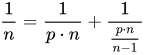


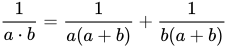
- To express a fraction {\displaystyle p/q} as the sum of two other fractions with given numerators {\displaystyle a} and {\displaystyle b} (GSS kalāsavarṇa 87, example in 88):[13]


{\displaystyle {\frac {p}{q}}={\frac {a}{{\frac {ai+b}{p}}\cdot {\frac {q}{i}}}}+{\frac {b}{{\frac {ai+b}{p}}\cdot {\frac {q}{i}}\cdot {i}}}} where {\displaystyle i} is to be chosen such that {\displaystyle p} divides {\displaystyle ai+b}
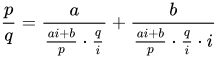


Some further rules were given in the Gaṇita-kaumudi of Nārāyaṇa in the 14th century.

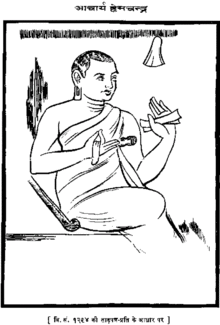
Hemachandra
Acharya Hemachandra was a Jain scholar, poet, and polymath who wrote on grammar, philosophy, prosody, and contemporary history. Noted as a prodigy by his contemporaries, he gained the title kalikālasarvajña, "the all-knowing of the Kali Yuga".
Early life
Hemachandra was born in Dhandhuka, in present-day Gujarat, on Kartika Sud Purnima (the full moon day of Kartika month). His date of birth differs according to sources but 1088 is generally accepted.[note 1][1] His father, Chachiga-deva was a Modh Bania Vaishnava. His mother, Pahini, was a Jain.[2][3] Hemchandra's original given name was Changadeva. In his childhood, the Jain monk Devachandra Suri visited Dhandhuka and was impressed by the young Hemachandra's intellect. His mother and maternal uncle concurred with Devachandra, in opposition to his father, that Hemachandra be a disciple of his. Devachandra took Hemachandra to Khambhat, where Hemachandra was placed under the care of the local governor Udayana. Chachiga came to Udayana's place to take his son back, but was so overwhelmed by the kind treatment he received, that he decided to willingly leave his son with Devachandra.[4]
Some years later, Hemachandra was initiated a Jain monk on Magha Sud Chauth (4th day of the bright half of Magha month) and was given a new name, Somchandra. Udayana helped Devchandra Suri in the ceremony.[2][3] He was trained in religious discourse, philosophy, logic and grammar and became well versed in Jain and non–Jain scriptures. At the age of 21, he was ordained an acharyaof the Śvētāmbara school of Jainism at Nagaur in present-day Rajasthan. At this time, he was named Hemachandra Suri.[2][3][5][6]
Hemachandra and Siddharaja
At the time, Gujarat was ruled by the Chaulukya dynasty from Anhilavada (Patan). It is not certain when Hemachandra visited Patan for the first time. As Jain monks are mendicants for eight months and stay at one place during Chaturmas, the four monsoon months, he started living at Patan during these periods and produced the majority of his works there.[2][3]
Probably around 1125, he was introduced to the Jayasimha Siddharaja (fl. 1092–1141) and soon rose to prominence in the Chaulukya royal court.[3] According to the Prabhavaka Charita of Chandraprabha, the earliest biography of Hemachandra, Jayasimha spotted Hemachandra while passing through the streets of his capital. The king was impressed with an impromptu verse uttered by the young monk.[7]
In 1135, when the Siddharaja conquered Malwa, he brought the works of Bhoja from Dhar along with other things. One day Siddhraja came across the manuscript of Sarasvati-Kanthabharana (also known as the Lakshana Prakash), a treatise on Sanskrit grammar. He was so impressed by it that he told the scholars in his court to produce a grammar that was as easy and lucid. Hemachandra requested Siddharaja to find the eight best grammatical treatises from Kashmir. He studied them and produced a new grammar work in the style of Pāṇini's Aṣṭādhyāyī.[2][3] He named his work Siddha-Hema-Śabdanuśāśana after himself and the king. Siddharaja was so pleased with the work that he ordered it to be placed on the back of an elephant and paraded through the streets of Anhilwad Patan.[8]Hemachandra also composed the Dvyashraya Kavya, an epic on the history of the Chaulukya dynasty, to illustrate his grammar.[3]
Hemachandra and Kumarapala

Idol of Hemachandra at Jain Center of New Jersey, US
According to the Prabhachandra, there was an incident where Siddharaja wanted to kill his nephew Kumarapala because it was prophesied that the kingdom would meet its demise at Kumarapala's hands. Hemachandra hid Kumarapala under a pile of manuscripts to save him.[2]However, such motifs are common in Indian folk literature, so it is unlikely it was an actual historical event. Also, many sources differ on Siddharaja's motives.[2]
Hemachandra became the advisor to Kumarapala.[2][3] During Kumarapala's reign, Gujarat became a center of culture. Using the Jain approach of Anekantavada, Hemchandra is said to have displayed a broad-minded attitude, which pleased Kumarapala.[5] Kumarapala was a Shaiva and ordered the rebuilding of Somnath at Prabhas Patan. Some people who were jealous of Hemachandra's rising popularity with the Kumarapala complained that Hemachandra was a very arrogant person, that he did not respect the devas and that he refused to bow down to Shiva. When called upon to visit the temple on the inauguration with Kumarapala, Hemachandra readily bowed before the lingam but said:
Bhava Bijankaura-janana Ragadyam Kshayamupagata Yasya, Brahma va Vishnu va Haro Jino va Namastasmai.
I bow down to him who has destroyed the passions like attachment and malice which are the cause of the cycle of birth and death; whether he is Brahma, Vishnu, Shiva or Jina.[5][9]
Ultimately, the king became a devoted follower of Hemachandra and a champion of Jainism.[2][5]
Starting in 1121, Hemachandra was involved in the construction of the Jain temple at Taranga. His influence on Kumarapala resulted in Jainism becoming the official religion of Gujarat and animal slaughter was banned in the state. The tradition of animal sacrifice in the name of religion was completely uprooted in Gujarat. As a result, even almost 900 years after Hemchandra, Gujarat still continues to be a predominantly lacto-vegetarian state, despite having an extensive coastline.[2][3]
Death
He announced about his death six months in advance and fasted in his last days, a Jain practice called sallekhana. He died at Anhilavad Patan. The year of death differs according to sources but 1173 is generally accepted.[1]
Works
_LACMA_M.88.62.2.jpg)
Instruction by Monks, Folio from the Siddhahemashabdanushasana
_LACMA_M.88.62.1.jpg)
Worship of Parshvanatha, Folio from the Siddhahemashabdanushasana
A prodigious writer, Hemachandra wrote grammars of Sanskrit and Prakrit, poetry, prosody, lexicons, texts on science and logic and many branches of Indian philosophy. It is said that Hemachandra composed 3.5 crore verses in total, many of which are now lost.[citation needed]
Jain philosophy
His systematic exposition of the Jain path in the Yogaśāstra and its auto-commentary is a very influential text in Jain thought. According to Olle Quarnström it is "the most comprehensive treatise on Svetambara Jainism known to us".[10]
Grammar
Siddha-Hema-Śabdanuśāśana
This Sanskrit grammar was written in the style of Pāṇini. It has seven chapters with each chapter having four sections, similar to that of the grammar of Bhoja. The Siddha-Hema-Śabdanuśāśana also includes six Prakrit languages: the "standard" Prakrit (virtually Maharashtri Prakrit), Shauraseni, Magahi, Paiśācī, the otherwise-unattested Cūlikāpaiśācī and Apabhraṃśa (virtually Gurjar Apabhraṃśa, prevalent in the area of Gujarat and Rajasthan at that time and the precursor of Gujarati language). He gave a detailed grammar of Apabhraṃśa and also illustrated it with the folk literature of the time for better understanding. It is the only known Apabhraṃśa grammar.[3]
Poetry
Dvyashraya Kavya
To illustrate the grammar, he produced the epic poetry Dvyashraya Kavya on the history of Chaulukya dynasty. It is an important source of history of region of the time.[3]
Trishashthi-Shalaka-Purusha
The epic poem Trīṣaṣṭiśalākāpuruṣacharitra or "Lives of Sixty-Three Great Men" is a hagiographical treatment of the twenty four tirthankaras and other important persons instrumental in defining the Jain philosophical position, collectively called the "śalākāpuruṣa", their asceticism and eventual liberation from the cycle of death and rebirth, as well as the legendary spread of the Jain influence. It still serves as the standard synthesis of source material for the early history of Jainism.[3] The appendix to this work, the Pariśiṣṭaparvanor Sthavirāvalīcarita,[11] contains his own commentary and is in itself a treatise of considerable depth[3] It has been translated into English as The Lives of the Jain Elders.[12]
Other
His Kavyanuprakasha follows the model of Kashmiri rhetorician Mammata's Kavya-prakasha. He quoted other scholars like Anandavardhana and Abhinavagupta in his works.[3]
Lexicography
Abhidhan-Chintamani (IAST abhidhāna-cintāmaṇi-kośa) is a lexicon while Anekarth Kosha is a lexicon of words bearing multiple meanings. Deshi-Shabda-Sangraho or Desi-nama-mala is the lexicon of local or non-Sanskrit origin. Niganthu Sesa is a botanical lexicon.[3]
Mathematics
Hemachandra, following the earlier Gopala, presented an earlier version of the Fibonacci sequence. It was presented around 1150, about fifty years before Fibonacci (1202). He was considering the number of cadences of length n, and showed that these could be formed by adding a short syllable to a cadence of length n − 1, or a long syllable to one of n − 2. This recursion relation F(n) = F(n − 1) + F(n − 2) is what defines the Fibonacci sequence.[13][14]
Other works
His other works are Chandanushasana (prosody), commentary in rhetoric work Alankara Chudamani, Abhidhana-chintamani,[2][15] Pramana-mimansa (logic), Vitaraga-Stotra(prayers).

Bhāskara[1] (also known as Bhāskarāchārya ("Bhāskara, the teacher"), and as Bhāskara II to avoid confusion with Bhāskara I) (1114–1185), was an Indian mathematician and astronomer. He was born in Bijapur in Karnataka.[2]
Bhāskara and his works represent a significant contribution to mathematical and astronomical knowledge in the 12th century. He has been called the greatest mathematician of medieval India.[3] His main work Siddhānta Shiromani, (Sanskrit for "Crown of Treatises")[4] is divided into four parts called Lilāvatī, Bījagaṇita, Grahagaṇita and Golādhyāya,[5] which are also sometimes considered four independent works.[6] These four sections deal with arithmetic, algebra, mathematics of the planets, and spheres respectively. He also wrote another treatise named Karaṇa Kautūhala.[6]
Bhāskara's work on calculus predates Newton and Leibniz by over half a millennium.[7][8] He is particularly known in the discovery of the principles of differential calculus and its application to astronomical problems and computations. While Newton and Leibniz have been credited with differential and integral calculus, there is strong evidence to suggest that Bhāskara was a pioneer in some of the principles of differential calculus. He was perhaps the first to conceive the differential coefficient and differential calculus.[9]
On 20 November 1981 the Indian Space Research Organisation launched the Bhaskara II satellite honouring the mathematician and astronomer.
Date, place, and family
Bhāskara gives his date of birth, and date of composition of his major work, in a verse in the Āryā metre:[6]
rasa-guṇa-pūrṇa-mahīsama
śhaka-nṛpa samaye 'bhavat mamotpattiḥ /
rasa-guṇa-varṣeṇa mayā
siddhānta-śiromaṇī racitaḥ //
This reveals that he was born in 1036 of the Śhaka era (1114 CE), and that he composed the Siddhānta Śiromaṇī when he was 36 years old.[6] He also wrote another work called the Karaṇa-kutūhala when he was 69 (in 1183).[6] His works show the influence of Brahmagupta, Sridhara, Mahāvīra, Padmanābha and other predecessors.[6]
He was born near Vijjadavida (believed to be Bijjaragi of Vijayapur in modern Karnataka). Bhāskara is said to have been the head of an astronomical observatory at Ujjain, the leading mathematical center of medieval India. He lived in the Sahyadri region (Patnadevi, in Jalgaon district, Maharashtra).[1]
History records his great-great-great-grandfather holding a hereditary post as a court scholar, as did his son and other descendants. His father Mahesvara[1] (Maheśvaropādhyāya[6]) was a mathematician, astronomer[6] and astrologer, who taught him mathematics, which he later passed on to his son Loksamudra. Loksamudra's son helped to set up a school in 1207 for the study of Bhāskara's writings.He died in 1185 CE
The Siddhanta-Shiromani
Lilavati
The first section Līlāvatī (also known as pāṭīgaṇita or aṅkagaṇita) it is the name of his daughter. consists of 277 verses.[6] It covers calculations, progressions, measurement, permutations, and other topics.[6]
Bijaganita
The second section Bījagaṇita has 213 verses.[6] It discusses zero, infinity, positive and negative numbers, and indeterminate equations including (the now called) Pell's equation, solving it using a kuṭṭaka method.[6] In particular, he also solved the {\displaystyle 61x^{2}+1=y^{2}} case that was to elude Fermat and his European contemporaries centuries later.[6]
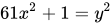
Grahaganita
In the third section Grahagaṇita, while treating the motion of planets, he considered their instantaneous speeds.[6] He arrived at the approximation:[11]
{\displaystyle \sin y'-\sin y\approx (y'-y)\cos y} for {\displaystyle y'} close to {\displaystyle y}, or in modern notation:[11]{\displaystyle {\frac {d}{dy}}\sin y=\cos y}.



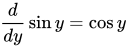
In his words:[11]
bimbārdhasya koṭijyā guṇastrijyāhāraḥ phalaṃ dorjyāyorantaram
This result had also been observed earlier by Muñjalācārya (or Mañjulācārya) in 932, in his astronomical work 'Laghu-mānasam, in the context of a table of sines.[11]
Bhāskara also stated that at its highest point a planet's instantaneous speed is zero.[11]
Mathematics
Some of Bhaskara's contributions to mathematics include the following:
- A proof of the Pythagorean theorem by calculating the same area in two different ways and then canceling out terms to get a2 + b2 = c2.[12]
- In Lilavati, solutions of quadratic, cubic and quartic indeterminate equations are explained.[13]
- Solutions of indeterminate quadratic equations (of the type ax2 + b = y2).
- Integer solutions of linear and quadratic indeterminate equations (Kuṭṭaka). The rules he gives are (in effect) the same as those given by the Renaissance European mathematicians of the 17th century
- A cyclic Chakravala method for solving indeterminate equations of the form ax2 + bx + c = y. The solution to this equation was traditionally attributed to William Brouncker in 1657, though his method was more difficult than the chakravala method.
- The first general method for finding the solutions of the problem x2 − ny2 = 1 (so-called "Pell's equation") was given by Bhaskara II.[14]
- Solutions of Diophantine equations of the second order, such as 61x2 + 1 = y2. This very equation was posed as a problem in 1657 by the French mathematician Pierre de Fermat, but its solution was unknown in Europe until the time of Euler in the 18th century.[13]
- Solved quadratic equations with more than one unknown, and found negative and irrational solutions.[citation needed]
- Preliminary concept of mathematical analysis.
- Preliminary concept of infinitesimal calculus, along with notable contributions towards integral calculus.[15]
- Conceived differential calculus, after discovering an approximation of the derivative and differential coefficient.
- Stated Rolle's theorem, a special case of one of the most important theorems in analysis, the mean value theorem. Traces of the general mean value theorem are also found in his works.
- Calculated the derivatives of trigonometric functions and formulae. (See Calculus section below.)
- In Siddhanta Shiromani, Bhaskara developed spherical trigonometry along with a number of other trigonometric results. (See Trigonometry section below.)
Arithmetic
Bhaskara's arithmetic text Leelavati covers the topics of definitions, arithmetical terms, interest computation, arithmetical and geometrical progressions, plane geometry, solid geometry, the shadow of the gnomon, methods to solve indeterminate equations, and combinations.
Lilavati is divided into 13 chapters and covers many branches of mathematics, arithmetic, algebra, geometry, and a little trigonometry and measurement. More specifically the contents include:
- Definitions.
- Properties of zero (including division, and rules of operations with zero).
- Further extensive numerical work, including use of negative numbers and surds.
- Estimation of π.
- Arithmetical terms, methods of multiplication, and squaring.
- Inverse rule of three, and rules of 3, 5, 7, 9, and 11.
- Problems involving interest and interest computation.
- Indeterminate equations (Kuṭṭaka), integer solutions (first and second order). His contributions to this topic are particularly important,[citation needed] since the rules he gives are (in effect) the same as those given by the renaissance European mathematicians of the 17th century, yet his work was of the 12th century. Bhaskara's method of solving was an improvement of the methods found in the work of Aryabhata and subsequent mathematicians.
His work is outstanding for its systemisation, improved methods and the new topics that he has introduced. Furthermore, the Lilavati contained excellent recreative problems and it is thought that Bhaskara's intention may have been that a student of 'Lilavati' should concern himself with the mechanical application of the method.[citation needed]
Algebra
His Bijaganita ("Algebra") was a work in twelve chapters. It was the first text to recognize that a positive number has two square roots (a positive and negative square root).[16] His work Bijaganita is effectively a treatise on algebra and contains the following topics:
- Positive and negative numbers.
- Zero.
- The 'unknown' (includes determining unknown quantities).
- Determining unknown quantities.
- Surds (includes evaluating surds).
- Kuṭṭaka (for solving indeterminate equations and Diophantine equations).
- Simple equations (indeterminate of second, third and fourth degree).
- Simple equations with more than one unknown.
- Indeterminate quadratic equations (of the type ax2 + b = y2).
- Solutions of indeterminate equations of the second, third and fourth degree.
- Quadratic equations.
- Quadratic equations with more than one unknown.
- Operations with products of several unknowns.
Bhaskara derived a cyclic, chakravala method for solving indeterminate quadratic equations of the form ax2 + bx + c = y.[16] Bhaskara's method for finding the solutions of the problem Nx2 + 1 = y2 (the so-called "Pell's equation") is of considerable importance.[14]
Trigonometry
The Siddhānta Shiromani (written in 1150) demonstrates Bhaskara's knowledge of trigonometry, including the sine table and relationships between different trigonometric functions. He also developed spherical trigonometry, along with other interesting trigonometrical results. In particular Bhaskara seemed more interested in trigonometry for its own sake than his predecessors who saw it only as a tool for calculation. Among the many interesting results given by Bhaskara, results found in his works include computation of sines of angles of 18 and 36 degrees, and the now well known formulae for {\displaystyle \sin \left(a+b\right)} and {\displaystyle \sin \left(a-b\right)}.


Calculus
His work, the Siddhānta Shiromani, is an astronomical treatise and contains many theories not found in earlier works.[citation needed] Preliminary concepts of infinitesimal calculus and mathematical analysis, along with a number of results in trigonometry, differential calculus and integral calculus that are found in the work are of particular interest.
Evidence suggests Bhaskara was acquainted with some ideas of differential calculus.[16] Bhaskara also goes deeper into the 'differential calculus' and suggests the differential coefficient vanishes at an extremum value of the function, indicating knowledge of the concept of 'infinitesimals'.[17]
- There is evidence of an early form of Rolle's theorem in his work
- If {\displaystyle f\left(a\right)=f\left(b\right)=0} then {\displaystyle f'\left(x\right)=0} for some {\displaystyle \ x} with {\displaystyle \ a<x<b}
- He gave the result that if {\displaystyle x\approx y} then {\displaystyle \sin(y)-\sin(x)\approx (y-x)\cos(y)}, thereby finding the derivative of sine, although he never developed the notion of derivatives.[18]
- Bhaskara uses this result to work out the position angle of the ecliptic, a quantity required for accurately predicting the time of an eclipse.
- In computing the instantaneous motion of a planet, the time interval between successive positions of the planets was no greater than a truti, or a 1⁄33750 of a second, and his measure of velocity was expressed in this infinitesimal unit of time.
- He was aware that when a variable attains the maximum value, its differential vanishes.
- He also showed that when a planet is at its farthest from the earth, or at its closest, the equation of the centre (measure of how far a planet is from the position in which it is predicted to be, by assuming it is to move uniformly) vanishes. He therefore concluded that for some intermediate position the differential of the equation of the centre is equal to zero.[citation needed] In this result, there are traces of the general mean value theorem, one of the most important theorems in analysis, which today is usually derived from Rolle's theorem. The mean value theorem was later found by Parameshvara in the 15th century in the Lilavati Bhasya, a commentary on Bhaskara's Lilavati.




Madhava (1340–1425) and the Kerala School mathematicians (including Parameshvara) from the 14th century to the 16th century expanded on Bhaskara's work and further advanced the development of calculus in India.
Astronomy
Using an astronomical model developed by Brahmagupta in the 7th century, Bhaskara accurately defined many astronomical quantities, including, for example, the length of the sidereal year, the time that is required for the Earth to orbit the Sun, as 365.2588 days which is the same as in Suryasiddhanta.[citation needed] The modern accepted measurement is 365.2563 days, a difference of just 3.5 minutes.[citation needed]
His mathematical astronomy text Siddhanta Shiromani is written in two parts: the first part on mathematical astronomy and the second part on the sphere.
The twelve chapters of the first part cover topics such as:
- Mean longitudes of the planets.
- True longitudes of the planets.
- The three problems of diurnal rotation.(Diurnal motion is an astronomical term referring to the apparent daily motion of stars around the Earth, or more precisely around the two celestial poles. It is caused by the Earth's rotation on its axis, so every star apparently moves on a circle, that is called the diurnal circle.)
- Syzygies.
- Lunar eclipses.
- Solar eclipses.
- Latitudes of the planets.
- Sunrise equation
- The Moon's crescent.
- Conjunctions of the planets with each other.
- Conjunctions of the planets with the fixed stars.
- The paths of the Sun and Moon.
The second part contains thirteen chapters on the sphere. It covers topics such as:
- Praise of study of the sphere.
- Nature of the sphere.
- Cosmography and geography.
- Planetary mean motion.
- Eccentric epicyclic model of the planets.
- The armillary sphere.
- Spherical trigonometry.
- Ellipse calculations.[citation needed]
- First visibilities of the planets.
- Calculating the lunar crescent.
- Astronomical instruments.
- The seasons.
- Problems of astronomical calculations.
Engineering
The earliest reference to a perpetual motion machine date back to 1150, when Bhāskara II described a wheel that he claimed would run forever.[19]
Bhāskara II used a measuring device known as Yaṣṭi-yantra. This device could vary from a simple stick to V-shaped staffs designed specifically for determining angles with the help of a calibrated scale.[20]
Legends
In his book Lilavati, he reasons: "In this quantity also which has zero as its divisor there is no change even when many quantities have entered into it or come out [of it], just as at the time of destruction and creation when throngs of creatures enter into and come out of [him, there is no change in] the infinite and unchanging [Vishnu]".[21]
"Behold!"
It has been stated, by several authors, that Bhaskara II proved the Pythagorean theorem by drawing a diagram and providing the single word "Behold!".[22][23] Sometimes Bhaskara's name is omitted and this is referred to as the Hindu proof, well known by schoolchildren.[24]
However, as mathematics historian Kim Plofker points out, after presenting a worked out example, Bhaskara II states the Pythagorean theorem:
Hence, for the sake of brevity, the square-root of the sum of the squares of the arm and upright is the hypotenuse: thus it is demonstrated.[25]
This is followed by:
And otherwise, when one has set down those parts of the figure there [merely] seeing [it is sufficient].[25]
Plofker suggests that this additional statement may be the ultimate source of the widespread "Behold!" legend.

Madhava of Sangamagrama
Madhava of Sangamagrama (c. 1340 – c. 1425), was a mathematician and astronomer from the town of Sangamagrama (believed to be present-day Aloor, Irinjalakuda in Thrissur District), Kerala, India. He is considered the founder of the Kerala school of astronomy and mathematics. He was the first to use infinite series approximations for a range of trigonometric functions, which has been called the "decisive step onward from the finite procedures of ancient mathematics to treat their limit-passage to infinity".[1] One of the greatest mathematician-astronomers of the Middle Ages, Madhava made pioneering contributions to the study of infinite series, calculus, trigonometry, geometry, and algebra.
Some scholars have also suggested that Madhava's work, through the writings of the Kerala school, may have been transmitted to Europe via Jesuit missionaries and traders who were active around the ancient port of Muziris at the time. As a result, it may have had an influence on later European developments in analysis and calculus.
Name
Madhava was born as Irińńaŗappiļļy or Iriññinavaļļi Mādhava . He had written that his house name was related to the Vihar where a plant called "bakuļam" was planted. According to Achyuta Pisharati, (who wrote a commentary on Veṇvāroha written by Madhava) bakuļam was locally known as "iraňňi". Dr. K.V. Sarma, an authority on Madhava has the opinion that the house name is either Irińńāŗappiļļy or Iriññinavaļļy'.[citation needed]
Irinjalakuda was once known as 'Irińńāţikuţal'. Sangamagrāmam (lit. sangamam = union, grāmam = village) is a rough translation to Sanskrit from Dravidian word 'Irińńāţikuţal', which means 'iru (two) ańńāţi (market) kǖţal (union)' or the union of two markets.
Historiography
Although there is some evidence of mathematical work in Kerala prior to Madhava (e.g., Sadratnamala c. 1300, a set of fragmentary results[6]), it is clear from citations that Madhava provided the creative impulse for the development of a rich mathematical tradition in medieval Kerala. However, most of Madhava's original work (except a couple of them) is lost. He is referred to in the work of subsequent Kerala mathematicians, particularly in Nilakantha Somayaji's Tantrasangraha (c. 1500), as the source for several infinite series expansions, including sinθ and arctanθ. The 16th-century text Mahajyānayana prakāra (Method of Computing Great Sines) cites Madhava as the source for several series derivations for π. In Jyeṣṭhadeva's Yuktibhāṣā (c. 1530),[7] written in Malayalam, these series are presented with proofs in terms of the Taylor series expansions for polynomials like 1/(1+x2), with x = tanθ, etc.
Thus, what is explicitly Madhava's work is a source of some debate. The Yukti-dipika (also called the Tantrasangraha-vyakhya), possibly composed by Sankara Variyar, a student of Jyeṣṭhadeva, presents several versions of the series expansions for sinθ, cosθ, and arctanθ, as well as some products with radius and arclength, most versions of which appear in Yuktibhāṣā. For those that do not, Rajagopal and Rangachari have argued, quoting extensively from the original Sanskrit,[1] that since some of these have been attributed by Nilakantha to Madhava, possibly some of the other forms might also be the work of Madhava.
Others have speculated that the early text Karanapaddhati (c. 1375–1475), or the Mahajyānayana prakāra might have been written by Madhava, but this is unlikely.[3]
Karanapaddhati, along with the even earlier Keralese mathematics text Sadratnamala, as well as the Tantrasangraha and Yuktibhāṣā, were considered in an 1834 article by Charles Matthew Whish, which was the first to draw attention to their priority over Newton in discovering the Fluxion (Newton's name for differentials).[6] In the mid-20th century, the Russian scholar Jushkevich revisited the legacy of Madhava,[8] and a comprehensive look at the Kerala school was provided by Sarma in 1972.[9]
Lineage

Explanation of the sine rule in Yuktibhāṣā
There are several known astronomers who preceded Madhava, including Kǖţalur Kizhār (2nd century),[10] Vararuci (4th century), and Sankaranarayana (866 AD). It is possible that other unknown figures may have preceded him. However, we have a clearer record of the tradition after Madhava. Parameshvara was a direct disciple. According to a palmleaf manuscript of a Malayalam commentary on the Surya Siddhanta, Parameswara's son Damodara (c. 1400–1500) had both Nilakantha Somayaji as his disciples. Jyeshtadevan was the disciple of Nilakanda. Achyuta Pisharati of Trikkantiyur is mentioned as a disciple of Jyeṣṭhadeva, and the grammarian Melpathur Narayana Bhattathiri as his disciple.[7]
Contributions
If we consider mathematics as a progression from finite processes of algebra to considerations of the infinite, then the first steps towards this transition typically come with infinite series expansions. It is this transition to the infinite series that is attributed to Madhava. In Europe, the first such series were developed by James Gregory in 1667. Madhava's work is notable for the series, but what is truly remarkable is his estimate of an error term (or correction term).[11] This implies that the limit nature of the infinite series was quite well understood by him. Thus, Madhava may have invented the ideas underlying infinite series expansions of functions, power series, trigonometric series, and rational approximations of infinite series.[12]
However, as stated above, which results are precisely Madhava's and which are those of his successors, are somewhat difficult to determine. The following presents a summary of results that have been attributed to Madhava by various scholars.
Infinite series
Among his many contributions, he discovered the infinite series for the trigonometric functions of sine, cosine, tangent and arctangent, and many methods for calculating the circumference of a circle. One of Madhava's series is known from the text Yuktibhāṣā, which contains the derivation and proof of the power series for inverse tangent, discovered by Madhava.[13] In the text, Jyeṣṭhadeva describes the series in the following manner:
“The first term is the product of the given sine and radius of the desired arc divided by the cosine of the arc. The succeeding terms are obtained by a process of iteration when the first term is repeatedly multiplied by the square of the sine and divided by the square of the cosine. All the terms are then divided by the odd numbers 1, 3, 5, .... The arc is obtained by adding and subtracting respectively the terms of odd rank and those of even rank. It is laid down that the sine of the arc or that of its complement whichever is the smaller should be taken here as the given sine. Otherwise the terms obtained by this above iteration will not tend to the vanishing magnitude.[14]”
This yields:
{\displaystyle r\theta ={\frac {r\sin \theta }{\cos \theta }}-(1/3)\,r\,{\frac {\left(\sin \theta \right)^{3}}{\left(\cos \theta \right)^{3}}}+(1/5)\,r\,{\frac {\left(\sin \theta \right)^{5}}{\left(\cos \theta \right)^{5}}}-(1/7)\,r\,{\frac {\left(\sin \theta \right)^{7}}{\left(\cos \theta \right)^{7}}}+\cdots }

or equivalently:
{\displaystyle \theta =\tan \theta -{\frac {\tan ^{3}\theta }{3}}+{\frac {\tan ^{5}\theta }{5}}-{\frac {\tan ^{7}\theta }{7}}+\cdots }

This series is Gregory's series (named after James Gregory, who rediscovered it three centuries after Madhava). Even if we consider this particular series as the work of Jyeṣṭhadeva, it would pre-date Gregory by a century, and certainly other infinite series of a similar nature had been worked out by Madhava. Today, it is referred to as the Madhava-Gregory-Leibniz series.[14][15]
Trigonometry
Madhava composed an accurate table of sines. Marking a quarter circle at twenty-four equal intervals, he gave the lengths of the half-chord (sines) corresponding to each of them. It is believed that he may have computed these values based on the series expansions:[4]
sin q = q – q3/3! + q5/5! – q7/7! +...cos q = 1 – q2/2! + q4/4! – q6/6! +...
The value of π (pi)
Madhava's work on the value of the mathematical constant Pi is cited in the Mahajyānayana prakāra ("Methods for the great sines").[citation needed] While some scholars such as Sarma[7] feel that this book may have been composed by Madhava himself, it is more likely the work of a 16th-century successor.[4] This text attributes most of the expansions to Madhava, and gives the following infinite series expansion of π, now known as the Madhava-Leibniz series:[16][17]
{\displaystyle {\frac {\pi }{4}}=1-{\frac {1}{3}}+{\frac {1}{5}}-{\frac {1}{7}}+\cdots +{\frac {(-1)^{n}}{2n+1}}+\cdots }

which he obtained from the power series expansion of the arc-tangent function. However, what is most impressive is that he also gave a correction term, Rn, for the error after computing the sum up to n terms. Madhava gave three expressions for the correction term Rn,[4] namely
Rn = 1/(4n), orRn = n/ (4n2 + 1), orRn = (n2 + 1) / (4n3 + 5n).
where the third correction leads to highly accurate computations of π.
It is not clear how Madhava might have found these correction terms.[18]
He also gave a more rapidly converging series by transforming the original infinite series of π, obtaining the infinite series
{\displaystyle \pi ={\sqrt {12}}\left(1-{1 \over 3\cdot 3}+{1 \over 5\cdot 3^{2}}-{1 \over 7\cdot 3^{3}}+\cdots \right)}

By using the first 21 terms to compute an approximation of π, he obtains a value correct to 11 decimal places (3.14159265359).[19] The value of 3.1415926535898, correct to 13 decimals, is sometimes attributed to Madhava,[20] but may be due to one of his followers. These were the most accurate approximations of π given since the 5th century (see History of numerical approximations of π).
The text Sadratnamala, usually considered as prior to Madhava, appears to give the astonishingly accurate value of π =3.14159265358979324 (correct to 17 decimal places). Based on this, R. Gupta has argued that this text may also have been composed by Madhava.[3][19]
Algebra
Madhava also carried out investigations into other series for arc lengths and the associated approximations to rational fractions of π, found methods of polynomial expansion, discovered tests of convergence of infinite series, and the analysis of infinite continued fractions.[3] He also discovered the solutions of transcendental equations by iteration, and found the approximation of transcendental numbers by continued fractions.[3]
Calculus
Madhava laid the foundations for the development of calculus, which were further developed by his successors at the Kerala school of astronomy and mathematics.[12][21] (It should be noted that certain ideas of calculus were known to earlier mathematicians.) Madhava also extended some results found in earlier works, including those of Bhāskara II.
Madhava developed some components of calculus such as differentiation, term-by-term integration, iterative methods for solutions of non-linear equations, and the theory that the area under a curve is its integral.[citation needed]
Madhava's works
K.V. Sarma has identified Madhava as the author of the following works:[22][23]
- Golavada
- Madhyamanayanaprakara
- Mahajyanayanaprakara (Method of Computing Great Sines)
- Lagnaprakarana (लग्नप्रकरण)
- Venvaroha (वेण्वारोह)[24]
- Sphutacandrapti (स्फुटचन्द्राप्ति)
- Aganita-grahacara (अगणित-ग्रहचार)
- Chandravakyani (चन्द्रवाक्यानि) (Table of Moon-mnemonics)
Kerala School of Astronomy and Mathematics
The Kerala school of astronomy and mathematics flourished for at least two centuries beyond Madhava. In Jyeṣṭhadeva we find the notion of integration, termed sankalitam, (lit. collection), as in the statement:
ekadyekothara pada sankalitam samam padavargathinte pakuti,[15]
which translates as the integration a variable (pada) equals half that variable squared (varga); i.e. The integral of x dx is equal to x2 / 2. This is clearly a start to the process of integral calculus. A related result states that the area under a curve is its integral. Most of these results pre-date similar results in Europe by several centuries. In many senses, Jyeshthadeva's Yuktibhāṣā may be considered the world's first calculus text.[6][12][21]
The group also did much other work in astronomy; indeed many more pages are developed to astronomical computations than are for discussing analysis related results.[7]
The Kerala school also contributed much to linguistics (the relation between language and mathematics is an ancient Indian tradition, see Katyayana). The ayurvedic and poetic traditions of Kerala can also be traced back to this school. The famous poem, Narayaneeyam, was composed by Narayana Bhattathiri.
Influence
Madhava has been called "the greatest mathematician-astronomer of medieval India",[3] or as "the founder of mathematical analysis; some of his discoveries in this field show him to have possessed extraordinary intuition."[25] O'Connor and Robertson state that a fair assessment of Madhava is that he took the decisive step towards modern classical analysis.[4]
Possible propagation to Europe
The Kerala school was well known in the 15th and 16th centuries, in the period of the first contact with European navigators in the Malabar Coast. At the time, the port of Muziris, near Sangamagrama, was a major center for maritime trade, and a number of Jesuit missionaries and traders were active in this region. Given the fame of the Kerala school, and the interest shown by some of the Jesuit groups during this period in local scholarship, some scholars, including G. Joseph of the U. Manchester have suggested[26] that the writings of the Kerala school may have also been transmitted to Europe around this time, which was still about a century before Newton.
Vatasseri Parameshvara Nambudiri (c. 1380–1460)
was a major Indian mathematician and astronomer of the Kerala school of astronomy and mathematics founded by Madhava of Sangamagrama. He was also an astrologer. Parameshvara was a proponent of observational astronomy in medieval India and he himself had made a series of eclipse observations to verify the accuracy of the computational methods then in use. Based on his eclipse observations, Parameshvara proposed several corrections to the astronomical parameters which had been in use since the times of Aryabhata. The computational scheme based on the revised set of parameters has come to be known as the Drgganita or Drig system. Parameshvara was also a prolific writer on matters relating to astronomy. At least 25 manuscripts have been identified as being authored by Parameshvara.
Biographical details
Parameshvara was a Hindu of Bhrgugotra following the Ashvalayanasutra of the Rgveda. Parameshvara's family name (Illam) was Vatasseri (also called Vatasreni) and his family resided in the village of Alathiyur (Sanskritised as Asvatthagrama) in Tirur, Kerala. Alathiyur is situated on the northern bank of the river Nila (river Bharathappuzha) at its mouth in Kerala. He was a grandson of a disciple of Govinda Bhattathiri (1237–1295 CE), a legendary figure in the astrological traditions of Kerala.
Parameshvara studied under teachers Rudra and Narayana, and also under Sangamagrama Madhava (c. 1350 – c. 1425) the founder of the Kerala school of astronomy and mathematics. Damodara, another prominent member of the Kerala school, was his son and also his pupil. Parameshvara was also a teacher of Nilakantha Somayaji (1444–1544) the author of the celebrated Tantrasamgraha.
Work
Parameshvara wrote commentaries on many mathematical and astronomical works such as those by Bhaskara I and Aryabhata. He made a series of eclipse observations over a 55-year period, and constantly attempted to compare these with the theoretically computed positions of the planets. He revised planetary parameters based on his observations.
One of Parameshvara's more significant contributions was his mean value type formula for the inverse interpolation of the sine.[2]
He was the first mathematician to give the radius of circle with an inscribed quadrilateral.[3] The expression is sometimes attributed to Lhuilier (1782), 350 years later. With the sides of the cyclic quadrilateral being a, b, c, and d, the radius R of the circumscribed circle is:
{\displaystyle R={\sqrt {\frac {(ab+cd)(ac+bd)(ad+bc)}{(a+b+c-d)(b+c+d-a)(c+d+a-b)(d+a+b-c)}}}.}

Works by Parameshvara
The following works of Parameshvara are well-known.[4] A complete list of all manuscripts attributed to Parameshvara is available in Pingree.[1]
- Bhatadipika – Commentary on Āryabhaṭīya of Āryabhaṭa I
- Karmadipika – Commentary on Mahabhaskariya of Bhaskara I
- Paramesvari – Commentary on Laghubhaskariya of Bhaskara I
- Sidhantadipika – Commentary on Mahabhaskariyabhashya of Govindasvāmi
- Vivarana – Commentary on Surya Siddhanta and Lilāvati
- Drgganita – Description of the Drig system (composed in 1431 CE)
- Goladipika – Spherical geometry and astronomy (composed in 1443 CE)
- Grahanamandana – Computation of eclipses (Its epoch is 15 July 1411 CE.)
- Grahanavyakhyadipika – On the rationale of the theory of eclipses
- Vakyakarana – Methods for the derivation of several astronomical tables.
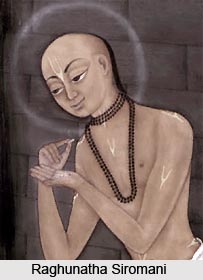
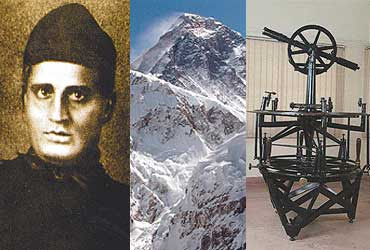

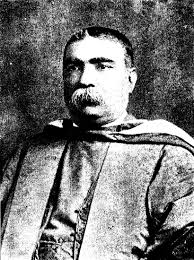

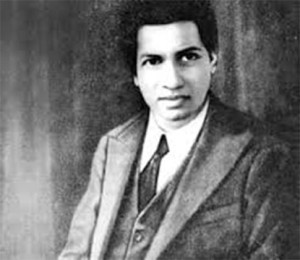
Srinivasa Ramanujan
Srinivasa Ramanujan FRS ( /ˈʃriːniˌvɑːsə ˈrɑːmɑːˌnʊdʒən/ ( listen), /-rɑːˈmɑːnʊdʒən/;[1] 22 December 1887 – 26 April 1920) was an Indian mathematician who lived during the British Rule in India. Though he had almost no formal training in pure mathematics, he made substantial contributions to mathematical analysis, number theory, infinite series, and continued fractions, including solutions to mathematical problems considered to be unsolvable. Ramanujan initially developed his own mathematical research in isolation; it was quickly recognized by Indian mathematicians. Seeking mathematicians who could better understand his work, in 1913 he began a postal partnership with the English mathematician G. H. Hardy at the University of Cambridge, England. Recognizing the extraordinary work sent to him as samples, Hardy arranged travel for Ramanujan to Cambridge. In his notes, Ramanujan had produced groundbreaking new theorems, including some that Hardy stated had 'defeated [him and his colleagues] completely', in addition to rediscovering recently proven but highly advanced results.
During his short life, Ramanujan independently compiled nearly 3,900 results (mostly identities and equations).[2] Many were completely novel; his original and highly unconventional results, such as the Ramanujan prime, the Ramanujan theta function, partition formulae, and mock theta functions, have opened entire new areas of work and inspired a vast amount of further research.[3] Nearly all his claims have now been proven correct.[4] The Ramanujan Journal, a peer-reviewed scientific journal, was established to publish work in all areas of mathematics influenced by Ramanujan,[5] and his notebooks - containing summaries of his published and unpublished results - have been analyzed and studied for decades since his death as a source of new mathematical ideas. As late as 2011 and again in 2012, researchers continued to discover that mere comments in his writings about "simple properties" and "similar outputs" for certain findings were themselves profound and subtle number theory results that remained unsuspected until nearly a century after his death and which relied on work published in 2006.[6][7] He became one of the youngest Fellows of the Royal Society and only the second Indian member, and the first Indian to be elected a Fellow of Trinity College, Cambridge. Of his original letters, Hardy stated that a 'single look' was enough to show they could only have been written by a mathematician of the highest calibre, comparing Ramanujan to other mathematical geniuses such as Euler and Jacobi.
In 1919, ill health – now believed to have been hepatic amoebiasis (a complication from episodes of dysentery many years previously) – compelled Ramanujan's return to India, where he died in 1920 at the age of 32. His last letters to Hardy, written January 1920, show that he was still continuing to produce new mathematical ideas and theorems. His "lost notebook", containing discoveries from the last year of his life, caused great excitement among mathematicians when it was rediscovered in 1976.
A deeply religious Hindu,[8] Ramanujan credited his substantial mathematical capacities to divinity, and stated that the mathematical knowledge he displayed was revealed to him by his family goddess. '"An equation for me has no meaning," he once said, "unless it expresses a thought of God."
Early life

Ramanujan's home on Sarangapani Sannidhi Street, Kumbakonam
Ramanujan (literally, "younger brother of Rama", a Hindu deity[10]:12) was born on 22 December 1887 into a Tamil Brahmin Iyengar family in Erode, Madras Presidency (now Tamil Nadu), at the residence of his maternal grandparents.[10]:11 His father, K. Srinivasa Iyengar, originally from Thanjavur district, worked as a clerk in a sari shop.[10]:17-18 His mother, Komalatammal, was a housewife and also sang at a local temple.[11] They lived in a small traditional home on Sarangapani Sannidhi Street in the town of Kumbakonam.[12] The family home is now a museum. When Ramanujan was a year and a half old, his mother gave birth to a son, Sadagopan, who died less than three months later. In December 1889, Ramanujan contracted smallpox, though he recovered, unlike 4,000 others who would die in a bad year in the Thanjavur district around this time. He moved with his mother to her parents' house in Kanchipuram, near Madras (now Chennai). His mother gave birth to two more children, in 1891 and 1894, both failing to reach their first birthdays.[10]:12
On 1 October 1892, Ramanujan was enrolled at the local school.[10]:13 After his maternal grandfather lost his job as a court official in Kanchipuram,[10]:19 Ramanujan and his mother moved back to Kumbakonam and he was enrolled in the Kangayan Primary School.[10]:14 When his paternal grandfather died, he was sent back to his maternal grandparents, then living in Madras. He did not like school in Madras, and tried to avoid attending. His family enlisted a local constable to make sure the boy attended school. Within six months, Ramanujan was back in Kumbakonam.[10]:14
Since Ramanujan's father was at work most of the day, his mother took care of the boy as a child. He had a close relationship with her. From her, he learned about tradition and puranas. He learned to sing religious songs, to attend pujas at the temple, and to maintain particular eating habits – all of which are part of Brahminculture.[10]:20 At the Kangayan Primary School, Ramanujan performed well. Just before turning 10, in November 1897, he passed his primary examinations in English, Tamil, geography and arithmetic with the best scores in the district.[10]:25 That year, Ramanujan entered Town Higher Secondary School, where he encountered formal mathematics for the first time.[10]:25
By age 11, he had exhausted the mathematical knowledge of two college students who were lodgers at his home. He was later lent a book by S. L. Loney on advanced trigonometry.[13][14] He mastered this by the age of 13 while discovering sophisticated theorems on his own. By 14, he was receiving merit certificates and academic awards that continued throughout his school career, and he assisted the school in the logistics of assigning its 1200 students (each with differing needs) to its 35-odd teachers.[10]:27 He completed mathematical exams in half the allotted time, and showed a familiarity with geometry and infinite series. Ramanujan was shown how to solve cubic equations in 1902; he developed his own method to solve the quartic. The following year, Ramanujan tried to solve the quintic, not knowing that it could not be solved by radicals.
In 1903, when he was 16, Ramanujan obtained from a friend a library copy of a A Synopsis of Elementary Results in Pure and Applied Mathematics, G. S. Carr's collection of 5,000 theorems.[10]:39[15] Ramanujan reportedly studied the contents of the book in detail.[16] The book is generally acknowledged as a key element in awakening his genius.[16] The next year, Ramanujan independently developed and investigated the Bernoulli numbers and calculated the Euler–Mascheroni constant up to 15 decimal places.[10]:90 His peers at the time commented that they "rarely understood him" and "stood in respectful awe" of him.[10]:27
When he graduated from Town Higher Secondary School in 1904, Ramanujan was awarded the K. Ranganatha Rao prize for mathematics by the school's headmaster, Krishnaswami Iyer. Iyer introduced Ramanujan as an outstanding student who deserved scores higher than the maximum.[10] He received a scholarship to study at Government Arts College, Kumbakonam,[10]:28[10]:45 but was so intent on mathematics that he could not focus on any other subjects and failed most of them, losing his scholarship in the process.[10]:47 In August 1905, Ramanujan ran away from home, heading towards Visakhapatnam, and stayed in Rajahmundry[17] for about a month.[10]:47-48 He later enrolled at Pachaiyappa's College in Madras. There he passed in mathematics, choosing only to attempt questions that appealed to him and leaving the rest unanswered, but performed poorly in other subjects, such as English, physiology and Sanskrit.[18] Ramanujan failed his Fellow of Arts exam in December 1906 and again a year later. Without a FA degree, he left college and continued to pursue independent research in mathematics, living in extreme poverty and often on the brink of starvation.[10]:55-56
It was in 1910, after a meeting between the 23-year-old Ramanujan and the founder of the Indian Mathematical Society, V. Ramaswamy Aiyer, also known as Professor Ramaswami, that Ramanujan started to get recognition within the mathematics circles of Madras, subsequently leading to his inclusion as a researcher at the University of Madras.[19]
Adulthood in India
On 14 July 1909, Ramanujan married Janaki (Janakiammal) (21 March 1899 – 13 April 1994), a girl whom his mother had selected for him a year earlier and who was ten years old when they married.[20][21][10]:71 It was not unusual for marriages to be arranged with girls. She came from Rajendram, a village close to Marudur (Karur district) Railway Station. Ramanujan's father did not participate in the marriage ceremony.[22] As was common at that time, Janakiammal continued to stay at her maternal home for three years after marriage till she attained puberty. In 1912, she and Ramanujan's mother joined Ramanujan in Madras.[23]
After the marriage, Ramanujan developed a hydrocele testis.[10]:72 The condition could be treated with a routine surgical operation that would release the blocked fluid in the scrotal sac, but his family did not have the money for the operation. In January 1910, a doctor volunteered to do the surgery at no cost.[24]
After his successful surgery, Ramanujan searched for a job. He stayed at a friend's house while he went from door to door around Madras looking for a clerical position. To make money, he tutored students at Presidency College who were preparing for their F.A. exam.[10]:73
In late 1910, Ramanujan was sick again. He feared for his health, and told his friend R. Radakrishna Iyer to "hand [his notebooks] over to Professor Singaravelu Mudaliar [the mathematics professor at Pachaiyappa's College] or to the British professor Edward B. Ross, of the Madras Christian College."[10]:74-75 After Ramanujan recovered and retrieved his notebooks from Iyer, he took a train from Kumbakonam to Villupuram, a city under French control.[25][26] In 1912, Ramanujan moved to a house in Saiva Muthaiah Mudali street, George Town, Madras with his wife and mother where they lived for a few months.[27] In May 1913, upon securing a research position at Madras University, Ramanujan moved with his family to Triplicane.[28]
Pursuit of career in mathematics
Ramanujan met deputy collector V. Ramaswamy Aiyer, who had founded the Indian Mathematical Society.[10]:77 Wishing for a job at the revenue department where Aiyer worked, Ramanujan showed him his mathematics notebooks. As Aiyer later recalled:
I was struck by the extraordinary mathematical results contained in [the notebooks]. I had no mind to smother his genius by an appointment in the lowest rungs of the revenue department.[29]
Aiyer sent Ramanujan, with letters of introduction, to his mathematician friends in Madras.[10]:77 Some of them looked at his work and gave him letters of introduction to R. Ramachandra Rao, the district collector for Nellore and the secretary of the Indian Mathematical Society.[30][31][32] Rao was impressed by Ramanujan's research but doubted that it was his own work. Ramanujan mentioned a correspondence he had with Professor Saldhana, a notable Bombay mathematician, in which Saldhana expressed a lack of understanding of his work but concluded that he was not a phony.[10]:80 Ramanujan's friend C. V. Rajagopalachari tried to quell Rao's doubts about Ramanujan's academic integrity. Rao agreed to give him another chance, and listened as Ramanujan discussed elliptic integrals, hypergeometric series, and his theory of divergent series, which Rao said ultimately converted him to a belief in Ramanujan's brilliance.[10]:80 When Rao asked him what he wanted, Ramanujan replied that he needed work and financial support. Rao consented and sent him to Madras. He continued his research, with Rao's financial aid taking care of his daily needs. With Aiyer's help, Ramanujan had his work published in the Journal of the Indian Mathematical Society.[10]:86
One of the first problems he posed in the journal was:
{\displaystyle {\sqrt {1+2{\sqrt {1+3{\sqrt {1+\cdots }}}}}}.}

He waited for a solution to be offered in three issues, over six months, but failed to receive any. At the end, Ramanujan supplied the solution to the problem himself. On page 105 of his first notebook, he formulated an equation that could be used to solve the infinitely nested radicals problem.
{\displaystyle x+n+a={\sqrt {ax+(n+a)^{2}+x{\sqrt {a(x+n)+(n+a)^{2}+(x+n){\sqrt {\cdots }}}}}}}

Using this equation, the answer to the question posed in the Journal was simply 3, obtained by setting x = 2, n = 1, and a = 0.[10]:87 Ramanujan wrote his first formal paper for the Journal on the properties of Bernoulli numbers. One property he discovered was that the denominators (sequence A027642 in the OEIS) of the fractions of Bernoulli numbers were always divisible by six. He also devised a method of calculating Bn based on previous Bernoulli numbers. One of these methods follows:
It will be observed that if n is even but not equal to zero,
- Bn is a fraction and the numerator of Bn/n in its lowest terms is a prime number,
- the denominator of Bn contains each of the factors 2 and 3 once and only once,
- 2n(2n − 1)Bn/n is an integer and 2(2n − 1)Bn consequently is an odd integer.
In his 17-page paper, "Some Properties of Bernoulli's Numbers" (1911), Ramanujan gave three proofs, two corollaries and three conjectures.[10]:91 Ramanujan's writing initially had many flaws. As Journal editor M. T. Narayana Iyengar noted:
Mr. Ramanujan's methods were so terse and novel and his presentation so lacking in clearness and precision, that the ordinary [mathematical reader], unaccustomed to such intellectual gymnastics, could hardly follow him.[33]
Ramanujan later wrote another paper and also continued to provide problems in the Journal.[34] In early 1912, he got a temporary job in the Madras Accountant General's office, with a salary of 20 rupees per month. He lasted only a few weeks.[35] Toward the end of that assignment, he applied for a position under the Chief Accountant of the Madras Port Trust.
In a letter dated 9 February 1912, Ramanujan wrote:
Sir,
I understand there is a clerkship vacant in your office, and I beg to apply for the same. I have passed the Matriculation Examination and studied up to the F.A. but was prevented from pursuing my studies further owing to several untoward circumstances. I have, however, been devoting all my time to Mathematics and developing the subject. I can say I am quite confident I can do justice to my work if I am appointed to the post. I therefore beg to request that you will be good enough to confer the appointment on me.[36]
Attached to his application was a recommendation from E. W. Middlemast, a mathematics professor at the Presidency College, who wrote that Ramanujan was "a young man of quite exceptional capacity in Mathematics".[37] Three weeks after he had applied, on 1 March, Ramanujan learned that he had been accepted as a Class III, Grade IV accounting clerk, making 30 rupees per month.[10]:96 At his office, Ramanujan easily and quickly completed the work he was given, so he spent his spare time doing mathematical research. Ramanujan's boss, Sir Francis Spring, and S. Narayana Iyer, a colleague who was also treasurer of the Indian Mathematical Society, encouraged Ramanujan in his mathematical pursuits.
Contacting British mathematicians
In the spring of 1913, Narayana Iyer, Ramachandra Rao and E. W. Middlemast tried to present Ramanujan's work to British mathematicians. M. J. M. Hill of University College London commented that Ramanujan's papers were riddled with holes.[10]:105 He said that although Ramanujan had "a taste for mathematics, and some ability," he lacked the educational background and foundation needed to be accepted by mathematicians.[38] Although Hill did not offer to take Ramanujan on as a student, he did give thorough and serious professional advice on his work. With the help of friends, Ramanujan drafted letters to leading mathematicians at Cambridge University.[10]:106
The first two professors, H. F. Baker and E. W. Hobson, returned Ramanujan's papers without comment.[10]:170-171 On 16 January 1913, Ramanujan wrote to G. H. Hardy. Coming from an unknown mathematician, the nine pages of mathematics made Hardy initially view Ramanujan's manuscripts as a possible fraud.[39] Hardy recognised some of Ramanujan's formulae but others "seemed scarcely possible to believe".[40]:494 One of the theorems Hardy found amazing was on the bottom of page three (valid for 0 < a < b + 1/2):
{\displaystyle {\begin{aligned}&\int \limits _{0}^{\infty }{\frac {1+{\dfrac {x^{2}}{(b+1)^{2}}}}{1+{\dfrac {x^{2}}{a^{2}}}}}\times {\frac {1+{\dfrac {x^{2}}{(b+2)^{2}}}}{1+{\dfrac {x^{2}}{(a+1)^{2}}}}}\times \cdots \,dx\\[6pt]={}&{\frac {\sqrt {\pi }}{2}}\times {\frac {\Gamma \left(a+{\frac {1}{2}}\right)\Gamma (b+1)\Gamma (b-a+1)}{\Gamma (a)\Gamma \left(b+{\frac {1}{2}}\right)\Gamma \left(b-a+{\frac {1}{2}}\right)}}.\end{aligned}}}
![{\displaystyle {\begin{aligned}&\int \limits _{0}^{\infty }{\frac {1+{\dfrac {x^{2}}{(b+1)^{2}}}}{1+{\dfrac {x^{2}}{a^{2}}}}}\times {\frac {1+{\dfrac {x^{2}}{(b+2)^{2}}}}{1+{\dfrac {x^{2}}{(a+1)^{2}}}}}\times \cdots \,dx\\[6pt]={}&{\frac {\sqrt {\pi }}{2}}\times {\frac {\Gamma \left(a+{\frac {1}{2}}\right)\Gamma (b+1)\Gamma (b-a+1)}{\Gamma (a)\Gamma \left(b+{\frac {1}{2}}\right)\Gamma \left(b-a+{\frac {1}{2}}\right)}}.\end{aligned}}}](https://wikimedia.org/api/rest_v1/media/math/render/svg/6ef6c56e5e8f162ef155fd3a0ab072026b3d28ac)
Hardy was also impressed by some of Ramanujan's other work relating to infinite series:
{\displaystyle 1-5\left({\frac {1}{2}}\right)^{3}+9\left({\frac {1\times 3}{2\times 4}}\right)^{3}-13\left({\frac {1\times 3\times 5}{2\times 4\times 6}}\right)^{3}+\cdots ={\frac {2}{\pi }}}{\displaystyle 1+9\left({\frac {1}{4}}\right)^{4}+17\left({\frac {1\times 5}{4\times 8}}\right)^{4}+25\left({\frac {1\times 5\times 9}{4\times 8\times 12}}\right)^{4}+\cdots ={\frac {2{\sqrt {2}}}{{\sqrt {\pi }}\,\Gamma ^{2}\left({\frac {3}{4}}\right)}}.}


The first result had already been determined by G. Bauer in 1859. The second was new to Hardy, and was derived from a class of functions called hypergeometric series, which had first been researched by Leonhard Euler and Carl Friedrich Gauss. Hardy found these results "much more intriguing" than Gauss's work on integrals.[10]:167 After seeing Ramanujan's theorems on continued fractions on the last page of the manuscripts, Hardy commented that the theorems "defeated me completely; I had never seen anything in the least like them before".[10]:168 He figured that Ramanujan's theorems "must be true, because, if they were not true, no one would have the imagination to invent them".[10]:168 Hardy asked a colleague, J. E. Littlewood, to take a look at the papers. Littlewood was amazed by Ramanujan's genius. After discussing the papers with Littlewood, Hardy concluded that the letters were "certainly the most remarkable I have received" and said that Ramanujan was "a mathematician of the highest quality, a man of altogether exceptional originality and power".[40]:494–495 One colleague, E. H. Neville, later remarked that "not one [theorem] could have been set in the most advanced mathematical examination in the world".[41]
On 8 February 1913, Hardy wrote Ramanujan a letter expressing his interest in his work, adding that it was "essential that I should see proofs of some of your assertions".[42] Before his letter arrived in Madras during the third week of February, Hardy contacted the Indian Office to plan for Ramanujan's trip to Cambridge. Secretary Arthur Davies of the Advisory Committee for Indian Students met with Ramanujan to discuss the overseas trip.[43] In accordance with his Brahmin upbringing, Ramanujan refused to leave his country to "go to a foreign land".[10]:185 Meanwhile, he sent Hardy a letter packed with theorems, writing, "I have found a friend in you who views my labour sympathetically."[44]
To supplement Hardy's endorsement, Gilbert Walker, a former mathematical lecturer at Trinity College, Cambridge, looked at Ramanujan's work and expressed amazement, urging the young man to spend time at Cambridge.[10]:175 As a result of Walker's endorsement, B. Hanumantha Rao, a mathematics professor at an engineering college, invited Ramanujan's colleague Narayana Iyer to a meeting of the Board of Studies in Mathematics to discuss "what we can do for S. Ramanujan".[45] The board agreed to grant Ramanujan a research scholarship of 75 rupees per month for the next two years at the University of Madras.[46] While he was engaged as a research student, Ramanujan continued to submit papers to the Journal of the Indian Mathematical Society. In one instance, Narayana Iyer submitted some of Ramanujan's theorems on summation of series to the journal, adding, "The following theorem is due to S. Ramanujan, the mathematics student of Madras University." Later in November, British Professor Edward B. Ross of Madras Christian College, whom Ramanujan had met a few years before, stormed into his class one day with his eyes glowing, asking his students, "Does Ramanujan know Polish?" The reason was that in one paper, Ramanujan had anticipated the work of a Polish mathematician whose paper had just arrived in the day's mail.[47] In his quarterly papers, Ramanujan drew up theorems to make definite integrals more easily solvable. Working off Giuliano Frullani's 1821 integral theorem, Ramanujan formulated generalisations that could be made to evaluate formerly unyielding integrals.[10]:183
Hardy's correspondence with Ramanujan soured after Ramanujan refused to come to England. Hardy enlisted a colleague lecturing in Madras, E. H. Neville, to mentor and bring Ramanujan to England.[10]:184 Neville asked Ramanujan why he would not go to Cambridge. Ramanujan apparently had now accepted the proposal; as Neville put it, "Ramanujan needed no converting and that his parents' opposition had been withdrawn".[41] Apparently, Ramanujan's mother had a vivid dream in which the family goddess, the deity of Namagiri, commanded her "to stand no longer between her son and the fulfilment of his life's purpose".[41] Ramanujan voyaged to England by ship, leaving his wife to stay with his parents in India.
Life in England

Ramanujan (centre) and his colleague G. H. Hardy(extreme right), with other scientists, outside the Senate House, Cambridge, c.1914–19

Whewell's Court, Trinity College, Cambridge
Ramanujan departed from Madras aboard the S.S. Nevasa on 17 March 1914.[10]:196 When he disembarked in London on 14 April, Neville was waiting for him with a car. Four days later, Neville took him to his house on Chesterton Road in Cambridge. Ramanujan immediately began his work with Littlewood and Hardy. After six weeks, Ramanujan moved out of Neville's house and took up residence on Whewell's Court, a five-minute walk from Hardy's room.[10]:202 Hardy and Littlewood began to look at Ramanujan's notebooks. Hardy had already received 120 theorems from Ramanujan in the first two letters, but there were many more results and theorems in the notebooks. Hardy saw that some were wrong, others had already been discovered, and the rest were new breakthroughs.[48] Ramanujan left a deep impression on Hardy and Littlewood. Littlewood commented, "I can believe that he's at least a Jacobi",[49] while Hardy said he "can compare him only with Euler or Jacobi."[50]
Ramanujan spent nearly five years in Cambridge collaborating with Hardy and Littlewood, and published part of his findings there. Hardy and Ramanujan had highly contrasting personalities. Their collaboration was a clash of different cultures, beliefs, and working styles. In the previous few decades, the foundations of mathematics had come into question and the need for mathematically rigorous proofs recognized. Hardy was an atheist and an apostle of proof and mathematical rigour, whereas Ramanujan was a deeply religious man who relied very strongly on his intuition and insights. While in England, Hardy tried his best to fill the gaps in Ramanujan's education and to mentor him in the need for formal proofs to support his results, without hindering his inspiration - a conflict that neither found easy.
Ramanujan was awarded a Bachelor of Science degree by research (this degree was later renamed PhD) in March 1916 for his work on highly composite numbers, the first part of which was published as a paper in the Proceedings of the London Mathematical Society. The paper was more than 50 pages and proved various properties of such numbers. Hardy remarked that it was one of the most unusual papers seen in mathematical research at that time and that Ramanujan showed extraordinary ingenuity in handling it.[citation needed] On 6 December 1917, he was elected to the London Mathematical Society. In 1918 he was elected a Fellow of the Royal Society, the second Indian admitted to the Royal Society, following Ardaseer Cursetjee in 1841. At age 31 Ramanujan was one of the youngest Fellows in the history of the Royal Society. He was elected "for his investigation in Elliptic functions and the Theory of Numbers." On 13 October 1918, he was the first Indian to be elected a Fellow of Trinity College, Cambridge.[10]:299-300
Illness and death
Throughout his life, Ramanujan was plagued by health problems. His health worsened in England; possibly he was also less resilient due to the difficulty of keeping to the strict dietary requirements of his religion in England and wartime rationing during 1914–1918. He was diagnosed with tuberculosis and a severe vitamin deficiency at the time, and was confined to a sanatorium. In 1919 he returned to Kumbakonam, Madras Presidency, and soon thereafter, in 1920, died at the age of 32. After his death, his brother Tirunarayanan chronicled Ramanujan's remaining handwritten notes consisting of formulae on singular moduli, hypergeometric series and continued fractions and compiled them.[23] Ramanujan's widow, Smt. Janaki Ammal, moved to Bombay; in 1950 she returned to Madras, where she lived in Triplicane until her death in 1994.[22][23]
A 1994 analysis of Ramanujan's medical records and symptoms by Dr. D. A. B. Young[51] concluded that his medical symptoms—including his past relapses, fevers and hepatic conditions—were much closer to those resulting from hepatic amoebiasis, an illness then widespread in Madras, rather than tuberculosis. He had two episodes of dysentery before he left India. When not properly treated, dysentery can lie dormant for years and lead to hepatic amoebiasis, whose diagnosis was not then well established.[52] Amoebiasis was a treatable and often curable disease at the time.[52][53]
Personality and spiritual life
Ramanujan has been described as a person of a somewhat shy and quiet disposition, a dignified man with pleasant manners.[54] He lived a simple life at Cambridge.[10]:234,241Ramanujan's first Indian biographers describe him as a rigorously orthodox Hindu. He credited his acumen to his family goddess, Mahalakshmi of Namakkal. He looked to her for inspiration in his work[10]:36 and said he dreamed of blood drops that symbolised her male consort, Narasimha. Afterward he would receive visions of scrolls of complex mathematical content unfolding before his eyes.[10]:281 He often said, "An equation for me has no meaning unless it represents a thought of God."[55]
Hardy cites Ramanujan as remarking that all religions seemed equally true to him.[10]:283 Hardy further argued that Ramanujan's religious belief had been romanticised by Westerners and overstated—in reference to his belief, not practice—by Indian biographers. At the same time, he remarked on Ramanujan's strict vegetarianism.[56]
Mathematical achievements
In mathematics, there is a distinction between insight and formulating or working through a proof. Ramanujan proposed an abundance of formulae that could be investigated later in depth. G. H. Hardy said that Ramanujan's discoveries are unusually rich and that there is often more to them than initially meets the eye. As a byproduct of his work, new directions of research were opened up. Examples of the most interesting of these formulae include the intriguing infinite series for π, one of which is given below:
{\displaystyle {\frac {1}{\pi }}={\frac {2{\sqrt {2}}}{9801}}\sum _{k=0}^{\infty }{\frac {(4k)!(1103+26390k)}{(k!)^{4}396^{4k}}}.}

This result is based on the negative fundamental discriminant d = −4 × 58 = −232 with class number h(d) = 2. 26390 = 5 × 7 × 13 × 58 and 16 × 9801 = 3962 and is related to the fact that
{\textstyle e^{\pi {\sqrt {58}}}=396^{4}-104.000000177\dots .}

This might be compared to Heegner numbers, which have class number 1 and yield similar formulae.
Ramanujan's series for π converges extraordinarily rapidly (exponentially) and forms the basis of some of the fastest algorithms currently used to calculate π. Truncating the sum to the first term also gives the approximation 9801√2/4412 for π, which is correct to six decimal places. See also the more general Ramanujan–Sato series.
One of Ramanujan's remarkable capabilities was the rapid solution of problems, illustrated by the following anecdote about an incident in which P. C. Mahalanobis posed a problem:
"'Imagine that you are on a street with houses marked 1 through n. There is a house in between (x) such that the sum of the house numbers to the left of it equals the sum of the house numbers to its right. If n is between 50 and 500, what are n and x?' This is a bivariate problem with multiple solutions. Ramanujan thought about it and gave the answer with a twist: He gave a continued fraction. The unusual part was that it was the solution to the whole class of problems. Mahalanobis was astounded and asked how he did it. 'It is simple. The minute I heard the problem, I knew that the answer was a continued fraction. Which continued fraction, I asked myself. Then the answer came to my mind', Ramanujan replied."[57][58]
His intuition also led him to derive some previously unknown identities, such as
{\displaystyle {\begin{aligned}&\left(1+2\sum _{n=1}^{\infty }{\frac {\cos(n\theta )}{\cosh(n\pi )}}\right)^{-2}+\left(1+2\sum _{n=1}^{\infty }{\frac {\cosh(n\theta )}{\cosh(n\pi )}}\right)^{-2}\\[6pt]&={\frac {2\Gamma ^{4}\left({\frac {3}{4}}\right)}{\pi }}={\frac {8\pi ^{3}}{\Gamma ^{4}\left({\frac {1}{4}}\right)}}\end{aligned}}}
![{\displaystyle {\begin{aligned}&\left(1+2\sum _{n=1}^{\infty }{\frac {\cos(n\theta )}{\cosh(n\pi )}}\right)^{-2}+\left(1+2\sum _{n=1}^{\infty }{\frac {\cosh(n\theta )}{\cosh(n\pi )}}\right)^{-2}\\[6pt]&={\frac {2\Gamma ^{4}\left({\frac {3}{4}}\right)}{\pi }}={\frac {8\pi ^{3}}{\Gamma ^{4}\left({\frac {1}{4}}\right)}}\end{aligned}}}](https://wikimedia.org/api/rest_v1/media/math/render/svg/a273ff31d6e0ed7f2cc18572a4ac0f55f61cc2a6)
for all θ, where Γ(z) is the gamma function, and related to a special value of the Dedekind eta function. Expanding into series of powers and equating coefficients of θ0, θ4, and θ8gives some deep identities for the hyperbolic secant.
In 1918 Hardy and Ramanujan studied the partition function P(n) extensively. They gave a non-convergent asymptotic series that permits exact computation of the number of partitions of an integer. Hans Rademacher, in 1937, was able to refine their formula to find an exact convergent series solution to this problem. Ramanujan and Hardy's work in this area gave rise to a powerful new method for finding asymptotic formulae called the circle method.[59]
In the last year of his life, Ramanujan discovered mock theta functions.[60] For many years these functions were a mystery, but they are now known to be the holomorphic parts of harmonic weak Maass forms.
The Ramanujan conjecture
Although there are numerous statements that could have borne the name Ramanujan conjecture, there is one that was highly influential on later work. In particular, the connection of this conjecture with conjectures of André Weil in algebraic geometry opened up new areas of research. That Ramanujan conjecture is an assertion on the size of the tau-function, which has as generating function the discriminant modular form Δ(q), a typical cusp form in the theory of modular forms. It was finally proven in 1973, as a consequence of Pierre Deligne's proof of the Weil conjectures. The reduction step involved is complicated. Deligne won a Fields Medal in 1978 for that work.[61]
In his paper "On certain arithmetical functions", Ramanujan defined the so-called delta-function whose coefficients are called τ(n) (the Ramanujan tau function).[62] He proved many congruences for these numbers such as τ(p) ≡ 1 + p11 mod 691 for primes p. This congruence (and others like it that Ramanujan proved) inspired Jean-Pierre Serre (1954 Fields Medalist) to conjecture that there is a theory of Galois representations which "explains" these congruences and more generally all modular forms. Δ(z) is the first example of a modular form to be studied in this way. Pierre Deligne (in his Fields Medal-winning work) proved Serre's conjecture. The proof of Fermat's Last Theorem proceeds by first reinterpreting elliptic curves and modular forms in terms of these Galois representations. Without this theory there would be no proof of Fermat's Last Theorem.[63]
Ramanujan's notebooks
While still in Madras, Ramanujan recorded the bulk of his results in four notebooks of loose-leaf paper. They were mostly written up without any derivations. This is probably the origin of the misapprehension that Ramanujan was unable to prove his results and simply thought up the final result directly. Mathematician Bruce C. Berndt, in his review of these notebooks and Ramanujan's work, says that Ramanujan most certainly was able to prove most of his results, but chose not to.
This may have been for any number of reasons. Since paper was very expensive, Ramanujan would do most of his work and perhaps his proofs on slate, and then transfer just the results to paper. Using a slate was common for mathematics students in the Madras Presidency at the time. He was also quite likely to have been influenced by the style of G. S. Carr's book, which stated results without proofs. Finally, it is possible that Ramanujan considered his workings to be for his personal interest alone and therefore recorded only the results.[64]
The first notebook has 351 pages with 16 somewhat organised chapters and some unorganised material. The second notebook has 256 pages in 21 chapters and 100 unorganised pages, with the third notebook containing 33 unorganised pages. The results in his notebooks inspired numerous papers by later mathematicians trying to prove what he had found. Hardy himself created papers exploring material from Ramanujan's work, as did G. N. Watson, B. M. Wilson, and Bruce Berndt.[64] A fourth notebook with 87 unorganised pages, the so-called "lost notebook", was rediscovered in 1976 by George Andrews.[52]
Hardy–Ramanujan number 1729
The number 1729 is known as the Hardy–Ramanujan number after a famous visit by Hardy to see Ramanujan at a hospital. In Hardy's words:[65]
I remember once going to see him when he was ill at Putney. I had ridden in taxi cab number 1729 and remarked that the number seemed to me rather a dull one, and that I hoped it was not an unfavorable omen. "No", he replied, "it is a very interesting number; it is the smallest number expressible as the sum of two cubes in two different ways."
Immediately before this anecdote, Hardy quoted Littlewood as saying, "Every positive integer was one of [Ramanujan's] personal friends."[66]
The two different ways are
1729 = 13 + 123 = 93 + 103.
Generalizations of this idea have created the notion of "taxicab numbers".
Mathematicians' views of Ramanujan
Hardy said: "He combined a power of generalization, a feeling for form, and a capacity for rapid modification of his hypotheses, that were often really startling, and made him, in his own peculiar field, without a rival in his day. The limitations of his knowledge were as startling as its profundity. Here was a man who could work out modular equations and theorems... to orders unheard of, whose mastery of continued fractions was... beyond that of any mathematician in the world, who had found for himself the functional equation of the zeta function and the dominant terms of many of the most famous problems in the analytic theory of numbers; and yet he had never heard of a doubly periodic function or of Cauchy's theorem, and had indeed but the vaguest idea of what a function of a complex variable was...".[67] When asked about the methods Ramanujan employed to arrive at his solutions, Hardy said that they were "arrived at by a process of mingled argument, intuition, and induction, of which he was entirely unable to give any coherent account."[68] He also stated that he had "never met his equal, and can compare him only with Euler or Jacobi."[68]
K. Srinivasa Rao has said,[69] "As for his place in the world of Mathematics, we quote Bruce C. Berndt: 'Paul Erdős has passed on to us Hardy's personal ratings of mathematicians. Suppose that we rate mathematicians on the basis of pure talent on a scale from 0 to 100, Hardy gave himself a score of 25, J. E. Littlewood 30, David Hilbert 80 and Ramanujan 100.'" During a lecture at IIT Madras in May 2011, Berndt stated that over the last 40 years, as nearly all of Ramanujan's theorems have been proven right, there had been greater appreciation of Ramanujan's work and brilliance, and that Ramanujan's work was now pervading many areas of modern mathematics and physics.[60][70]
In his book Scientific Edge, the physicist Jayant Narlikar spoke of "Srinivasa Ramanujan, discovered by the Cambridge mathematician Hardy, whose great mathematical findings were beginning to be appreciated from 1915 to 1919. His achievements were to be fully understood much later, well after his untimely death in 1920. For example, his work on the highly composite numbers (numbers with a large number of factors) started a whole new line of investigations in the theory of such numbers."
Posthumous recognition

Bust of Ramanujan in the garden of Birla Industrial & Technological Museum
Ramanujan's home state of Tamil Nadu celebrates 22 December (Ramanujan's birthday) as 'State IT Day'. A stamp picturing Ramanujan was released by the Government of India in 1962 – the 75th anniversary of Ramanujan's birth – commemorating his achievements in the field of number theory,[71] and a new design was issued on 26 December 2011, by the India Post.[72][73]
Since Ramanujan's centennial year, his birthday, 22 December, has been annually celebrated as Ramanujan Day by the Government Arts College, Kumbakonam where he studied and at the IIT Madras in Chennai. A prize for young mathematicians from developing countries has been created in Ramanujan's name by the International Centre for Theoretical Physics (ICTP) in cooperation with the International Mathematical Union, which nominate members of the prize committee. The SASTRA University, based in the state of Tamil Nadu in South India, has instituted the SASTRA Ramanujan Prize of US$10,000 to be given annually to a mathematician not exceeding the age of 32 for outstanding contributions in an area of mathematics influenced by Ramanujan. Based on the recommendations of a high level committee appointed by the University Grants Commission (UGC), Government of India, Srinivasa Ramanujan Centre, established by SASTRA, has been declared as an OFF-CAMPUS CENTRE under the ambit of SASTRA University. House of Ramanujan Mathematics, a museum on life and works of the Mathematical prodigy, Srinivasa Ramanujan, also exists on this campus. SASTRA purchased the house where Srinivasa Ramanujan lived at Kumabakonam and renovated it.[74] Vasavi College of Engineering named its Department of Computer Science and Information Technology "Ramanujan Block".
In 2011, on the 125th anniversary of his birth, the Indian Government declared that 22 December will be celebrated every year as National Mathematics Day.[75] Then Indian Prime Minister Manmohan Singh also declared that the year 2012 would be celebrated as the National Mathematics Year[76].
In popular culture
- The Man Who Knew Infinity: A Life of the Genius Ramanujan is a biography of Ramanujan, written in 1991 by Robert Kanigel and published by Washington Square Press.
- The Man Who Knew Infinity is a 2015 film based on the book by Robert Kanigel. In the film, Ramanujan is portrayed by British actor Dev Patel.[77][78][79]
- Ramanujan, an Indo-British collaboration film, chronicling the life of Ramanujan, was released in 2014 by the independent film company Camphor Cinema.[80] The cast and crew include director Gnana Rajasekaran, cinematographer Sunny Joseph and editor B. Lenin.[81][82] Popular Indian and English stars Abhinay Vaddi, Suhasini Maniratnam, Bhama, Kevin McGowan and Michael Lieber star in pivotal roles.[83]
- The thriller novel The Steradian Trail by M. N. Krish weaves Ramanujan and his accidental discovery into its plot connecting religion, mathematics, finance and economics.[84][85]
- Partition, a play by Ira Hauptman about Hardy and Ramanujan, first performed in 2013.[86][87][88][89]
- A play, First Class Man by Alter Ego Productions,[90] was based on David Freeman's First Class Man. The play is centred around Ramanujan and his complex and dysfunctional relationship with Hardy. On 16 October 2011, it was announced that Roger Spottiswoode, best known for his James Bond film Tomorrow Never Dies, is working on the film version, starring actor Siddharth. Like the book and play it is also titled The First Class Man.[91]
- A Disappearing Number is a recent British stage production by the company Complicite that explores the relationship between Hardy and Ramanujan.
- The novel The Indian Clerk by David Leavitt explores in fiction the events following Ramanujan's letter to Hardy.[92][93]
- Google honoured him on his 125th birth anniversary by replacing its logo with a doodle on its home page.[94][95]
- Ramanujan was mentioned in the 1997 film Good Will Hunting, in a scene where professor Gerald Lambeau (Stellan Skarsgard) explains to Sean Maguire (Robin Williams) the genius of Will Hunting (Matt Damon) by comparing him to Ramanujan.
- On 22 March 1988, the PBS series Nova aired a documentary about Ramanujan, "The Man Who Loved Numbers" (Season 15, Episode 19).[96]
- In the book Hyperspace by Michio Kaku, Ramanujan's contributions to Superstring theory and a brief synopsis of his life are given in Part II Unification in Ten Dimensions in the chapter Superstrings under the sections Mystery of Modular Functions and Reinventing 100 Years of Mathematics.
Selected publications on Ramanujan and his work
- Berndt, Bruce C. (1998). Butzer, P. L.; Oberschelp, W.; Jongen, H. Th., eds. Charlemagne and His Heritage: 1200 Years of Civilization and Science in Europe (PDF). Turnhout, Belgium: Brepols Verlag. pp. 119–146. ISBN 2-503-50673-9.
- Berndt, Bruce C.; Andrews, George E. (2005). Ramanujan's Lost Notebook. Part I. New York: Springer. ISBN 0-387-25529-X.
- Berndt, Bruce C.; Andrews, George E. (2008). Ramanujan's Lost Notebook. Part II. New York: Springer. ISBN 978-0-387-77765-8.
- Berndt, Bruce C.; Andrews, George E. (2012). Ramanujan's Lost Notebook. Part III. New York: Springer. ISBN 978-1-4614-3809-0.
- Berndt, Bruce C.; Andrews, George E. (2013). Ramanujan's Lost Notebook. Part IV. New York: Springer. ISBN 978-1-4614-4080-2.
- Berndt, Bruce C.; Rankin, Robert A. (1995). Ramanujan: Letters and Commentary. 9. Providence, Rhode Island: American Mathematical Society. ISBN 0-8218-0287-9.
- Berndt, Bruce C.; Rankin, Robert A. (2001). Ramanujan: Essays and Surveys. 22. Providence, Rhode Island: American Mathematical Society. ISBN 0-8218-2624-7.
- Berndt, Bruce C. (2006). Number Theory in the Spirit of Ramanujan. 9. Providence, Rhode Island: American Mathematical Society. ISBN 0-8218-4178-5.
- Berndt, Bruce C. (1985). Ramanujan's Notebooks. Part I. New York: Springer. ISBN 0-387-96110-0.
- Berndt, Bruce C. (1999). Ramanujan's Notebooks. Part II. New York: Springer. ISBN 0-387-96794-X.
- Berndt, Bruce C. (2004). Ramanujan's Notebooks. Part III. New York: Springer. ISBN 0-387-97503-9.
- Berndt, Bruce C. (1993). Ramanujan's Notebooks. Part IV. New York: Springer. ISBN 0-387-94109-6.
- Berndt, Bruce C. (2005). Ramanujan's Notebooks. Part V. New York: Springer. ISBN 0-387-94941-0.
- Hardy, G. H. (March 1937). "The Indian Mathematician Ramanujan". The American Mathematical Monthly. 44 (3): 137–155. doi:10.2307/2301659. JSTOR 2301659.
- Hardy, G. H. (1978). Ramanujan. New York: Chelsea Pub. Co. ISBN 0-8284-0136-5.
- Hardy, G. H. (1999). Ramanujan: Twelve Lectures on Subjects Suggested by His Life and Work. Providence, Rhode Island: American Mathematical Society. ISBN 0-8218-2023-0.
- Henderson, Harry (1995). Modern Mathematicians. New York: Facts on File Inc. ISBN 0-8160-3235-1.
- Kanigel, Robert (1991). The Man Who Knew Infinity: a Life of the Genius Ramanujan. New York: Charles Scribner's Sons. ISBN 0-684-19259-4.
- Kolata, Gina (19 June 1987). "Remembering a 'Magical Genius'". Science, New Series. American Association for the Advancement of Science. 236 (4808): 1519–1521. Bibcode:1987Sci...236.1519K. doi:10.1126/science.236.4808.1519.
- Leavitt, David (2007). The Indian Clerk (paperback ed.). London: Bloomsbury. ISBN 978-0-7475-9370-6.
- Narlikar, Jayant V. (2003). Scientific Edge: the Indian Scientist From Vedic to Modern Times. New Delhi, India: Penguin Books. ISBN 0-14-303028-0.
- Ono, Ken; Aczel, Amir D. (2016-04-13). My Search for Ramanujan: How I Learned to Count. Springer. ISBN 978-3319255668.
- Sankaran, T. M. (2005). "Srinivasa Ramanujan- Ganitha lokathile Mahaprathibha" (in Malayalam). Kochi, India: Kerala Sastra Sahithya Parishath.
Selected publications on works of Ramanujan
- Ramanujan, Srinivasa; Hardy, G. H.; Seshu Aiyar, P. V.; Wilson, B. M.; Berndt, Bruce C. (2000). Collected Papers of Srinivasa Ramanujan. AMS. ISBN 0-8218-2076-1.
This book was originally published in 1927[97] after Ramanujan's death. It contains the 37 papers published in professional journals by Ramanujan during his lifetime. The third reprint contains additional commentary by Bruce C. Berndt.
- S. Ramanujan (1957). Notebooks (2 Volumes). Bombay: Tata Institute of Fundamental Research.
These books contain photocopies of the original notebooks as written by Ramanujan.
- S. Ramanujan (1988). The Lost Notebook and Other Unpublished Papers. New Delhi: Narosa. ISBN 3-540-18726-X.
This book contains photo copies of the pages of the "Lost Notebook".
- Problems posed by Ramanujan, Journal of the Indian Mathematical Society.
- S. Ramanujan (2012). Notebooks (2 Volumes). Bombay: Tata Institute of Fundamental Research.
This was produced from scanned and microfilmed images of the original manuscripts by expert archivists of Roja Muthiah Research Library, Chennai.
See also


Prasanta Chandra Mahalanobis
Prasanta Chandra Mahalanobis OBE, FRS[1] (29 June 1893 – 28 June 1972) was an Indian scientist and applied statistician. He is best remembered for the Mahalanobis distance, a statistical measure and for being one of the members of the first Planning Commission of free India. He made pioneering studies in anthropometry in India. He founded the Indian Statistical Institute, and contributed to the design of large-scale sample surveys.
Early life
Mahalanobis belonged to a family of Bengali landed gentry who lived in Bikrampur (now in Bangladesh). His grandfather Gurucharan (1833–1916) moved to Calcutta in 1854 and built up a business, starting a chemist shop in 1860. Gurucharan was influenced by Debendranath Tagore (1817–1905), father of the Nobel Prize–winning poet, Rabindranath Tagore. Gurucharan was actively involved in social movements such as the Brahmo Samaj, acting as its Treasurer and President. His house on 210 Cornwallis Street was the center of the Brahmo Samaj. Gurucharan married a widow, an action against social traditions.
His elder son Subodhchandra (1867–1953) became a distinguished educator after studying physiology at Edinburgh University. He was elected as a Fellow of the Royal Society of Edinburgh.[2] He was the Head of the Dept. of Physiology, University of Cardiff (the first Indian to occupy this post in a British university). In 1900, Subodhchandra returned to India, founding the Dept. of Physiology in the Presidency College, Calcutta. Subodhchandra also became a member of the Senate of the Calcutta University.
Gurucharan's younger son, Prabodh Chandra (1869-1942) was the father of P. C. Mahalanobis. Born in the house at 210 Cornwallis Street, Mahalanobis grew up in a socially active family surrounded by intellectuals and reformers.[1]
Mahalanobis received his early schooling at the Brahmo Boys School in Calcutta, graduating in 1908. He joined the Presidency College, Calcutta where he was taught by teachers who included Jagadish Chandra Bose, and Prafulla Chandra Ray. Others attending were Meghnad Saha, a year junior, and Subhas Chandra Bose, two years his junior at college.[7] Mahalanobis received a Bachelor of Science degree with honours in physics in 1912. He left for England in 1913 to join the University of London.
After missing a train, he stayed with a friend at King's College, Cambridge. He was impressed by King's College Chapel and his host's friend M. A. Candeth suggested that he could try joining there, which he did. He did well in his studies at King's, but also took an interest in cross-country walking and punting on the river. He interacted with the mathematical genius Srinivasa Ramanujan during the latter's time at Cambridge.[8] After his Tripos in physics, Mahalanobis worked with C. T. R. Wilson at the Cavendish Laboratory. He took a short break and went to India, where he was introduced to the Principal of Presidency College and was invited to take classes in physics.[1]
After returning to England, Mahalanobis was introduced to the journal Biometrika. This interested him so much that he bought a complete set and took them to India. He discovered the utility of statistics to problems in meteorology and anthropology, beginning to work on problems on his journey back to India.[1]
In Calcutta, Mahalanobis met Nirmalkumari, daughter of Herambhachandra Maitra, a leading educationist and member of the Brahmo Samaj. They married on 27 February 1923, although her father did not completely approve of the union. He was concerned about Mahalanobis's opposition to various clauses in the membership of the student wing of the Brahmo Samaj, including prohibitions against members' drinking alcohol and smoking. Sir Nilratan Sircar, P. C. Mahalanobis' maternal uncle, took part in the wedding ceremony in place of the father of the bride.[1]
Indian Statistical Institute

Mahalanobis memorial at ISI Delhi.
Many colleagues of Mahalanobis took an interest in statistics. An informal group developed in the Statistical Laboratory, which was located in his room at the Presidency College, Calcutta. On 17 December 1931 Mahalanobis called a meeting with Pramatha Nath Banerji (Minto Professor of Economics), Nikhil Ranjan Sen (Khaira Professor of Applied Mathematics) and Sir R. N. Mukherji. Together they established the Indian Statistical Institute (ISI), and formally registered on 28 April 1932 as a non-profit distributing learned society under the Societies Registration Act XXI of 1860.[1]
The Institute was initially in the Physics Department of the Presidency College; its expenditure in the first year was Rs. 238. It gradually grew with the pioneering work of a group of his colleagues, including S. S. Bose, J. M. Sengupta, R. C. Bose, S. N. Roy, K. R. Nair, R. R. Bahadur, Gopinath Kallianpur, D. B. Lahiri and C. R. Rao. The institute also gained major assistance through Pitamber Pant, who was a secretary to Prime Minister Jawaharlal Nehru. Pant was trained in statistics at the Institute and took a keen interest in its affairs.[1]
In 1933, the Institute founded the journal Sankhya, along the lines of Karl Pearson's Biometrika.[1]
The institute started a training section in 1938. Many of the early workers left the ISI for careers in the United States and with the government of India. Mahalanobis invited J. B. S. Haldane to join him at the ISI; Haldane joined as a Research Professor from August 1957, staying until February 1961. He resigned from the ISI due to frustrations with the administration and disagreements with Mahalanobis' policies. He was concerned with the frequent travels and absence of the director and complained that the "... journeyings of our Director define a novel random vector." Haldane helped the ISI develop in biometrics.[9]
In 1959, the institute was declared as an institute of national importance and a deemed university.[1]
Contributions to statistics
Mahalanobis distance
A chance meeting with Nelson Annandale, then the director of the Zoological Survey of India, at the 1920 Nagpur session of the Indian Science Congress led to Annandale asking him to analyse anthropometric measurements of Anglo-Indians in Calcutta. Mahalanobis had been influenced by the anthropometric studies published in the journal Biometrika and he chose to ask the questions on what factors influence the formation of European and Indian marriages. He wanted to examine if the Indian side came from any specific castes. He used the data collected by Annandale and the caste specific measurements made by Herbert Risley to come up with the conclusion that the sample represented a mix of Europeans mainly with people from Bengal and Punjab but not with those from the Northwest Frontier Provinces or from Chhota Nagpur. He also concluded that the intermixture more frequently involved the higher castes than the lower ones.[10][11] This analysis was described by his first scientific paper in 1922.[12] During the course of these studies he found a way of comparing and grouping populations using a multivariate distance measure. This measure, denoted "D2" and now eponymously named Mahalanobis distance, is independent of measurement scale.[1] Mahalanobis also took an interest in physical anthropology and in the accurate measurement of skull measurements for which he developed an instrument that he called the "profiloscope".[13]
Sample surveys
His most important contributions are related to large-scale sample surveys. He introduced the concept of pilot surveys and advocated the usefulness of sampling methods. Early surveys began between 1937 and 1944 and included topics such as consumer expenditure, tea-drinking habits, public opinion, crop acreage and plant disease. Harold Hotellingwrote: "No technique of random sample has, so far as I can find, been developed in the United States or elsewhere, which can compare in accuracy with that described by Professor Mahalanobis" and Sir R. A. Fisher commented that "The ISI has taken the lead in the original development of the technique of sample surveys, the most potent fact finding process available to the administration".[1]
He introduced a method for estimating crop yields which involved statisticians sampling in the fields by cutting crops in a circle of diameter 4 feet. Others such as P. V. Sukhatme and V. G. Panse who began to work on crop surveys with the Indian Council of Agricultural Research and the Indian Agricultural Statistics Research Institute suggested that a survey system should make use of the existing administrative framework. The differences in opinion led to acrimony and there was little interaction between Mahalanobis and agricultural research in later years.[14][15][16]
Later life
In later life, Mahalanobis was a member of the planning commission[17] contributed prominently to newly independent India's five-year plans starting from the second. In the second five-year plan he emphasised industrialisation on the basis of a two-sector model.[1] His variant of Wassily Leontief's Input-output model, the Mahalanobis model, was employed in the Second Five Year Plan, which worked towards the rapid industrialisation of India and with other colleagues at his institute, he played a key role in the development of a statistical infrastructure. He encouraged a project to assess deindustrialisation in India and correct some previous census methodology errors and entrusted this project to Daniel Thorner.[18]
Mahalanobis also had an abiding interest in cultural pursuits and served as secretary to Rabindranath Tagore, particularly during the latter's foreign travels, and also worked at his Visva-Bharati University, for some time. He received one of the highest civilian awards, the Padma Vibhushan from the Government of India for his contribution to science and services to the country.
Mahalanobis died on 28 June 1972, a day before his seventy-ninth birthday. Even at this age, he was still active doing research work and discharging his duties as the Secretary and Director of the Indian Statistical Institute and as the Honorary Statistical Advisor to the Cabinet of the Government of India.
Honours
- Officer of the Order of the British Empire (Civil Division), 1942 New Year Honours list[19]
- Weldon Memorial Prize from the University of Oxford (1944)
- Fellow of the Royal Society, London (1945)[1][20]
- President of Indian Science Congress (1950)
- Fellow of the Econometric Society, USA (1951)
- Fellow of the Pakistan Statistical Association (1952)
- Honorary Fellow of the Royal Statistical Society, UK (1954)
- Sir Deviprasad Sarvadhikari Gold Medal (1957)
- Foreign member of the Academy of Sciences of the USSR (1958)
- Honorary Fellow of King's College, Cambridge (1959)
- Fellow of the American Statistical Association (1961)
- Durgaprasad Khaitan Gold Medal (1961)
- Padma Vibhushan (1968)
- Srinivasa Ramanujan Gold Medal (1968)
The government of India decided in 2006 to celebrate his birthday, 29 June, as National Statistical Day.
Subbayya Sivasankaranarayana Pillai
Subbayya Sivasankaranarayana Pillai (1901–1950) was an Nagercoil native Indian mathematician specialising in number theory. His contribution to Waring's problem was described in 1950 by K. S. Chandrasekharan as "almost certainly his best piece of work and one of the very best achievements in Indian Mathematics since Ramanujan".[1]
Biography
Subbayya Sivasankaranarayana Pillai was born to parents Subbayya Pillai and Gomati Ammal who were natives of Nagercoil. His mother died a year after his birth and his father when Pillai was in his last year at school.[1]
Pillai did his Intermediate course in the Scott Christian College at Nagercoil[1] and managed to earn a B.A. degree from Maharaja's college, Trivandrum.[2]
In 1927, Pillai was awarded a research fellowship at the University of Madras to work among professors K. Ananda Rau and Ramaswamy S. Vaidyanathaswamy. He was from 1929 to 1941 at Annamalai University where he worked as a lecturer. It was in Annamalai University that he did his major work in Waring's problem.[2] In 1941 he went to the University of Travancore and a year later to the University of Calcutta as a lecturer (where he was at the invitation of Friedrich Wilhelm Levi).[3]
For his achievements he was invited in August 1950, for a year to visit the Institute for Advanced Study, Princeton, USA. He was also invited to participate in the International Congress of Mathematicians at Harvard University as a delegate of the Madras Universitybut he died during the crash of TWA Flight 903 in Egypt on the way to the conference.[4]
Contributions
He proved the Waring's problem for {\displaystyle k\geq 6} in 1935[5] under the further condition of {\displaystyle (3^{k}+1)/(2^{k}-1)\leq [1.5^{k}]+1} ahead of Leonard Eugene Dickson who around the same time proved it for {\displaystyle k\geq 7.}[6]

![(3^k + 1)/(2^k - 1)\le [1.5^k] + 1](https://wikimedia.org/api/rest_v1/media/math/render/svg/8021540ebbe5e1cc9797e7ecf03deed1f63cfcbe)

He showed that {\displaystyle g(k)=2^{k}+l-2} where {\displaystyle l} is the largest natural number {\displaystyle \leq (3/2)^{k}} and hence computed the precise value of {\displaystyle g(6)=73}.[5]



The Pillai sequence 1, 4, 27, 1354, ..., is a quickly-growing integer sequence in which each term is the sum of the previous term and a prime number whose following prime gap is larger than the previous term. It was studied by Pillai in connection with representing numbers as sums of prime numbers.
Tirukkannapuram Vijayaraghavan
Tirukkannapuram Vijayaraghavan (Tamil: திருக்கண்ணபுரம் விஜயராகவன்; 30 November 1902 – 20 April 1955) was an Indian mathematician from the Madras region. He worked with G. H. Hardy when he went to Oxford in mid-1920s on Pisot–Vijayaraghavan numbers. He was a fellow of Indian Academy of Sciences elected in the year 1934.
Vijayaraghavan was well versed in Sanskrit and Tamil. He was a close friend of André Weil. He served with him in Aligarh Muslim University. He later moved to the University of Dhaka in protest at Weil's firing from AMU.[1]
Vijayaraghavan proved a special case of Herschfeld's theorem on nested radicals:[2] For {\displaystyle a_{n}>0}

{\displaystyle {\sqrt {a_{1}+{\sqrt {a_{2}+{\sqrt {a_{3}+{\sqrt {a_{4}+\cdots }}}}}}}}}
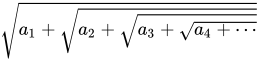
converges if and only if
{\displaystyle {\overline {\lim }}(\log a_{n})/2^{n}<+\infty ,}

where {\displaystyle {\overline {\lim }}} denotes the limit superior.

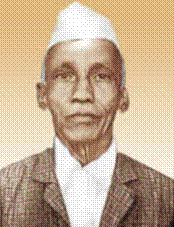
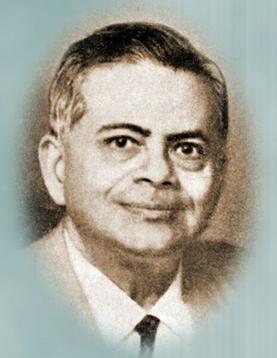
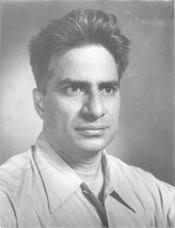
Damodar Dharmananda Kosambi
Damodar Dharmananda Kosambi (31 July 1907 – 29 June 1966) was an Indian mathematician, statistician, philologist, historian and polymath who contributed to genetics by introducing Kosambi map function.[1] He is well known for his work in numismaticsand for compiling critical editions of ancient Sanskrit texts. His father, Dharmananda Damodar Kosambi, had studied ancient Indian texts with a particular emphasis on Buddhism and its literature in the Pali language. Damodar Kosambi emulated him by developing a keen interest in his country's ancient history. Kosambi was also a Marxist historian specialising in ancient India who employed the historical materialist approach in his work.[2] He is particularly known for his classic work An Introduction to the Study of Indian History.
He is described as "the patriarch of the Marxist school of Indian historiography".[2] Kosambi was critical of the policies of then prime minister Jawaharlal Nehru, which, according to him, promoted capitalism in the guise of democratic socialism. He was an enthusiast of the Chinese revolution and its ideals, and, in addition, a leading activist in the World Peace Movement.
Early life
After a few years of schooling in India, in 1918, Damodar and his elder sister, Manik travelled to Cambridge, Massachusetts with their father, the eminent Buddhist and Palischolar, Dharmananda Damodar Kosambi. The latter was tasked by Professor Charles Rockwell Lanman of Harvard University to complete compiling a critical edition of Visuddhimagga, a book on Buddhist philosophy, which was originally started by Henry Clarke Warren. There, the young Damodar spent a year in a Grammar school and then was admitted to the Cambridge High and Latin School in 1920. He became a member of the Cambridge branch of American Boy Scouts.
It was in Cambridge that he befriended another prodigy of the time, Norbert Wiener, whose father Leo Wiener was the elder Kosambi's colleague at Harvard University.
Kosambi excelled in his final school examination and was one of the few candidates who was exempt on the basis of merit from necessarily passing an entrance examination essential at the time to gain admission to Harvard University. He enrolled in Harvard in 1924, but eventually postponed his studies, and returned to India. He stayed with his father who was now working in the Gujarat University, and was in the close circles of Mahatma Gandhi.
In January 1926, Kosambi returned to the US with his father, who once again studied at Harvard University for a year and half. Kosambi studied mathematics under George David Birkhoff, who wanted him to concentrate on mathematics, but the ambitious Kosambi instead took many diverse courses excelling in each of them. In 1929, Harvard awarded him the Bachelor of Arts degree with a summa cum laude. He was also granted membership to the esteemed Phi Beta Kappa Society, the oldest undergraduate honours organisation in the United States. He returned to India soon after.
Banaras and Aligarh
He obtained the post of professor at the Banaras Hindu University (BHU), teaching German alongside mathematics. He struggled to pursue his research on his own, and published his first research paper, "Precessions of an Elliptic Orbit" in the Indian Journal of Physics in 1930.
In 1931, Kosambi married Nalini from the wealthy Madgaonkar family. It was in this year that he was hired by mathematician André Weil, then Professor of Mathematics at Aligarh Muslim University, to the post of lecturership in mathematics at Aligarh.[3] His other colleagues at Aligarh included Vijayraghavan. During his two years stay in Aligarh, he produced eight research papers in the general area of Differential Geometry and Path Spaces. His fluency in several European languages allowed him to publish some of his early papers in French, Italian and German journals in their respective languages.
Fergusson College, Pune
Marxism cannot, even on the grounds of political expediency or party solidarity, be reduced to a rigid formalism like mathematics. Nor can it be treated as a standard technique such as work on an automatic lathe. The material, when it is present in human society, has endless variations; the observer is himself part of the observed population, with which he interacts strongly and reciprocally. This means that the successful application of the theory needs the development of analytical power, the ability to pick out the essential factors in a given situation. This cannot be learned from books alone. The one way to learn it is by constant contact with the major sections of the people. For an intellectual, this means at least a few months spent in manual labour, to earn his livelihood as a member of the working class; not as a superior being, nor as a reformist, nor as a sentimental "progressive" visitor to the slums. The experience gained from living with worker and peasant, as one of them, has then to be consistently refreshed and regularly evaluated in the light of one's reading. For those who are prepared to do this, these essays might provide some encouragement, and food for thought.
— From Exasperating Essays: Exercises in Dialectical Method(1957)
In 1933, he joined the Deccan Education Society's Fergusson College in Pune, where he taught mathematics for the next 12 years. In 1935, his eldest daughter, Maya was born, while in 1939, the youngest, Meera.
In Pune, while teaching mathematics and conducting research in the field, he started his interdisciplinary pursuit. In 1944 he published a small article of 4 pages titled 'The Estimation of Map Distance from Recombination Values' in Annals of Eugenics, in which he introduced what later came to be known as Kosambi map function.
One of the most important contributions of Kosambi to statistics is the widely known technique called proper orthogonal decomposition (POD). Although it was originally developed by Kosambi in 1943, it is now referred to as the Karhunen–Loève expansion. In the 1943 paper entitled 'Statistics in Function Space' presented in the Journal of the Indian Mathematical Society, Kosambi presented the Proper Orthogonal Decomposition some years before Karhunen (1945) and Loeve (1948). This tool has found application to such diverse fields as image processing, signal processing, data compression, oceanography, chemical engineering and fluid mechanics. Unfortunately this most important contribution of his is barely acknowledged in most papers that utilise the POD method. In recent years though, some authors have indeed referred to it as the Kosambi-Karhunen-Loeve decomposition.[4]
It was his studies in numismatics that initiated him into the field of historical research. He did extensive research in difficult science of numismatics. His evaluation of data was by modern statistical methods.[5] He made a thorough study of Sanskrit and ancient literature, and he started his classic work on the ancient poet Bhartṛhari. He published his critical editions of Bhartrihari's Śatakatraya and Subhashitas during 1945–1948.
It was during this period that he started his political activism, coming close to the radical streams in the ongoing Independence movement, especially the Communist Party of India. He became an outspoken Marxist and wrote some political articles.
Tata Institute of Fundamental Research
In 1945, Homi J. Bhabha invited Kosambi to join the Tata Institute of Fundamental Research (TIFR) as Professor of Mathematics, which he accepted. After independence, in 1948–49 he was sent to England and to the USA as a UNESCO Fellow to study the theoretical and technical aspects of computing machines. In London, he started his long-lasting friendship with Indologist and historian A.L. Basham. In the spring semester of 1949, he was a visiting professor of geometry in the Mathematics Department at the University of Chicago, where his colleague from his Harvard days, Marshall Harvey Stone, was the chair. In April–May 1949, he spent nearly two months at the Institute for Advanced Study in Princeton, New Jersey, discussing with such illustrious physicists and mathematicians as J. Robert Oppenheimer, Hermann Weyl, John von Neumann, Marston Morse, Oswald Veblen and Carl Ludwig Siegel amongst others.
After his return to India, in the Cold War circumstances, he was increasingly drawn into the World Peace Movement and served as a Member of the World Peace Council. He became a tireless crusader for peace, campaigning against the nuclearisation of the world. Kosambi's solution to India's energy needs was in sharp conflict with the ambitions of the Indian ruling class. He proposed alternative energy sources, like solar power. His activism in the peace movement took him to Beijing, Helsinki and Moscow. However, during this period he relentlessly pursued his diverse research interests, too. Most importantly, he worked on his Marxist rewriting of ancient Indian history, which culminated in his book, An Introduction to the Study of Indian History (1956).
He visited China many times during 1952–62 and was able to watch the Chinese revolution very closely, making him critical of the way modernisation and development were envisaged and pursued by the Indian ruling classes. All these contributed to straining his relationship with the Indian government and Bhabha, eventually leading to Kosambi's exit from the Tata Institute of Fundamental Research in 1962.
Post-TIFR days
His exit from the TIFR gave Kosambi the opportunity to concentrate on his research in ancient Indian history culminating in his book, The Culture and Civilisation of Ancient India, which was published in 1965 by Routledge, Kegan & Paul. The book was translated into German, French and Japanese and was widely acclaimed. He also utilised his time in archaeological studies, and contributed in the field of statistics and number theory. His article on numismatics was published in February 1965 in Scientific American.
Due to the efforts of his friends and colleagues, in June 1964, Kosambi was appointed as a Scientist Emeritus of the Council of Scientific and Industrial Research (CSIR) affiliated with the Maharashtra Vidnyanvardhini in Pune. He pursued many historical, scientific and archaeological projects (even writing stories for children). But most works he produced in this period could not be published during his lifetime. On 29 June 1966, he died in Pune. He was posthumously decorated with the Hari Om Ashram Award by the government of India's University Grant Commission in 1980.
His friend A.L. Basham, a well-known indologist, wrote in his obituary:
At first it seemed that he had only three interests, which filled his life to the exclusion of all others — ancient India, in all its aspects, mathematics and the preservation of peace. For the last, as well as for his two intellectual interests, he worked hard and with devotion, according to his deep convictions. Yet as one grew to know him better one realized that the range of his heart and mind was very wide...In the later years of his life, when his attention turned increasingly to anthropology as a means of reconstructing the past, it became more than ever clear that he had a very deep feeling for the lives of the simple people of Maharashtra.[6]
Kosambi's historiography

Cover of An Introduction to the Study of Indian History
Certain opponents of Marxism dismiss it as an outworn economic dogma based upon 19th century prejudices. Marxism never was a dogma. There is no reason why its formulation in the 19th century should make it obsolete and wrong, any more than the discoveries of Gauss, Faraday and Darwin, which have passed into the body of science... The defense generally given is that the Gita and the Upanishadsare Indian; that foreign ideas like Marxism are objectionable. This is generally argued in English the foreign language common to educated Indians; and by persons who live under a mode of production (the bourgeois system forcibly introduced by the foreigner into India.) The objection, therefore seems less to the foreign origin than to the ideas themselves which might endanger class privilege. Marxism is said to be based upon violence, upon the class-war in which the very best people do not believe nowadays. They might as well proclaim that meteorology encourages storms by predicting them. No Marxist work contains incitement to war and specious arguments for senseless killing remotely comparable to those in the divine Gita.
— From Exasperating Essays: Exercises in Dialectical Method (1957)
As a historian, Kosambi revolutionised Indian historiography with his realistic and scientific approach. He understood history in terms of the dynamics of socio-economic formations rather than just a chronological narration of "episodes" or the feats of a few great men – kings, warriors or saints. In the very first paragraph of his classic work, An Introduction to the Study of Indian History, he gives an insight into his methodology as a prelude to his life work on ancient Indian history:
"The light-hearted sneer “India has had some episodes, but no history“ is used to justify lack of study, grasp, intelligence on the part of foreign writers about India’s past. The considerations that follow will prove that it is precisely the episodes — lists of dynasties and kings, tales of war and battle spiced with anecdote, which fill school texts — that are missing from Indian records. Here, for the first time, we have to reconstruct a history without episodes, which means that it cannot be the same type of history as in the European tradition."[7]
According to A. L. Basham, "An Introduction to the Study of Indian History is in many respects an epoch making work, containing brilliantly original ideas on almost every page; if it contains errors and misrepresentations, if now and then its author attempts to force his data into a rather doctrinaire pattern, this does not appreciably lessen the significance of this very exciting book, which has stimulated the thought of thousands of students throughout the world."[6]
Professor Sumit Sarkar says: "Indian Historiography, starting with D.D. Kosambi in the 1950s, is acknowledged the world over – wherever South Asian history is taught or studied – as quite on a par with or even superior to all that is produced abroad. And that is why Irfan Habib or Romila Thapar or R.S. Sharma are figures respected even in the most diehard anti-Communist American universities. They cannot be ignored if you are studying South Asian history."[8]
In his obituary of Kosambi published in Nature, J. D. Bernal had summed up Kosambi's talent as follows: "Kosambi introduced a new method into historical scholarship, essentially by application of modern mathematics. By statistical study of the weights of the coins, Kosambi was able to establish the amount of time that had elapsed while they were in circulation and so set them in order to give some idea of their respective ages."
Legacy
Kosambi is an inspiration to many across the world, especially to Sanskrit philologists[9] and Marxist scholars. He is one of the few along with James Mill and Vincent Smith, who has so deeply influenced the writing of Indian history.[10] The Government of Goa has instituted the annual D.D. Kosambi Festival of Ideas since February 2008 to commemorate his birth centenary.[11]
Historian Irfan Habib said, "D. D. Kosambi and R.S. Sharma, together with Daniel Thorner, brought peasants into the study of Indian history for the first time."[12]
Kosambi was an atheist.[13]
India Post issued a commemorative postage stamp on 31 July 2008 to honour Kosambi.[14][15]
Books by D.D. Kosambi
Works on history and society
- 1956 An Introduction to the Study of Indian History (Popular Book Depot, Bombay)
- 1957 Exasperating Essays: Exercise in the Dialectical Method (People's Book House, Poona)
- 1962 Myth and Reality: Studies in the Formation of Indian Culture (Popular Prakashail, Bombay)
- 1965 The Culture and Civilisation of Ancient India in Historical Outline (Routledge & Kegan Paul, London)
- 1981 Indian Numismatics (Orient Blackswan, New Delhi)
- 2002 D.D. Kosambi: Combined Methods in Indology and Other Writings – Compiled, edited and introduced by Brajadulal Chattopadhyaya (Oxford University Press, New Delhi). Pdf on archive.org
- 2009 The Oxford India Kosambi – Compiled, edited and introduced by Brajadulal Chattopadhyaya (Oxford University Press, New Delhi)
- 2014 Unsettling The Past, edited by Meera Kosambi (Permanent Black, Ranikhet)
- 2016 Adventures into the Unknown: Essays, edited by Ram Ramaswamy (Three Essays Collective, New Delhi)
Edited works
- 1945 The Satakatrayam of Bhartrhari with the Comm. of Ramarsi, edited in collaboration with Pt. K. V. Krishnamoorthi Sharma (Anandasrama Sanskrit Series, No.127, Poona)
- 1946 The Southern Archetype of Epigrams Ascribed to Bhartrhari (Bharatiya Vidya Series 9, Bombay) (First critical edition of a Bhartrhari recension.)
- 1948 The Epigrams Attributed to Bhartrhari (Singhi Jain Series 23, Bombay) (Comprehensive edition of the poet's work remarkable for rigorous standards of text criticism.)
- 1952 The Cintamani-saranika of Dasabala; Supplement to Journal of Oriental Research, xix, pt, II (Madras) (A Sanskrit astronomical work which shows that King Bhoja of Dhara died in 1055–56.)
- 1957 The Subhasitaratnakosa of Vidyakara, edited in collaboration with V.V. Gokhale (Harvard Oriental Series 42)
Mathematical and scientific publications
In addition to the papers listed below, Kosambi wrote two books in mathematics, the manuscripts of which have not been traced. The first was a book on path geometry that was submitted to Marston Morse in the mid-1940s and the second was on prime numbers, submitted shortly before his death. Unfortunately, neither book was published. The list of articles below is complete but does not include his essays on science and scientists, some of which have appeared in the collection Science, Society, and Peace(People's Publishing House, 1995). Four articles (between 1962 and 1965) are written under the pseudonym S. Ducray.
- 1930 Precessions of an elliptical orbit, Indian Journal of Physics, 5, 359–364
- 1931 On a generalization of the second theorem of Bourbaki, Bulletin of the Academy of Sciences, U. P., 1, 145–147
- 1932 Modern differential geometries, Indian Journal of Physics, 7, 159–164
- 1932 On differential equations with the group property, Journal of the Indian Mathematical Society, 19, 215–219
- 1932 Geometrie differentielle et calcul des variations, Rendiconti della Reale Accademia Nazionale dei Lincei, 16, 410–415 (in French)
- 1932 On the existence of a metric and the inverse variational problem, Bulletin of the Academy of Sciences, U. P., 2, 17–28
- 1932 Affin-geometrische Grundlagen der Einheitlichen Feld–theorie, Sitzungsberichten der Preussische Akademie der Wissenschaften, Physikalisch-mathematische klasse, 28, 342–345 (in German)
- 1933 Parallelism and path-spaces, Mathematische Zeitschrift, 37, 608–618
- 1933 Observations sur le memoire precedent, Mathematische Zeitschrift, 37, 619–622 (in French)
- 1933 The problem of differential invariants, Journal of the Indian Mathematical Society, 20, 185–188
- 1933 The classification of integers, Journal of the University of Bombay, 2, 18–20
- 1934 Collineations in path-space, Journal of the Indian Mathematical Society, 1, 68–72
- 1934 Continuous groups and two theorems of Euler, The Mathematics Student, 2, 94–100
- 1934 The maximum modulus theorem, Journal of the University of Bombay, 3, 11–12
- 1935 Homogeneous metrics, Proceedings of the Indian Academy of Sciences, 1, 952–954
- 1935 An affine calculus of variations, Proceedings of the Indian Academy of Sciences, 2, 333–335
- 1935 Systems of differential equations of the second order, Quarterly Journal of Mathematics (Oxford), 6, 1–12
- 1936 Differential geometry of the Laplace equation, Journal of the Indian Mathematical Society, 2, 141–143
- 1936 Path-spaces of higher order, Quarterly Journal of Mathematics (Oxford), 7, 97–104
- 1936 Path-geometry and cosmogony, Quarterly Journal of Mathematics (Oxford), 7, 290–293
- 1938 Les metriques homogenes dans les espaces cosmogoniques, Comptes rendus de l’Acad ́emie des Sciences, 206, 1086–1088 (in French)
- 1938 Les espaces des paths generalises qu’on peut associer avec un espace de Finsler, Comptes rendus de l’Acad ́emie des Sciences, 206, 1538–1541 (in French)
- 1939 The tensor analysis of partial differential equations, Journal of the Indian Mathematical Society, 3, 249–253 (1939); Japanese version of this article in Tensor, 2, 36–39
- 1940 A statistical study of the weights of the old Indian punch-marked coins, Current Science, 9, 312–314
- 1940 On the weights of old Indian punch-marked coins, Current Science, 9, 410–411
- 1940 Path-equations admitting the Lorentz group, Journal of the London Mathematical Society, 15, 86–91
- 1940 The concept of isotropy in generalized path-spaces, Journal of the Indian Mathematical Society, 4, 80–88
- 1940 A note on frequency distribution in series, The Mathematics Student, 8, 151–155
- 1941 A bivariate extension of Fisher’s Z–test, Current Science, 10, 191–192
- 1941 Correlation and time series, Current Science, 10, 372–374
- 1941 Path-equations admitting the Lorentz group–II, Journal of the Indian Mathematical Society, 5, 62–72
- 1941 On the origin and development of silver coinage in India, Current Science, 10, 395–400
- 1942 On the zeros and closure of orthogonal functions, Journal of the Indian Mathematical Society, 6, 16–24
- 1942 The effect of circulation upon the weight of metallic currency, Current Science, 11, 227–231
- 1942 A test of significance for multiple observations, Current Science, 11, 271–274
- 1942 On valid tests of linguistic hypotheses, New Indian Antiquary, 5, 21–24
- 1943 Statistics in function space, Journal of the Indian Mathematical Society, 7, 76–88
- 1944 The estimation of map distance from recombination values, Annals of Eugenics, 12, 172–175
- 1944 Direct derivation of Balmer spectra, Current Science, 13, 71–72
- 1944 The geometric method in mathematical statistics, American Mathematical Monthly, 51, 382–389
- 1945 Parallelism in the tensor analysis of partial differential equations, Bulletin of the American Mathematical Society, 51, 293–296
- 1946 The law of large numbers, The Mathematics Student, 14, 14–19
- 1946 Sur la differentiation covariante, Comptes rendus de l’Acad ́emie des Sciences, 222, 211–213 (in French)
- 1947 An extension of the least–squares method for statistical estimation, Annals of Eugenics, 18, 257–261
- 1947 Possible Applications of the Functional Calculus, Proceedings of the 34th Indian Science Congress. Part II: Presidential Addresses, 1–13
- 1947 Les invariants differentiels d’un tenseur covariant a deux indices, Comptes rendus de l’Acad ́emie des Sciences, 225, 790–92
- 1948 Systems of partial differential equations of the second order, Quarterly Journal of Mathematics (Oxford), 19, 204–219
- 1949 Characteristic properties of series distributions, Proceedings of the National Institute of Science of India, 15, 109–113
- 1949 Lie rings in path-space, Proceedings of the National Academy of Sciences (USA), 35, 389–394
- 1949 The differential invariants of a two-index tensor, Bulletin of the American Mathematical Society, 55, 90–94
- 1951 Series expansions of continuous groups, Quarterly Journal of Mathematics (Oxford, Series 2), 2, 244–257
- 1951 Seasonal variations in the Indian birth–rate, Annals of Eugenics, 16, 165–192 (with S. Raghavachari)
- 1952 Path-spaces admitting collineations, Quarterly Journal of Mathematics (Oxford, Series 2), 3, 1–11
- 1952 Path-geometry and continuous groups, Quarterly Journal of Mathematics (Oxford, Series 2), 3, 307–320
- 1954 Seasonal variations in the Indian death–rate, Annals of Human Genetics, 19, 100–119 (with S. Raghavachari)
- 1954 The metric in path-space, Tensor (New Series), 3, 67–74
- 1957 The method of least–squares, Advancement in Mathematics, 3, 485–491 (in Chinese)
- 1958 Classical Tauberian theorems, Journal of the Indian Society of Agricultural Statistics, 10, 141–149
- 1958 The efficiency of randomization by card–shuffling, Journal of the Royal Statistics Society, 121, 223–233 (with U. V. R. Rao)
- 1959 The method of least–squares, Journal of the Indian Society of Agricultural Statistics, 11, 49–57
- 1959 An application of stochastic convergence, Journal of the Indian Society of Agricultural Statistics, 11, 58–72
- 1962 A note on prime numbers, Journal of the University of Bombay, 31, 1–4 (as S. Ducray)
- 1963 The sampling distribution of primes, Proceedings of the National Academy of Sciences (USA), 49, 20–23
- 1963 Normal Sequences, Journal of the University of Bombay, 32, 49–53 (as S. Ducray)
- 1964 Statistical methods in number theory, Journal of the Indian Society of Agricultural Statistics, 16, 126–135
- 1964 Probability and prime numbers, Proceedings of the Indian Academy of Sciences, 60, 159–164 (as S. Ducray)
- 1965 The sequence of primes, Proceedings of the Indian Academy of Sciences, 62, 145–149 (as S. Ducray)
- 1966 Numismatics as a Science, Scientific American, February 1966, pages 102–111
- 2016 Selected Works in Mathematics and Statistics, ed. Ramakrishna Ramaswamy, Springer. (Posthumous publication)
Subrahmanyan Chandrasekhar
Subrahmanyan Chandrasekhar FRS PV[1] (/ˌtʃʌndrəˈʃeɪkər/ ( listen); 19 October 1910 – 21 August 1995),[3] was an Indian Americanastrophysicist who spent his professional life in the United States.[4] He was awarded the 1983 Nobel Prize for Physics with William A. Fowler for "...theoretical studies of the physical processes of importance to the structure and evolution of the stars". His mathematical treatment of stellar evolution yielded many of the best current theoretical models of the later evolutionary stages of massive stars and black holes.[5][6] The Chandrasekhar limit is named after him.
Chandrasekhar worked on a wide variety of physical problems in his lifetime, contributing to the contemporary understanding of stellar structure, white dwarfs, stellar dynamics, stochastic process, radiative transfer, the quantum theory of the hydrogen anion, hydrodynamic and hydromagnetic stability, turbulence, equilibrium and the stability of ellipsoidal figures of equilibrium, general relativity, mathematical theory of black holes and theory of colliding gravitational waves.[7] At the University of Cambridge, he developed a theoretical model explaining the structure of white dwarf stars that took into account the relativistic variation of mass with the velocities of electrons that comprise their degenerate matter. He showed that the mass of a white dwarf could not exceed 1.44 times that of the Sun – the Chandrasekhar limit. Chandrasekhar revised the models of stellar dynamics first outlined by Jan Oort and others by considering the effects of fluctuating gravitational fields within the Milky Way on stars rotating about the galactic centre. His solution to this complex dynamical problem involved a set of twenty partial differential equations, describing a new quantity he termed ‘dynamical friction’, which has the dual effects of decelerating the star and helping to stabilize clusters of stars. Chandrasekhar extended this analysis to the interstellar medium, showing that clouds of galactic gas and dust are distributed very unevenly.
Chandrasekhar studied at Presidency College, Madras (now Chennai) and the University of Cambridge. A long-time professor at the University of Chicago, he did some of his studies at the Yerkes Observatory, and served as editor of The Astrophysical Journal from 1952 to 1971. He was on the faculty at Chicago from 1937 until his death in 1995 at the age of 84, and was the Morton D. HullDistinguished Service Professor of Theoretical Astrophysics.[8]
Chandrasekhar married Lalitha Doraiswamy in September 1936. He had met her as a fellow student at Presidency College, Madras. Chandrasekhar was the nephew of C. V. Raman, who was awarded the Nobel Prize for Physics in 1930. He became a naturalized citizen of the U.S. in 1953. Others considered him as warm, positive, generous, unassuming, meticulous, and open to debate, as well as private, intimidating, impatient, and stubborn regarding non-scientific matters,[4] and unforgiving to those who ridiculed his work.[
Early life and education
Chandrasekhar was born on 19 October 1910 in Lahore, Punjab, British India (now Pakistan) in a Brahmin family, to Sitalakshmi (Divan Bahadur) Balakrishnan (1891–1931) and Chandrasekhara Subrahmanya Ayyar (1885–1960)[10] who was stationed in Lahore as Deputy Auditor General of the Northwestern Railways at the time of Chandrasekhar's birth. He had two elder sisters, Rajalakshmi and Balaparvathi, three younger brothers, Vishwanathan, Balakrishnan, and Ramanathan and four younger sisters, Sarada, Vidya, Savitri, and Sundari. His paternal uncle was the Indian physicist and Nobel laureate C. V. Raman. His mother was devoted to intellectual pursuits, had translated Henrik Ibsen's A Doll's House into Tamil and is credited with arousing Chandra's intellectual curiosity at an early age[11]. The family moved from Lahore to Allahabad in 1916, and finally settled in Madras in 1918.
Chandrasekhar was tutored at home until the age of 12[11]. In middle school his father would teach him Mathematics and Physics and his mother would teach him Tamil. He later attended the Hindu High School, Triplicane, Madras during the years 1922–25. Subsequently, he studied at Presidency College, Madras from 1925 to 1930, writing his first paper, "The Compton Scattering and the New Statistics", in 1929 after being inspired by a lecture by Arnold Sommerfeld. He obtained his bachelor's degree, B.Sc. (Hon.), in physics, in June 1930. In July 1930, Chandrasekhar was awarded a Government of India scholarship to pursue graduate studies at the University of Cambridge, where he was admitted to Trinity College, Cambridge, secured by R. H. Fowler with whom he communicated his first paper. During his travels to England, Chandrasekhar spent his time working out the statistical mechanics of the degenerate electron gas in white dwarf stars, providing relativistic corrections to Fowler's previous work (see Legacy below).
In his first year at Cambridge, as a research student of Fowler, Chandrasekhar spent his time calculating mean opacities and applying his results to the construction of an improved model for the limiting mass of the degenerate star. At the meetings of the Royal Astronomical Society, he met E. A. Milne. At the invitation of Max Born he spent the summer of 1931, his second year of post-graduate studies, at Born’s institute at Göttingen, working on opacities, atomic absorption coefficients, and model stellar photospheres. On the advice of P. A. M. Dirac, he spent his final year of graduate studies at the Institute for Theoretical Physics in Copenhagen, where he met Niels Bohr.
After receiving a bronze medal for his work on degenerate stars, in the summer of 1933, Chandrasekhar was awarded his PhD degree at Cambridge with a thesis among his four papers on rotating self-gravitating polytropes, and the following October, he was elected to a Prize Fellowship at Trinity College for the period 1933–1937.
During this time, Chandrasekhar made acquaintance with British physicist Sir Arthur Eddington. In an infamous encounter at the Royal Astronomical Society in London in 1935, Eddington publicly ridiculed the concept of the Chandrasekhar limit[11]. Although Eddington would later be proved wrong by computers and the first positive identification of a black hole in 1972, this encounter caused Chandrasekhar to contemplate employment outside the UK. Later in life, on multiple occasions, Chandrasekhar expressed the view that Eddington's behavior was in part racially motivated.[12]
Career and research
Early career
In January 1937, Chandrasekhar was recruited to the University of Chicago faculty as assistant professor by Otto Struve and President Robert Maynard Hutchins. He was to remain at the university for his entire career, becoming Morton D. Hull Distinguished Service Professor of Theoretical Astrophysics in 1952 and attaining emeritus status in 1985. In 1953, he and his wife took American citizenship.[13] Famously, Chandrasekhar declined many offers from other universities, including one to succeed Henry Norris Russell, the preeminent American astronomer, as director of the Princeton University Observatory.
Chandrasekhar did some work at Yerkes Observatory in Williams Bay, Wisconsin, which was run by the University of Chicago. After the Laboratory for Astrophysics and Space Research (LASR) was built by NASA in 1966 at the University, Chandrasekhar occupied one of the four corner offices on the second floor. (The other corners housed John A. Simpson, Peter Meyer, and Eugene N. Parker.) Chandrasekhar lived at 4800 Lake Shore Drive after the high-rise apartment complex was built in the late 1960s, and later at 5550 Dorchester Building.
World War II
During World War II, Chandrasekhar worked at the Ballistic Research Laboratory at the Aberdeen Proving Ground in Maryland. While there, he worked on problems of ballistics, resulting in reports such as 1943's On the decay of plane shock waves and The normal reflection of a blast wave.[7] Chandrasekhar's expertise in hydrodynamics led Robert Oppenheimer to invite him to join the Manhattan Project at Los Alamos, but delays in the processing of his security clearance prevented him from contributing to the project. It has been rumoured that he visited the Calutron project, where he suggested that young women be employed to operate the calutrons producing enriched radioactive materials for the atomic weapons.
Philosophy of systematization
He wrote that his scientific research was motivated by his desire to participate in the progress of different subjects in science to the best of his ability, and that the prime motive underlying his work was systematization. "What a scientist tries to do essentially is to select a certain domain, a certain aspect, or a certain detail, and see if that takes its appropriate place in a general scheme which has form and coherence; and, if not, to seek further information which would help him to do that." [14]
Chandrasekhar developed a unique style of mastering several fields of physics and astrophysics; consequently, his working life can be divided into distinct periods. He would exhaustively study a specific area, publish several papers in it and then write a book summarizing the major concepts in the field. He would then move on to another field for the next decade and repeat the pattern. Thus he studied stellar structure, including the theory of white dwarfs, during the years 1929 to 1939, and subsequently focused on stellar dynamics, theory of Brownian motion from 1939 to 1943. Next, he concentrated on the theory of radiative transfer and the quantum theory of the negative ion of hydrogen from 1943 to 1950. This was followed by sustained work on hydrodynamic and hydromagnetic stability from 1950 to 1961. In the 1960s, he studied the equilibrium and the stability of ellipsoidal figures of equilibrium, and also general relativity. During the period, 1971 to 1983 he studied the mathematical theory of black holes, and, finally, during the late 80s, he worked on the theory of colliding gravitational waves.[7]
Work with students
Chandra worked closely with his students and expressed pride in the fact that over a 50-year period (from roughly 1930 to 1980), the average age of his co-author collaborators had remained the same, at around 30. He insisted that students address him as "Chandrasekhar" until they received their Ph.D. degree, after which time they (as other colleagues) were encouraged to address him as "Chandra". When Chandrasekhar was working at the Yerkes Observatory in 1940s, he would drive 150 miles to and fro every weekend to teach a course at University of Chicago. Two of the students who took the course, Tsung-Dao Lee and Chen-Ning Yang, won the Nobel prize before he could get one for himself. Regarding classroom interactions during his lectures, noted astrophysicist Carl Sagan stated from firsthand experience that “frivolous questions” from unprepared students were “dealt with in the manner of a summary execution”, while questions of merit “were given serious attention and response”.[4]
Other activities
From 1952 to 1971 Chandrasekhar was editor of The Astrophysical Journal.[15] During the years 1990 to 1995, Chandrasekhar worked on a project devoted to explaining the detailed geometric arguments in Sir Isaac Newton's Philosophiae Naturalis Principia Mathematica using the language and methods of ordinary calculus. The effort resulted in the book Newton's Principia for the Common Reader, published in 1995. Chandrasekhar was an honorary member of the International Academy of Science.[citation needed]
Personal life
Chandrasekhar died of a sudden heart attack at the University of Chicago Hospital in 1995, having survived a prior heart attack in 1975.[4] He was survived by his wife, Lalitha Chandrasekhar, who died on 2 September 2013 at the age of 102.[16] In the Biographical Memoirs of the Fellows of the Royal Society of London, R. J. Tayler wrote: "Chandrasekhar was a classical applied mathematician whose research was primarily applied in astronomy and whose like will probably never be seen again."[1] He was a serious student of literature and western classical music.[9]
Religious view
Once when involved in a discussion about the Gita, Chandrashekhar said, "I should like to preface my remarks with a personal statement in order that my later remarks will not be misunderstood. I consider myself an atheist."[17] This was also confirmed many times in his other talks.[18] In an interview with Kevin Krisciunas at the University of Chicago, on 6 October 1987, Chandrasekhar commented: "Of course, he (Otto Struve) knew I was an atheist, and he never brought up the subject with me".[19]
Awards, honours and legacy
Nobel prize
Chandrasekhar was awarded the Nobel Prize in Physics in 1983 for his studies on the physical processes important to the structure and evolution of stars. Chandrasekhar accepted this honor, but was upset the citation mentioned only his earliest work, seeing it as a denigration of a lifetime's achievement. He shared it with William A. Fowler.
Other awards

An exhibition on life and works of Subrahmanyan Chandrasekhar was held at Science City, Kolkata, on January, 2011.
- Elected a Fellow of the Royal Society (FRS) in 1944[1]
- Henry Norris Russell Lectureship (1949)[20]
- Bruce Medal (1952)[21]
- Gold Medal of the Royal Astronomical Society (1953)[22]
- Rumford Prize of the American Academy of Arts and Sciences (1957)[23]
- National Medal of Science, USA (1966)[24]
- Padma Vibhushan (1968)
- Henry Draper Medal of the National Academy of Sciences (1971)[25]
- Copley Medal of the Royal Society (1984)
- Honorary Fellow of the International Academy of Science (1988)[citation needed]
- Gordon J. Laing Award (1989)
- Jansky Lectureship before the National Radio Astronomy Observatory
- Humboldt Prize[when?]
Legacy
Chandrasekhar's most notable work was the astrophysical Chandrasekhar limit. The limit describes the maximum mass of a white dwarf star, ~1.44 solar masses, or equivalently, the minimum mass which must be exceeded for a star to ultimately collapse into a neutron star or black hole (following a supernova). The limit was first calculated by Chandrasekhar in 1930 during his maiden voyage from India to Cambridge, England for his graduate studies. In 1979, NASA named the third of its four "Great Observatories" after Chandrasekhar. This followed a naming contest which attracted 6,000 entries from fifty states and sixty-one countries. The Chandra X-ray Observatory was launched and deployed by Space Shuttle Columbia on 23 July 1999. The Chandrasekhar number, an important dimensionless number of magnetohydrodynamics, is named after him. The asteroid 1958 Chandra is also named after Chandrasekhar.
Chandra Astrophysics Institute (CAI) is a program offered for high school students who are interested in astrophysics mentored by MIT scientists[26] sponsored by Chandra X-ray Observatory.[27] American astronomer Carl Sagan, who studied Mathematics under Chandrasekhar, at the University of Chicago, praised him in the book The Demon-Haunted World: "I discovered what true mathematical elegance is from Subrahmanyan Chandrasekhar." Chandrasekhar guided 50 students to their PhDs.[citation needed].
After his death, his widow Lalitha Chandrasekhar made a gift of his Nobel Prize money to the University of Chicago towards the establishment of the Subrahmanyan Chandrasekhar Memorial Fellowship. First awarded in the year 2000, each year, this fellowship is given to an outstanding applicant to graduate school in the Ph.D. programs of the Department of Physics or the Department of Astronomy and Astrophysics.[28]
On 19 October 2017, Google showed a Google Doodle in 28 countries honouring Chandrasekhar’s 107th birthday, and the Chandrasekhar limit.[29][30]
Publications
Books
- Chandrasekhar, S. (1958) [1939]. An Introduction to the Study of Stellar Structure. New York: Dover. ISBN 0-486-60413-6.
- Chandrasekhar, S. (2005) [1942]. Principles of Stellar Dynamics. New York: Dover. ISBN 0-486-44273-X.
- Chandrasekhar, S. (1947). Heywood, Robert B., ed. The Works of the Mind:The Scientist. Chicago: University of Chicago Press. pp. 159–179. OCLC 752682744.
- Chandrasekhar, S. (1960) [1950]. Radiative Transfer. New York: Dover. ISBN 0-486-60590-6.
- Chandrasekhar, S. (1975) [1960]. Plasma Physics. Chicago: The University of Chicago Press. ISBN 0-226-10084-7.
- Chandrasekhar, S. (1981) [1961]. Hydrodynamic and Hydromagnetic Stability. New York: Dover. ISBN 0-486-64071-X.
- Chandrasekhar, S. (1987) [1969]. Ellipsoidal Figures of Equilibrium. New York: Dover. ISBN 0-486-65258-0.
- Chandrasekhar, S. (1998) [1983]. The Mathematical Theory of Black Holes. New York: Oxford University Press. ISBN 0-19-850370-9.
- Chandrasekhar, S. (1983) [1983]. Eddington: The Most Distinguished Astrophysicist of His Time. Cambridge University Press. ISBN 9780521257466.
- Chandrasekhar, S. (1990) [1987]. Truth and Beauty. Aesthetics and Motivations in Science. Chicago: The University of Chicago Press. ISBN 0-226-10087-1.
- Chandrasekhar, S. (1995). Newton's Principia for the Common Reader. Oxford: Clarendon Press. ISBN 0-19-851744-0.
Notes
- Chandrasekhar, S. (1943). Stochastic Problems in Physics and Astronomy. Reviews of modern physics.
- Chandrasekhar, S. (1993). Classical general relativity. Royal Society.
- Chandrasekhar, S. (1979). The Role of General Relativity: Retrospect and Prospect. Proc. IAU Meeting.[31]
- Spiegel, E.A. (2011) [1954]. The Theory of Turbulence : Subrahmanyan Chandrasekhar's 1954 Lectures. Netherlands: Springer. ISBN 978-94-007-0117-5.
- Chandrasekhar, S. (1943). New methods in stellar dynamics. New York Academy of Sciences.
- Chandrasekhar, S. (1954). The illumination and polarization of the sunlit sky on Rayleigh scattering. American Philosophical Society.
- Chandrasekhar, S. (1983). On Stars, their evolution and their stability, Noble lecture. Stockholm: Noble Foundation.
- Chandrasekhar, S. (1981). New horizons of human knowledge: a series of public talks given at Unesco. Unesco Press.
- Chandrasekhar, S. (1975). Shakespeare, Newton, and Beethoven: Or, Patterns of Creativity. University of Chicago.
- Chandrasekhar, S. (1973). P.A.M. Dirac on his seventieth birthday. Contemporary Physics.[32]
- Chandrasekhar, S. (1995). Reminiscences and discoveries on Ramanujan's bust. Royal Society. ASIN B001B12NJ8.
- Chandrasekhar, S. (1990). How one may explore the physical content of the general theory of relativity. American Mathematical Society. ASIN B001B10QTM.
Journals
Chandrasekhar had published around 380 papers[33][34] in his lifetime. He wrote his first paper in 1928 when he was still an undergraduate student about Compton effect[35] and last paper which was accepted for publication just two months before his death was in 1995 which was about non-radial oscillation of star.[36] The University of Chicago Press published selected papers of Chandrasekhar in seven volumes.
- Chandrasekhar, S. (1989). Selected Papers, Vol 1, Stellar structure and stellar atmospheres. Chicago: University of Chicago Press. ISBN 9780226100890.
- Chandrasekhar, S. (1989). Selected Papers, Vol 2, Radiative transfer and negative ion of hydrogen. Chicago: University of Chicago Press. ISBN 9780226100920.
- Chandrasekhar, S. (1989). Selected Papers, Vol 3, Stochastic, statistical and hydromagnetic problems in Physics and Astronomy. Chicago: University of Chicago Press. ISBN 9780226100944.
- Chandrasekhar, S. (1989). Selected Papers, Vol 4, Plasma Physics, Hydrodynamic and Hydromagnetic stability, and applications of the Tensor-Virial theorem. Chicago: University of Chicago Press. ISBN 9780226100975.
- Chandrasekhar, S. (1990). Selected Papers, Vol 5, Relativistic Astrophysics. Chicago: University of Chicago Press. ISBN 9780226100982.
- Chandrasekhar, S. (1991). Selected Papers, Vol 6, The Mathematical Theory of Black Holes and of Colliding Plane Waves. Chicago: University of Chicago Press. ISBN 9780226101019.
- Chandrasekhar, S. (1997). Selected Papers, Vol 7, The non-radial oscillations of star in General Relativity and other writings. Chicago: University of Chicago Press. ISBN 9780226101040.
Books about Chandrasekhar
- Miller, Arthur I. (2005). Empire of the Stars: Friendship, Obsession, and Betrayal in the Quest for Black Holes. Boston: Houghton Mifflin. ISBN 0-618-34151-X.
- Srinivasan, G., ed. (1997). From White Dwarfs to Black Holes: The Legacy of S. Chandrasekhar. Chicago: The University of Chicago Press. ISBN 0-226-76996-8.
- Penrose, R. (1996). Chandrasekhar, Black Holes and Singularities. J. Astrophys. Astr.[37]
- Wali, Kameshwar C. (1991). Chandra: A Biography of S. Chandrasekhar. Chicago: The University of Chicago Press. ISBN 0-226-87054-5.
- Wali, Kameshwar C., ed. (1997). Chandrasekhar: The Man Behind the Legend - Chandra Remembered. London: imperial College Press. ISBN 1-86094-038-2.
- Wignesan, T., ed. (2004). The Man who Dwarfed the Stars. The Asianists' Asia. ISSN 1298-0358.
- Venkataraman, G. (1992). Chandrasekhar and His Limit. Hyderabad, India: Universities Press. ISBN 81-7371-035-X.
- Saikia, D J.; et al., eds. (2011). Fluid flows to Black Holes: A tribute to S Chandrasekhar on his birth centenary. Singapore: World Scientific Publishing Co. Ptd Ltd. ISBN 981-4299-57-X.
- Kameshwar, C Wali, ed. (2001). A Quest For Perspectives. Singapore: World Scientific Publishing Co. Ptd Ltd. ISBN 1-86094-201-6.
- Ramnath, Radhika, ed. (2012). S. Chandrasekhar: Man of Science. Harpercollins. ASIN B00C3EWIME.
- Kameshwar, C Wali, ed. (2011). A Scientific Autobiography: S Chandrasekhar. Singapore: World Scientific Publishing Co. Ptd Ltd. ISBN 981-4299-57-X.
- Salwi, Dilip, ed. (2004). S. Chandrasekhar: The scholar scientist. Rupa. ISBN 8129104911.
- Pandey, Rakesh Kumar, ed. (2017). Chandrasekhar Limit: Size of White Dwarfs. Lap Lambert Academic Publishing. ISBN 3330317663.
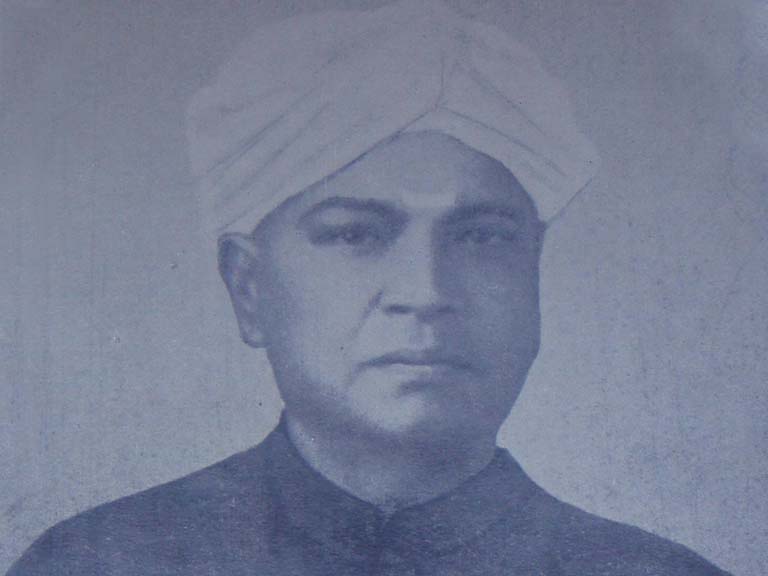
Rattan Chand
Dr. Rattan Chand (Hindi : डॉ रतन चन्द ) is a former senior bureaucrat who has served Government of India at various positions for more than 35 years. Apart from working at senior positions in Government of India he has also been a resource person to USAID, World Bank, International Monetary Fund (IMF), United Nations, World Health Organisation and many other organisations. He has represented Government of India at many International Meetings, Conferences, Working Sessions, Seminars worldwide mainly in the Health Sector. He is currently member of the working group of National Statistical Commission, Government of India and senior expert for World Bank.
Early life and education
Rattan Chand was born to a humble brahmin family. He was born on 10 May 1955 in a small village in Bilaspur district, Himachal Pradesh, India. His father Pandit Harsukh, had been a freedom fighter and then lived as a farmer for rest of his life . He received elementary education from a small govt school in Bilaspur (HP) and went on to get his matriculation from Government Senior Secondary School, Kiratpur Sahib. He did his Bachelors of Science (B.Sc.) from Punjabi University, Punjab. He did his Masters in Mathematics from Punjabi University, Punjab and then completed his Masters of Philosophy (M.Phil.) from Jawaharlal Nehru University, Delhi, New Delhi.

Dr. Rattan Chand at US Bureau of Census, Washington DC, USA on 20th May 1992
He later completed his Ph.D. in Demography from International Institute of Population Sciences. He is also an alumnus from US Bureau of Census. Dr Rattan Chand joined the Indian Civil Service at Group A level through Union Public Service Commission (UPSC) in 1982.
Career
Dr. Chand has reorganised the ‘Bulletin on Rural Health Statistics’ and updated it regularly. As a senior official in National Sample Survey Organisation, he handled important work of survey of unorganised sector enterprises and drafted the first ever survey report on ‘Informal Sector in India’. For better dissemination of the results, system of organising the National Seminars on survey results was introduced by him. As National Director & Convenor (PNDT) in the Ministry of Health and Family Welfare, he strengthened the programme implementation by involving all major stakeholders. For the first time, an annual report on implementation of Prenatal Diagnosis Techniques (PNDT) Act was prepared and released. A website giving information on the programme and activities undertaken was launched. While working in National Accounts Division, he developed a ‘Guide to Government Budget Analysis and Preparation of Accounts’ for the general government sector. As Chief Director, in the Ministry of Health and Family Welfare, under him, a Web based Health Management Information System (HMIS) was developed to increase the flow and use of information at all levels. Also, Annual Health Surveys were introduced under him to track changes in program and impact indicators in the poor performing districts. He contributed significantly to the launch of the fourth round of National Family Health Survey.

Dr. Rattan Chand, Chief Guest of 56th Convocation of International Institute of Population Sciences (IIPS), delivering convocation lecture on May 2014.
Dr Rattan Chand has been one of the key people involved in the National Family Health Surveys conducted by Government of India. While talking to New York Times, Dr. Chand said, “This round will provide both district and national level data because of a revamped format. The plan is to conduct such a survey every three years.” Dr. Chand also said that he wasn’t aware why the national survey had been delayed but explained that consultations had been under way for a while to come up with a new redesigned survey.[1] Dr. Rattan Chand had also said that the annual healthy survey (AHS) was being scrapped to avoid duplication. “There was no reason to carry multiple surveys to map the same indicators. It was thought to be better to have one comprehensive survey instead of four fragmented ones,the new version of NFHS will not compromise of any indicators that were mapped in other surveys. We have asked the census commissioner to come out with district-level infant, under-5 and maternal mortality once in three years.”[2]
Efforts Against Female Foeticide
Given the dismal Child Sex Ratio in the country, and the Supreme Court directive of 2003 to State governments to enforce the law banning the use of sex determination technologies, the Ministry set up a National Inspection and Monitoring Committee (NIMC) in October last. Dr. Rattan Chand, Director (PNDT) was made the convenor of the NIMC. The NIMC under the guidance of Dr. Rattan Chand conducted raids in some of the districts in Maharashtra, Punjab, Haryana, Himachal Pradesh, Delhi and Gujarat. In April, it conducted raids on three clinics in Delhi. In its reports sent to the Chief Secretaries of the respective States, the committee observed that the Authorities had failed to monitor or supervise the registered clinics.[3]
As Director (PNDT) & Convenor of PNDT Act, 1994, Dr. Chand raided many hospitals and clinic all over India and shut them down for running illegal Sex determination tests. Dr. Rattan Chand said that even if the NIMC conducted raids, it could only send a report to the highest levels in the State Government. It was up to the State authorities to act on it.[3]
Membership and Affiliations
- Member, Executive Council, Indian Association for Study of Population[4]
- Member, Working Group, National Statistical Commission, Government of India
- Member, Executive & General Council, International Institute for Population Sciences (IIPS), Mumbai, INDIA
- Member, Technical Advisory Committee, Annual Health Survey (AHS), Government of India
- Member, Technical Advisory Committee, District Level Household Survey (DLHS), Government of India
- Member, Technical Advisory Committee, National Family Health Survey (NFHS), Government of India
- Member, Technical Advisory Committee, Sample Registration System (SRS), Government of India
- Member, Technical Coordination Committee, Health Management information System (HMIS)
- Member, Technical Group on population projections, Government of India
- Member, Working Group on Survey of Health and Morbidity, National Sample Survey Organisation (NSSO), Government of India
- Member, Indian Association for Research in National Income and Wealth
- Former Convenor, National Inspection and Monitoring Committee, Ministry of Health and Family Welfare, Government of India
- Former Member, Governing Body, National Institute of Health & Family Welfare (NIHFW)
- Visiting Faculty, National Academy of Statistical Administration, Greater Noida, India
- Visiting Faculty, National Judicial Academy (India)
Important Publications
- ‘Quality of Life approach for identification of the poor’: Journal of Rural development, Vol.19, No.1, January – March 2004. ISSN 0970-3357
- ‘Socio-economic Dimensions of Unemployment in India’, The Indian Journal of Social Development, Vol.1.no.2.December-2004. ISSN 0972-3692
- ‘Inequality in Household Consumption in Indian States, 1973-2000’: Indian Journal of Millennium Development Studies, Vol.1.No.1.March-2006; ISSN 0973-3981
- ‘Incidence of Hunger in India, 1983-2002’. Paper Presented at the National Seminar on the Results of NSS 57th Round Survey Results, March 2004.
- ‘Health Implications of Poverty and Hunger’, INDIAN DEVELOPMENT REVIEW Vol.3.No.1,June 2005, ISSN 0972-9437
- ‘An Integrated Summary of the NSS 55th Round Consumer Expenditure Survey Results’, Published in ‘Sarvekshana’- Journal of National Sample Survey Organisation, 86thIssue,Vol.XIV, no.4 and XV, No.1.ISSN 2249-197X
- ‘An Integrated Summary of the NSS 55th Round Employment-Unemployment Survey Results’, Published in ‘Sarvekshana’ – Journal of National Sample Survey Organisation, 87th Issue, Vol. XV, no.2&3. ISSN 2249-197X
- ‘Population Change and Demand for Cereals – An Inter-State Analysis 1981-2001’, Jawaharlal Nehru University.
- ‘Fertility and Infant Mortality in Developing Countries – A study of the Relative role of social and economic dimensions of development’,
- ‘Socio-economic Dimensions of Tuberculosis in India’
References
- Jump up^ India’s Battle Against Nutrition Data Deficiency The New York Times, October 24, 2013
- Jump up^ http://www.livemint.com/Politics/zjD4pm80nNrUgpvbpcBRKK/Govt-discontinues-annual-health-survey.html
- ^ Jump up to:a b Small gain for the girl child Front Line)
- Jump up^ http://www.iasp.ac.in/Executive_council2008_2010.html

Sourav Chatterjee
Sourav Chatterjee (born November 1979)[1] is a mathematician, specializing in mathematical statistics and probability theory. Chatterjee is credited with work on Stein's method on spin glasses and also the Universality of Lindeberg principle. For these achievements, he was awarded a Sloan Fellowship in 2007 from the Alfred P. Sloan Foundation[2] and the Tweedie New Researcher Award in 2008 from the Institute of Mathematical Statistics.
Career
Chatterjee received a Bachelor and Master of Statistics from Indian Statistical Institute, Kolkata, and a Ph.D from Stanford University in 2005, where he worked under the supervision of Persi Diaconis.[4] Chatterjee joined University of California, Berkeley, as a Visiting Assistant Professor, then received a tenure-track Assistant Professor position in 2006. In July 2009 he became an Associate Professorof Statistics and Mathematics at University of California, Berkeley. Then in September 2009, Chatterjee became an Associate Professor of Mathematics at the Courant Institute of Mathematical Sciences, New York University.[5] He spent the academic year 2012-2013 as a Visiting Associate Professor of Mathematics and Statistics at Stanford University. Since autumn 2013 he has joined the faculty of Stanford University as a full professor with joint appointments in the departments of Mathematics and Statistics.[6]
He is also an associate editor of Annals of Probability, since January 2009, and Annales de l'Institut Henri Poincaré (B) Probabilities et Statistiques, since January 2008.[5][7][8]
Achievements
- 2008 Tweedie New Researcher Award, from the Institute of Mathematical Statistics.
- Sloan Research Fellowship in Mathematics, 2007-2009.
- Rollo Davidson Prize 2010.
- IMS Medallion Lecture, 2012.[9]
- Inaugural Wolfgang Doeblin Prize in Probability, 2012.
- Loeve Prize 2013.
- ICM Invited talk, 2014.
Translate This Page
JanGanMan Shreya Ghoshal.mp3